Verifying Entanglement with Limited Data
Why It Matters
Efficient entanglement verification lowers the cost and complexity of deploying quantum communication and computing systems, accelerating their commercial rollout. The method enables real‑world devices to certify quantum resources without exhaustive measurements.
Key Takeaways
- •New method creates entanglement witnesses from limited measurement data.
- •Mirrored witnesses demonstrated experimentally with polarization‑entangled photons.
- •Technique reduces measurement overhead for quantum communication verification.
- •Numerical optimization tailors witnesses to specific experimental constraints.
- •Approach bridges practical detection with existing theoretical frameworks.
Pulse Analysis
Quantum entanglement is the cornerstone of emerging technologies such as secure communication, fault‑tolerant computing, and high‑precision sensing. Traditionally, confirming entanglement required full quantum state tomography, a process that scales poorly as system size grows and demands extensive measurement resources. Researchers have therefore pursued shortcuts—partial tomography, Bell‑inequality tests, and device‑independent protocols—but each carries trade‑offs in reliability or applicability. The new approach reframes limited measurement outcomes as a flexible family of entanglement witnesses, offering a middle ground that retains rigor while dramatically cutting experimental overhead.
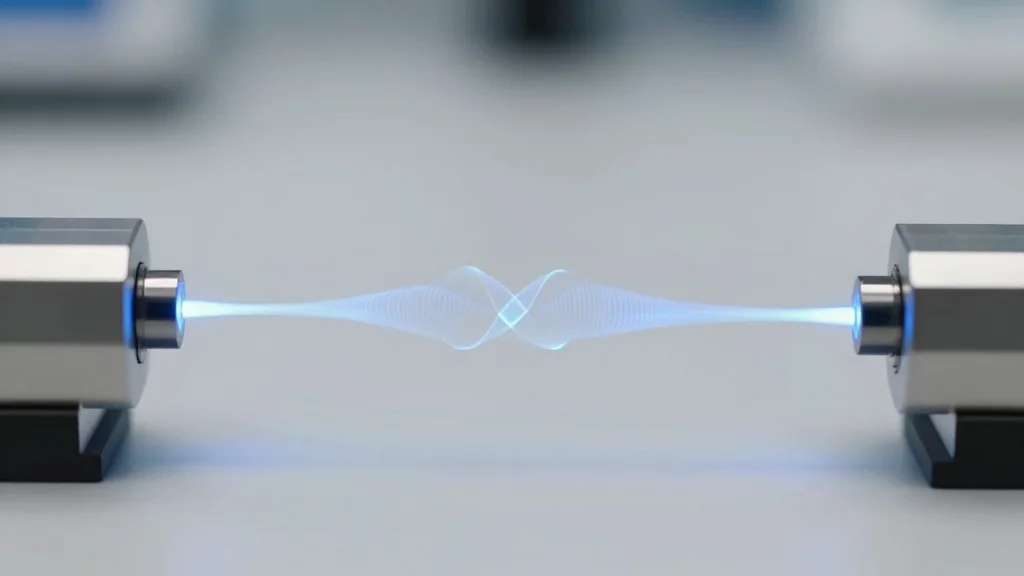
The core innovation lies in two complementary strategies. First, the team applies a mirroring transformation to simple candidate observables, generating a set of “mirrored witnesses” that can flag entanglement even when data are sparse. Second, a numerical optimization routine searches the space of possible witnesses to identify those best suited for the specific measurement constraints at hand. In a proof‑of‑concept experiment, polarization‑entangled photon pairs were measured in just a few bases, yet the constructed witnesses unequivocally certified entanglement. This dual‑track methodology not only validates the theoretical promise of mirrored witnesses but also demonstrates a scalable workflow for real‑world labs.
For industry, the impact is immediate. Quantum key distribution networks, for instance, can now embed lightweight verification modules that run on existing hardware, reducing latency and power consumption. Likewise, quantum processors can perform rapid sanity checks on entangled qubit registers without halting computation for full tomography. As quantum ecosystems mature, standards bodies will likely adopt such efficient verification protocols, fostering interoperability and trust. Future research will explore extending the technique to multipartite systems and integrating it with error‑correction routines, paving the way for robust, large‑scale quantum infrastructures.
Verifying Entanglement with Limited Data
Comments
Want to join the conversation?
Loading comments...