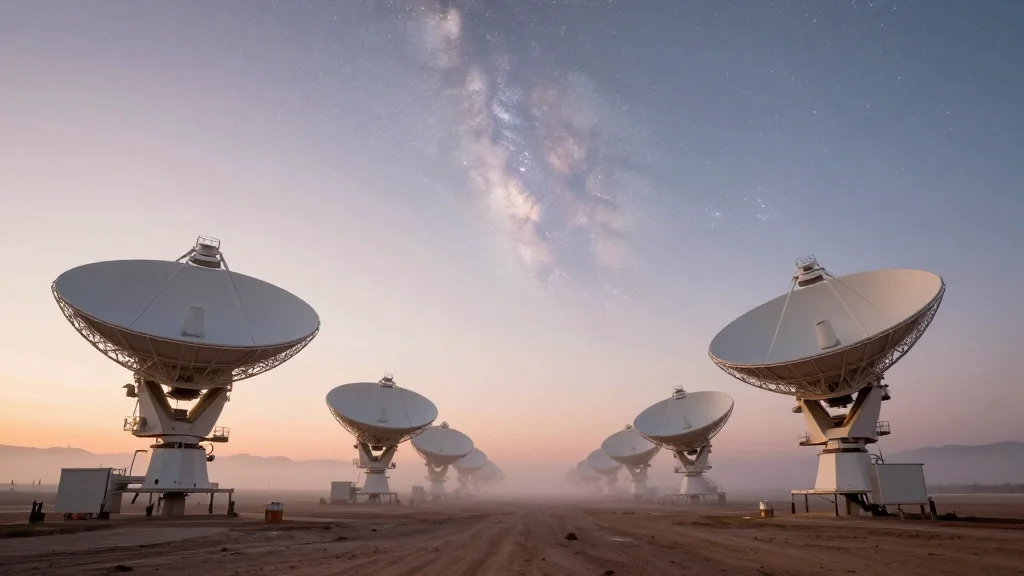
Very Long Baseline Array Maps Turbulent “Weather” In the Milky Way
Why It Matters
Understanding Milky Way turbulence refines predictions of star‑formation rates and improves galactic‑evolution simulations, directly impacting astrophysics research and related high‑performance computing sectors.
Key Takeaways
- •VLBA achieved sub‑milliarcsecond resolution of hydrogen gas turbulence
- •Turbulent eddies span 1–200 light‑year scales in the galactic plane
- •Observed turbulence regulates gas density and star‑formation efficiency
- •Data offers a calibration point for galaxy‑evolution simulations
Pulse Analysis
The Very Long Baseline Array (VLBA), a continent‑spanning network of ten radio dishes, delivers unparalleled angular resolution, allowing astronomers to dissect the Milky Way’s interstellar medium at unprecedented detail. By targeting the ubiquitous 21‑centimeter hydrogen line, researchers captured minute Doppler shifts that translate into a three‑dimensional map of gas motions, effectively visualizing the galaxy’s turbulent "weather" patterns. This capability bridges a long‑standing gap between large‑scale surveys and the fine‑grained dynamics that drive star formation.
The resulting map uncovers a hierarchy of turbulent structures, from compact vortices a few light‑years across to sprawling shock fronts extending hundreds of light‑years. These motions stir the interstellar gas, compressing some regions while dispersing others, thereby directly influencing where and how efficiently new stars can form. The findings also challenge existing theoretical models, which often assume simpler, isotropic turbulence. By providing concrete measurements of velocity dispersion and energy cascades, the VLBA data equips astrophysicists with a reality‑check for simulations of galactic evolution.
Beyond pure science, the breakthrough showcases the power of high‑precision interferometry for big‑data processing and real‑time calibration—technologies that ripple into telecommunications, satellite navigation, and AI‑driven signal analysis. As the VLBA continues to refine its techniques, similar turbulence mapping could be extended to nearby galaxies, offering comparative insights into universal star‑formation mechanisms and informing the next generation of space‑based observatories.
Very Long Baseline Array Maps Turbulent “Weather” in the Milky Way
Comments
Want to join the conversation?
Loading comments...