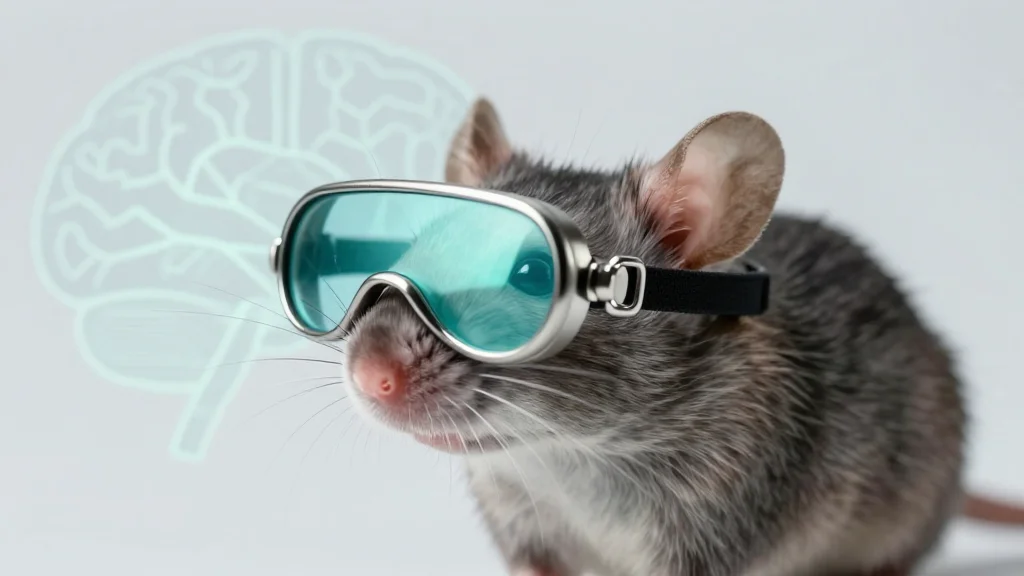
Visual Experience Physically Shapes the Brain’s Feedback Loops
Why It Matters
The findings show that early visual experience can rewire predictive feedback loops, reshaping how the brain anticipates sensory input—a insight critical for neurodevelopmental research and for designing biologically inspired AI vision systems.
Key Takeaways
- •Mice exposed to a single orientation develop excess neurons tuned to that angle
- •Primary visual cortex orientation preferences shift to match forced visual input
- •Feedback pathways remodel receptive fields, aligning with imposed orientation
- •Modeling suggests Hebbian strengthening upward, anti‑Hebbian weakening downward
- •Experience‑driven plasticity reshapes top‑down visual circuits
Pulse Analysis
Predictive coding models posit that the brain constantly generates expectations about incoming sensory data, relying on feedback pathways that convey contextual priors from higher‑order areas to primary sensory cortices. While the existence of these top‑down loops is well documented, the degree to which real‑world visual experience can physically reconfigure them has remained speculative. The new mouse study bridges that gap by showing that early‑life exposure to a narrowly constrained visual world directly rewires both feedforward and feedback connections, offering a tangible biological substrate for expectation formation.
In the experiment, juvenile mice wore steel goggles that filtered visual scenes to a single geometric angle for more than four weeks. Two‑photon imaging of the lateromedial‑to‑primary visual cortex synapses revealed a dramatic shift: neurons in V1 became hyper‑responsive to the enforced orientation, and the descending feedback axons altered their receptive‑field geometry to mirror that bias. Computational simulations attributed the upward changes to classic Hebbian "cells that fire together wire together" strengthening, while the descending adjustments followed an anti‑Hebbian rule that weakens coincident activity, thereby decorrelating redundant signals. This dual‑plasticity mechanism explains how the brain balances reinforcement of frequent patterns with the need to remain sensitive to novel inputs.
The implications extend beyond basic neuroscience. Understanding how sensory experience sculpts predictive feedback can inform therapeutic strategies for amblyopia and other developmental visual disorders, where abnormal feedback may lock in maladaptive priors. Moreover, the Hebbian/anti‑Hebbian framework offers a blueprint for next‑generation artificial vision systems that adaptively tune both bottom‑up feature detectors and top‑down expectation modules, mirroring the brain's efficient learning dynamics. Future work will need to map horizontal cortical connections and test naturalistic environments to fully capture the complexity of experience‑driven wiring in the living brain.
Visual experience physically shapes the brain’s feedback loops
Comments
Want to join the conversation?
Loading comments...