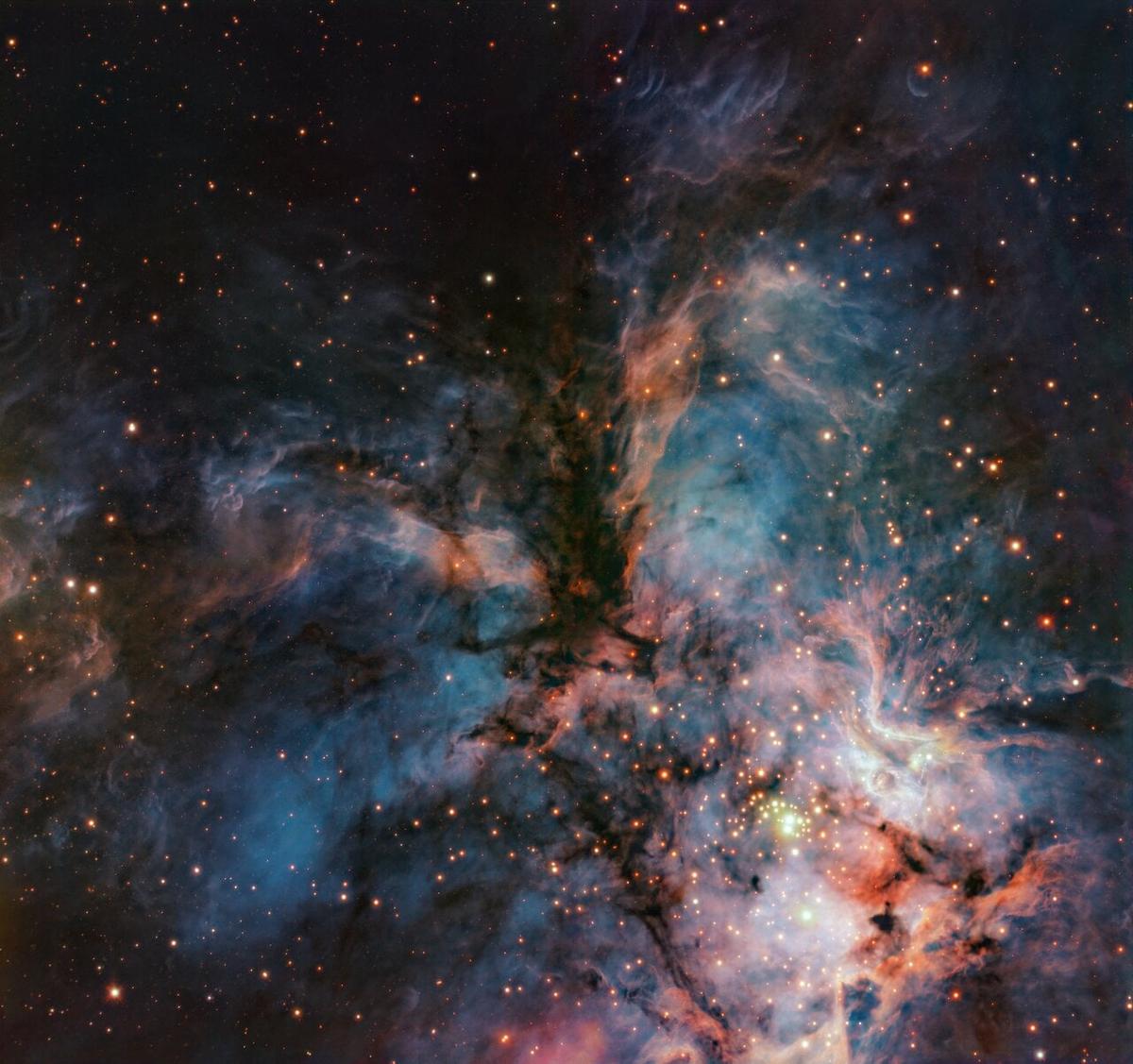
VLT Image Captures a "Cosmic Hawk" Spanning Its Wings.
•March 6, 2026
0
Why It Matters
The detection of numerous brown dwarfs in RCW 36 refines models of substellar formation and informs the initial mass function in dense clusters. The striking imagery also enhances public engagement with astrophysics.
Key Takeaways
- •VLT's HAWK‑1 captured RCW 36 nebula in near‑infrared
- •Image reveals young massive stars and numerous brown dwarfs
- •Adaptive optics corrected atmosphere, enabling high‑resolution detection
- •Study advances understanding of substellar formation mechanisms
- •Public image likened to hawk, engaging outreach audiences
Pulse Analysis
The Very Large Telescope’s HAWK‑1 instrument pushes infrared astronomy forward by combining a wide‑field imager with state‑of‑the‑art adaptive optics. This synergy allows astronomers to pierce the dense dust clouds that hide stellar nurseries, delivering images with unprecedented clarity and depth. In the case of RCW 36, the near‑infrared data expose structures invisible to optical telescopes, turning a chaotic nebular region into a coherent portrait of star formation activity.
Beyond the visual appeal, the VLT observations have yielded a rich substellar census. By isolating faint brown dwarfs amid the glare of massive young stars, the team refined estimates of the cluster’s initial mass function and offered new constraints on how objects below the hydrogen‑fusion limit arise in crowded environments. These findings challenge traditional models that treat brown dwarf formation as a by‑product of stellar processes, suggesting that dense, turbulent gas may foster independent substellar collapse. Such insights are critical for building comprehensive theories of stellar and planetary system evolution.
ESO’s photo‑of‑the‑week strategy turns complex scientific results into accessible storytelling. The “cosmic hawk” analogy captures public imagination, linking the dramatic image to the underlying physics of massive stars dispersing their natal clouds. This outreach not only raises awareness of cutting‑edge research but also inspires the next generation of astronomers. As adaptive optics and infrared detectors continue to improve, future VLT campaigns will likely reveal even finer details of star‑forming regions, deepening our grasp of the universe’s formative processes.
VLT Image Captures a "Cosmic Hawk" Spanning its Wings.
0
Comments
Want to join the conversation?
Loading comments...