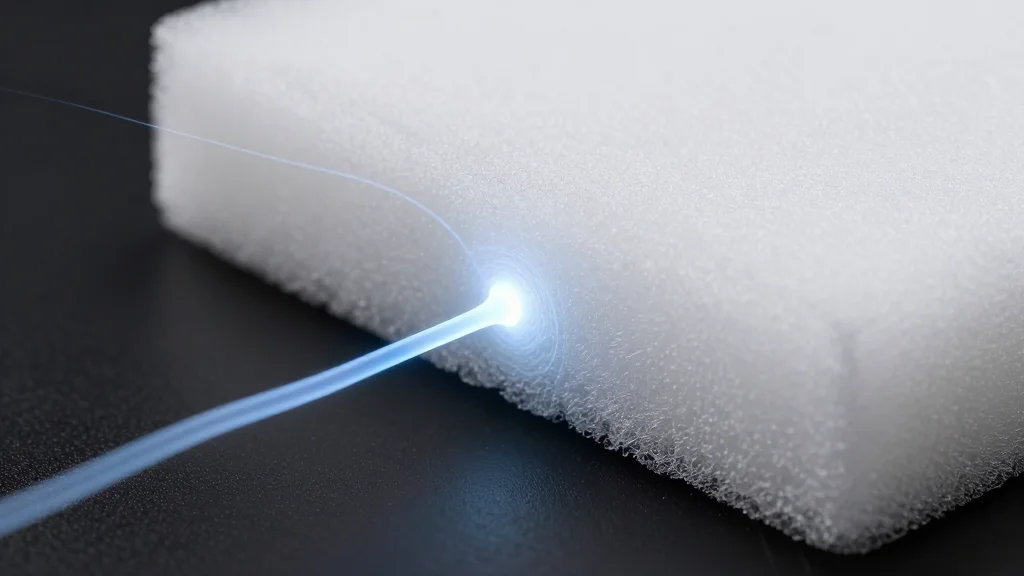
Void-Filled Material Stops Intense Electron Beam
Why It Matters
Programmable energy deposition in porous foams could boost fast‑ignition fusion efficiency and enable new tabletop radiation sources, reshaping high‑energy‑density research.
Key Takeaways
- •Low‑density foam (5 mg cm⁻³) stops REBs far better than denser foam
- •Magnetic fields in foam pores deflect and trap electrons, causing anomalous stopping
- •Energy loss concentrates within ~50 µm of foam, far shallower than expected
- •Designed microstructures could program beam transport for fusion and compact radiation sources
Pulse Analysis
The ability to steer ultra‑intense relativistic electron beams (REBs) has long been a bottleneck in high‑energy‑density physics. REBs, delivering petawatt‑scale power in picosecond bursts, are essential for probing matter under conditions found in stellar interiors and for driving fast‑ignition inertial‑confinement fusion. Traditional approaches rely on thick, dense shields to attenuate the beam, but these methods add mass and limit precision. The recent discovery that a highly porous foam can halt a mega‑ampere electron current reshapes how researchers think about beam mitigation and target design.
In experiments at the XingGuang‑III laser facility, a foam with a bulk density of only 5 mg cm⁻³ reduced the forward‑going electron flux by orders of magnitude, outperforming a 200 mg cm⁻³ counterpart. Particle‑in‑cell simulations revealed that currents flowing through the solid filaments generate intense magnetic vortices inside the pores. These fields scatter electrons laterally and trap them, producing an “anomalous‑stopping” effect that conventional stopping‑power models, which depend chiefly on mass density, cannot predict. The result is a rapid energy dump within roughly 50 µm of material.
The practical upside is profound. By tailoring pore size, connectivity, and material composition, engineers could program where and how REBs deposit their energy, improving coupling efficiency in fast‑ignition fusion and reducing unwanted pre‑heat. Moreover, the same magnetic‑induced deflection can be harnessed to generate ultrabright X‑ray or gamma‑ray bursts on a tabletop, expanding diagnostic capabilities for laboratory astrophysics. Ongoing work will explore liquid‑filled foams and additive‑manufactured lattices, positioning porous microstructures as a versatile tool for next‑generation high‑power laser experiments.
Void-Filled Material Stops Intense Electron Beam
Comments
Want to join the conversation?
Loading comments...