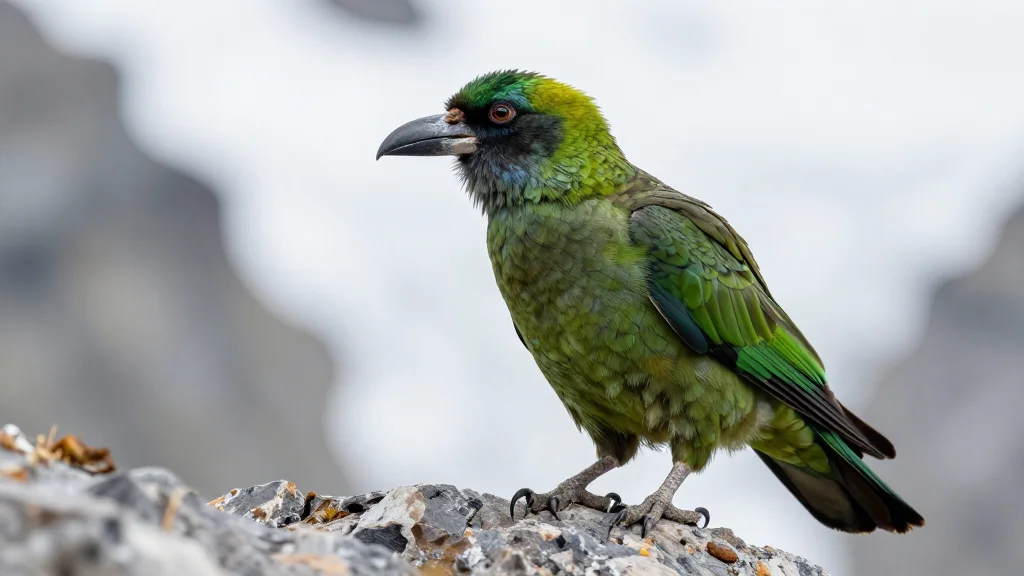
Watch: Disabled Parrot Takes up Jousting to Stay King of the Keas
Why It Matters
The discovery reshapes how scientists view disability and hierarchy in intelligent animals, showing that adaptive behavior can secure dominance. It also provides a fresh model for studying resilience and innovation in wildlife.
Key Takeaways
- •Bruce's lower-beak jousting won 36 dominance contests in 30 days
- •Disabled kea maintained alpha status despite missing upper beak
- •Study recorded 227 social conflicts, showing novel fighting style effectiveness
- •Findings challenge assumption that physical superiority dictates bird hierarchy
Pulse Analysis
Kea (Nestor notabilis) have long been celebrated for their problem‑solving abilities, but the University of Canterbury’s recent field study adds a new layer to that reputation. By focusing on Bruce, a kea missing its upper beak, researchers captured 227 social interactions over 30 days, noting that Bruce’s forward‑thrusting lower‑beak attacks consistently repelled rivals. The bird’s dominance was further corroborated by the lowest fecal glucocorticoid metabolite levels among males, indicating reduced stress despite its physical handicap. This case illustrates that cognitive flexibility can compensate for anatomical loss, expanding the known boundaries of avian intelligence.
The implications extend beyond ornithology into broader theories of animal behavior and evolutionary biology. Traditional models often assume that size or weaponry dictates hierarchical outcomes; Bruce’s success forces a reevaluation of those assumptions, emphasizing the role of learned innovation. Such findings resonate with researchers developing bio‑inspired robotics, where adaptive algorithms can overcome hardware limitations. Moreover, the study underscores the importance of observing naturalistic problem‑solving, offering a template for future investigations into how other species might develop compensatory tactics when faced with injuries or environmental pressures.
From a conservation perspective, recognizing the capacity for behavioral adaptation in kea could inform management strategies in New Zealand’s alpine ecosystems. If individuals can mitigate physical impairments through novel tactics, populations may be more resilient to threats such as habitat loss or human‑induced injuries. The research also raises ethical considerations about how we assess animal welfare; a disabled animal’s ability to thrive challenges simplistic notions of fitness. Continued monitoring of Bruce and similar cases will deepen our understanding of resilience, informing both scientific theory and practical conservation efforts.
Watch: Disabled parrot takes up jousting to stay king of the keas
Comments
Want to join the conversation?
Loading comments...