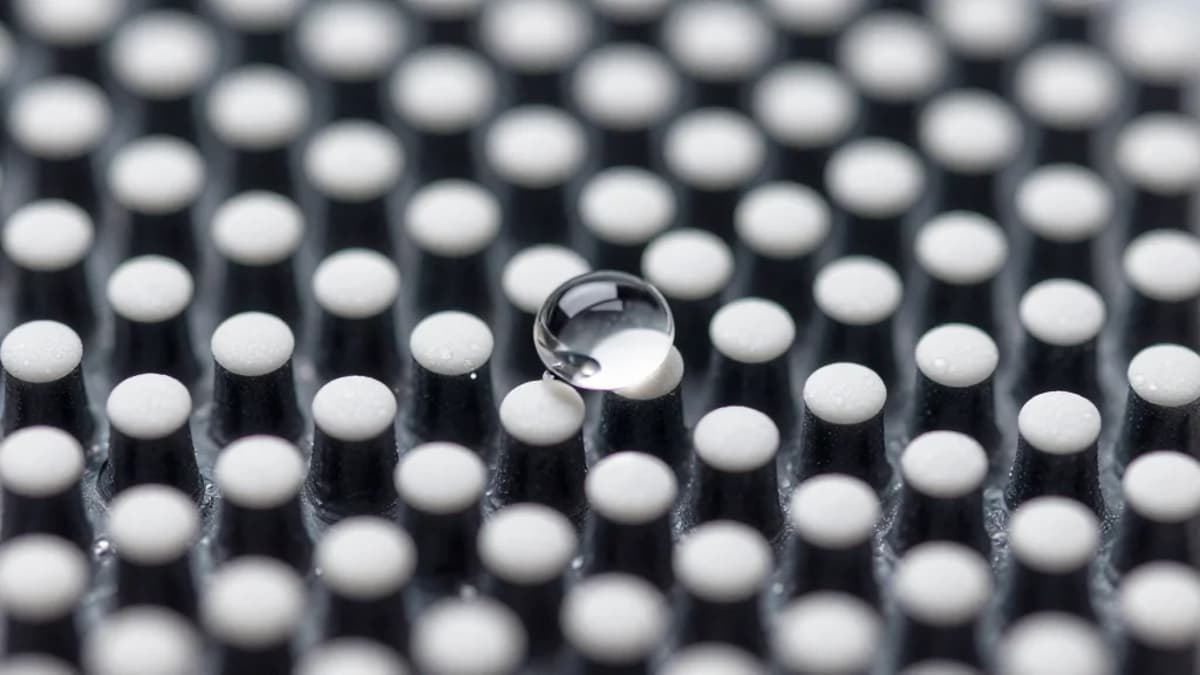
Water Drops Sliding Over Arrays of Janus Micropillars With Hydrophilic Tops: A New Mechanism of Drop Charging
•March 11, 2026
0
Why It Matters
The discovery provides a controllable route to triboelectric charging, opening new possibilities for micro‑energy harvesting and anti‑static surface design.
Key Takeaways
- •Janus pillars combine hydrophilic tops with hydrophobic walls
- •Sliding drops generate charge via satellite droplet formation
- •Charge polarity linked to APTES and PFOTS surface chemistry
- •Satellite droplets evaporate within one second
- •Mechanism operates in Cassie state, unlike flat surfaces
Pulse Analysis
Slide electrification on flat hydrophobic surfaces has long been understood as a contact‑line phenomenon that leaves the rear of a moving drop negatively charged. However, that model struggles to explain charge generation on textured or partially wetting substrates. By fabricating Janus micropillars with a stark hydrophilic‑hydrophobic contrast, the research team created a platform where droplets retain a high apparent contact angle yet still engage the hydrophilic tops. This hybrid wetting state preserves the Cassie‑Baxter condition while introducing localized liquid bridges that act as charge reservoirs.
High‑speed reflection microscopy revealed that each pillar captures a tiny satellite droplet as the main drop slides. These satellites, rich in surface‑bound ions from APTES‑derived NH₂ groups and PFOTS‑derived fluorinated chains, evaporate in under a second. The rapid disappearance forces charge redistribution between the primary drop and the evaporating droplets, effectively separating ions within the liquid phase rather than at the solid‑liquid interface. The resulting net charge polarity flips according to the balance of NH₃/NH₄⁺ formation and PFOTS degradation, offering a tunable electrostatic output directly linked to surface chemistry.
The ability to engineer charge polarity and magnitude through micro‑scale surface patterning has immediate implications for triboelectric nanogenerators, where consistent and predictable charge generation is critical. In microfluidic devices, controlled electrification could enable droplet manipulation without external electrodes, enhancing lab‑on‑a‑chip technologies. Moreover, the approach suggests new anti‑static coatings that mitigate charge buildup by directing it into evaporating micro‑droplets, reducing surface discharge risks. Future work will likely explore scaling the pillar arrays and integrating them into flexible substrates, paving the way for commercial energy‑harvesting surfaces and smarter fluidic interfaces.
Water Drops Sliding Over Arrays of Janus Micropillars With Hydrophilic Tops: A New Mechanism of Drop Charging
0
Comments
Want to join the conversation?
Loading comments...