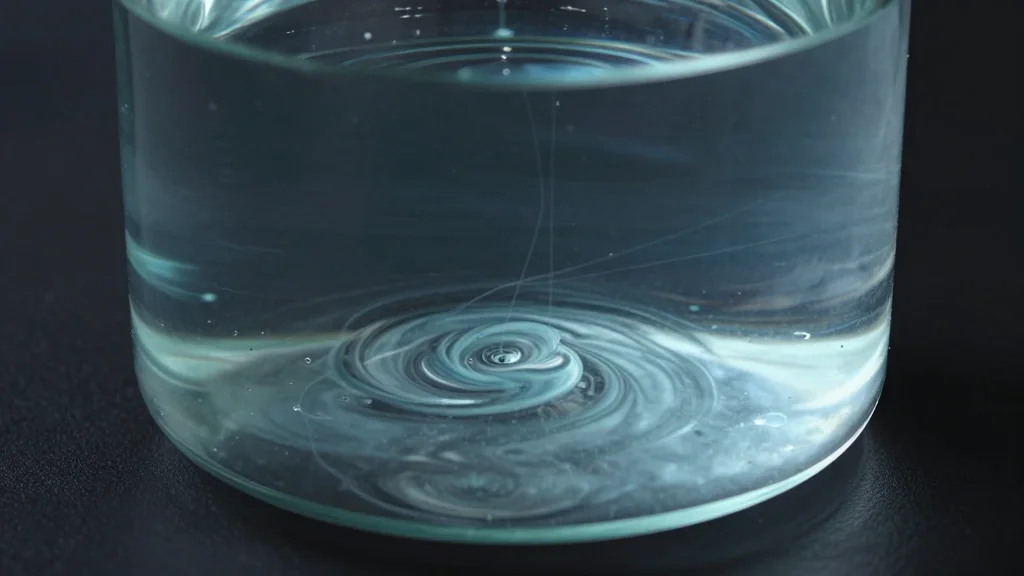
Water Simulation of Famous Quantum Effect Reveals Unexpected Wave Patterns
Why It Matters
The discovery shows that simple fluid analogs can expose topological quantum phenomena inaccessible to direct measurement, opening low‑cost pathways for studying complex quantum systems and potential superconducting analogs.
Key Takeaways
- •Water tank mimics Aharonov–Bohm effect via vortex‑induced wave patterns
- •Opposing waves generate rotating nodal lines opposite vortex rotation
- •Higher vortex speed produces more nodal lines
- •Analog system could model superconducting lattice behavior
- •Study appears in Communications Physics, 2026
Pulse Analysis
The recent OIST experiment revives a decades‑old idea that classical fluids can stand in for quantum particles. By generating a controlled vortex in a transparent tank and sending surface waves from opposite sides, researchers observed rotating nodal lines—thin, stationary water strips that spin counter‑clockwise to the vortex. This visual manifestation of a topological phase shift mirrors the Aharonov–Bohm effect, where electrons acquire a phase change despite never encountering a magnetic field directly. The fluid platform offers a tangible, high‑speed‑camera‑recorded view of phenomena that in quantum labs require indirect inference and sophisticated instrumentation.
Beyond the striking visuals, the experiment provides quantitative insight: the count of nodal lines scales with vortex circulation speed, confirming a direct link between fluid dynamics and wave‑phase topology. Such a relationship suggests that fluid analogs can serve as testbeds for theoretical predictions about phase‑dependent transport in condensed‑matter systems, including exotic superconductors where electron pairs move without resistance. By adjusting vortex arrays, researchers could simulate lattice‑like magnetic textures, potentially revealing emergent behaviors analogous to supercurrents or topological insulators, all without the cryogenic costs of real quantum materials.
The broader implication is a renewed appreciation for analog experimentation in physics. While quantum simulations on computers grow in power, physical analogs retain the advantage of intuitive, real‑time observation. The OIST team’s findings encourage interdisciplinary collaborations, inviting fluid dynamicists, materials scientists, and quantum theorists to co‑design experiments that bridge macroscopic and microscopic worlds. As the field seeks scalable ways to explore topological effects, such low‑cost, visually accessible platforms may become essential tools for both education and frontier research.
Water simulation of famous quantum effect reveals unexpected wave patterns
Comments
Want to join the conversation?
Loading comments...