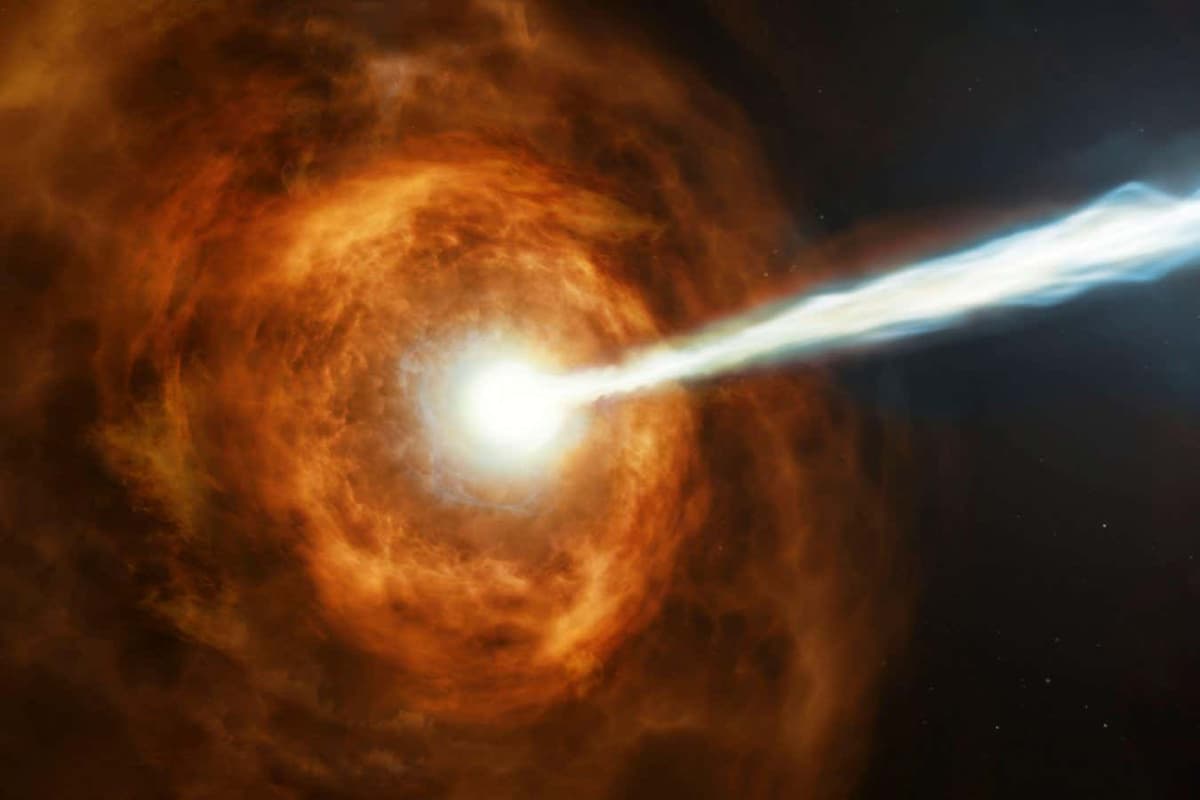
We May Have Seen a 'Dirty Fireball' Star Explosion for the First Time
Why It Matters
The detection validates a long‑theorized explosion class, refining models of stellar death and black‑hole formation, and could reshape predictions of high‑energy astrophysical events.
Key Takeaways
- •First confirmed observation of a dirty fireball explosion
- •Gamma‑ray burst showed unusually dense surrounding material
- •Jet likely originated from nascent black hole
- •Findings challenge existing massive‑star collapse models
Pulse Analysis
The death throes of massive stars have long fascinated astronomers, with supernovae and gamma‑ray bursts (GRBs) serving as the most dramatic endpoints. Traditional GRBs arise when a collapsing star forms a black hole that powers a narrow, ultra‑relativistic jet, punching through the stellar envelope and emitting intense high‑energy radiation. A "dirty fireball" differs by retaining a substantial amount of baryonic material, which slows the jet and alters its emission profile. Understanding this variant helps fill gaps in the taxonomy of stellar explosions and clarifies how jet composition influences observable signatures.
The recent event, captured on April 3, 2026, was flagged by NASA's Fermi Gamma‑ray Space Telescope, which recorded a burst with a softer spectrum and prolonged afterglow compared to typical GRBs. Follow‑up observations from ground‑based optical facilities revealed a dense circumstellar medium, confirming the presence of excess matter that “dirty” the fireball. This combination of high‑energy detection and multi‑wavelength follow‑up provides the first empirical evidence that such explosions occur, supporting theoretical predictions that have existed for decades.
Implications extend beyond academic curiosity. By incorporating dirty fireballs into stellar evolution models, researchers can better estimate the rates of black‑hole formation and the contribution of these events to cosmic ray production. Future missions, such as the upcoming SVOM satellite, will prioritize rapid localization of similar bursts, enabling deeper statistical studies. Ultimately, recognizing this explosion class sharpens our predictive tools for high‑energy transients, informing both fundamental physics and the design of next‑generation observatories.
We may have seen a 'dirty fireball' star explosion for the first time
Comments
Want to join the conversation?
Loading comments...