'We Still Can't See Dark Matter. But What If We Can Hear It?'

Why It Matters
If gravitational‑wave observations can reveal dark‑matter density, they create a new indirect detection channel that could accelerate understanding of the universe’s missing mass.
Key Takeaways
- •GW190728 shows potential dark‑matter imprint in gravitational‑wave signal
- •Study examined 28 clean black‑hole merger events from LIGO, Virgo, KAGRA
- •Dense “buttery” dark matter could amplify merger signatures for detection
- •Researchers stress result is hint, not confirmed dark‑matter discovery
- •Method offers new avenue for indirect dark‑matter searches via wave analysis
Pulse Analysis
The hunt for dark matter has long relied on indirect clues such as galaxy rotation curves, lensing effects, and particle‑detector experiments. Traditional approaches aim to "see" dark matter through its gravitational pull or rare interactions with ordinary matter, yet none have yielded a conclusive signal. Gravitational‑wave astronomy, a field that exploded after LIGO’s first detection in 2015, offers a fresh perspective: instead of visualizing dark matter, scientists can listen for its subtle influence on spacetime ripples generated by cataclysmic events.
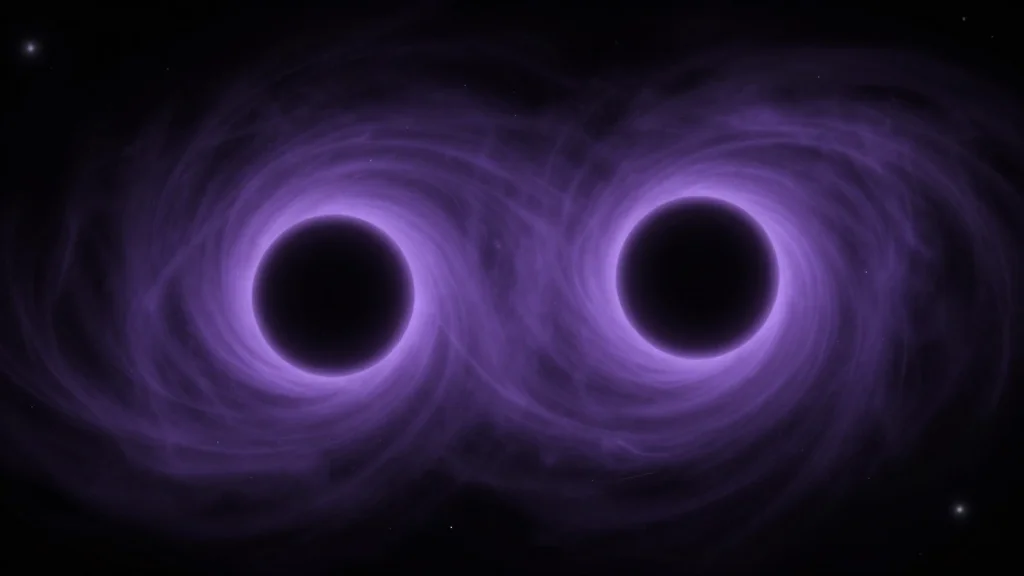
In a recent study, a team led by MIT physicist Josu Aurrekoetxea sifted through 28 of the clearest black‑hole merger signals captured by LIGO, Virgo and Japan’s KAGRA detector. All but one event matched expectations for mergers occurring in the near‑vacuum of interstellar space. The outlier, GW190728, exhibited a faint distortion consistent with a merger taking place inside a dense pocket of dark matter—described by the authors as a "buttery" environment. By modeling how dark matter could alter the waveform’s phase and amplitude, the researchers identified a pattern that, while not a definitive detection, provides a concrete signature to target in future observations.
The implications extend beyond a single anomalous event. If subsequent detections confirm similar imprints, gravitational‑wave observatories could become powerful dark‑matter probes, complementing collider and astrophysical searches. Enhanced detector sensitivity, planned upgrades to LIGO and the upcoming Einstein Telescope, will increase the catalog of merger events, sharpening statistical confidence. This interdisciplinary bridge between cosmology and gravitational‑wave physics could ultimately narrow the parameter space for dark‑matter candidates, guiding both theoretical models and experimental designs toward a long‑sought breakthrough.
'We Still Can't See Dark Matter. But What If We Can Hear It?'
Comments
Want to join the conversation?
Loading comments...