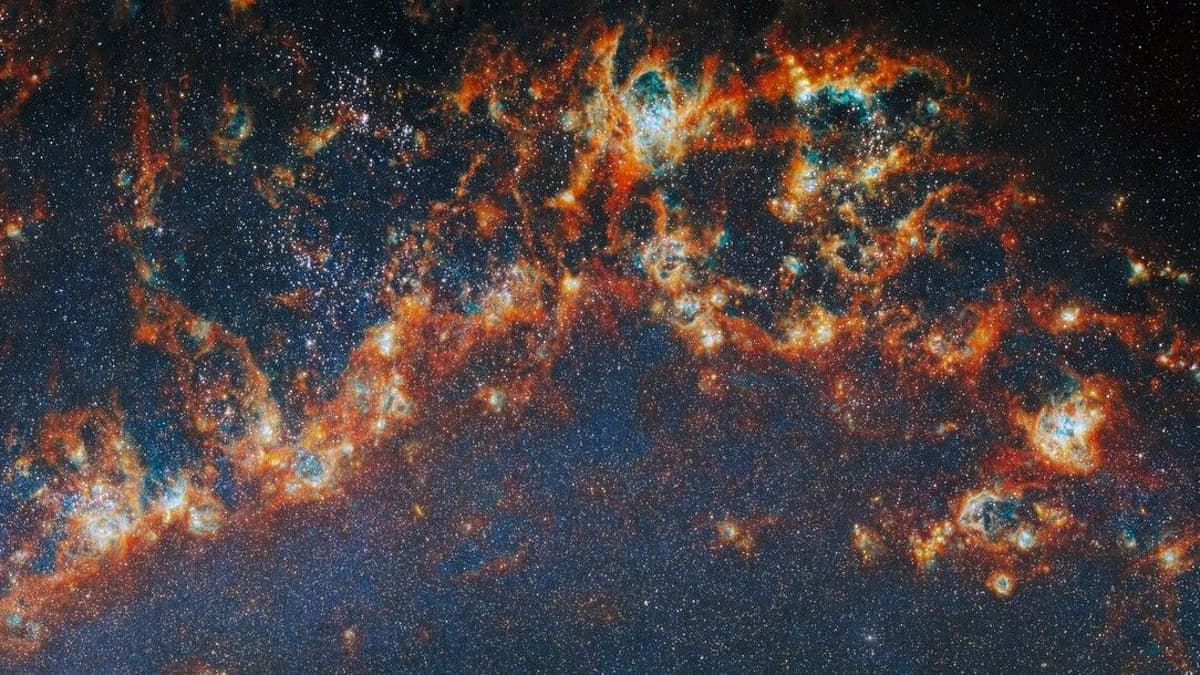
Webb and Hubble Sink Deep Into the Dazzling Whirlpool Galaxy — Space Photo of the Week
Why It Matters
Understanding how quickly star clusters disperse their birth clouds refines models of galaxy evolution and sheds light on the sources that powered cosmic reionization after the Big Bang.
Key Takeaways
- •JWST and Hubble combined to image Whirlpool Galaxy spiral arm
- •Massive star clusters disperse natal gas in ~5 million years
- •Smaller clusters take 7‑8 million years to clear surrounding gas
- •Rapid gas clearing boosts ultraviolet output, influencing cosmic reionization
- •Findings published in Nature Astronomy on May 6, 2026
Pulse Analysis
The new composite image of Messier 51 leverages JWST’s infrared sensitivity and Hubble’s optical clarity, exposing star‑forming regions that were previously hidden behind dust. By resolving individual clusters within a single spiral arm, researchers could directly measure how long nascent stars remain enshrouded in their birth clouds. This level of detail marks a step forward from earlier surveys that relied on indirect tracers, offering a concrete timeline for the dispersal of gas by stellar winds, ultraviolet radiation, and supernova explosions.
The study quantifies stellar feedback: the most massive clusters clear their surroundings in about five million years, whereas less massive groups take up to eight million years. This accelerated clearing curtails the reservoir of cold gas available for subsequent star formation, effectively throttling a galaxy’s growth rate. Such feedback loops are central to modern galaxy‑formation simulations, and the empirical data now available from JWST‑Hubble synergy provide a benchmark for calibrating those models.
Beyond individual galaxies, the rapid emergence of massive clusters has cosmological implications. The early universe entered a re‑ionization epoch roughly 500 million to one billion years after the Big Bang, when high‑energy photons stripped electrons from neutral atoms. The study’s timing suggests that massive star clusters could have supplied enough ultraviolet radiation, within a few million years, to drive this transformation. As astronomers continue to map star‑forming regions across diverse environments, the Whirlpool Galaxy results will inform both the microphysics of stellar birth and the macro‑evolution of the cosmos.
Webb and Hubble sink deep into the dazzling Whirlpool Galaxy — Space photo of the week
Comments
Want to join the conversation?
Loading comments...