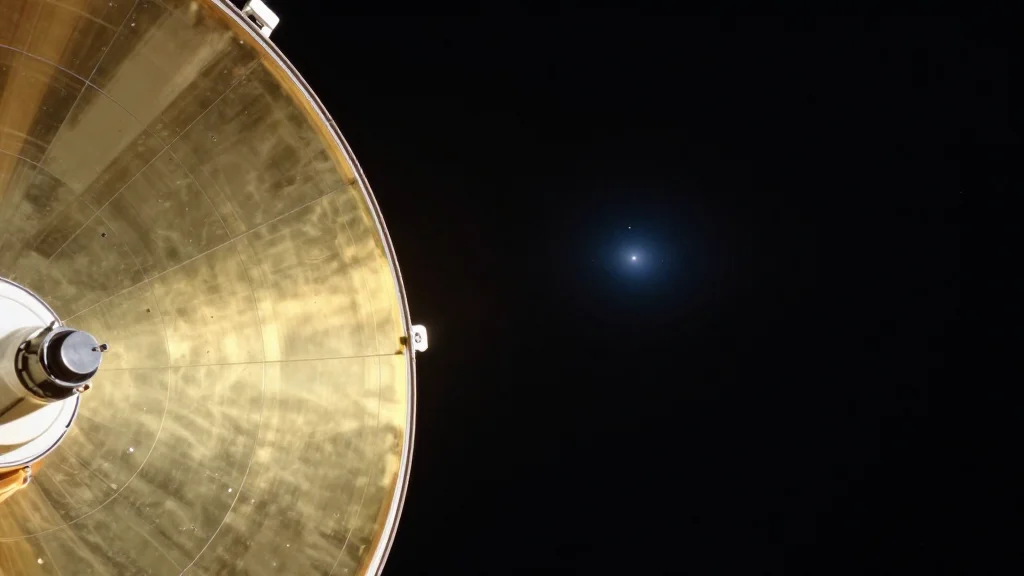
Webb Discovers One of the Universe's First Galaxies

Why It Matters
LAP1‑B provides direct evidence of primordial star formation and dark‑matter‑driven galaxy growth, informing models of the universe’s first structures. Its chemical fingerprint helps validate theories about Population III stars and early chemical enrichment.
Key Takeaways
- •LAP1‑B observed 800 Myr after Big Bang via JWST.
- •Gravitational lensing amplified galaxy’s light by ~100×.
- •Oxygen abundance 240× lower than Sun, indicating primordial composition.
- •Elevated carbon‑to‑oxygen ratio matches Population III supernova signatures.
- •Dark matter dominates galaxy’s mass, confirming early halo formation.
Pulse Analysis
The James Webb Space Telescope continues to push the frontier of observational cosmology, now reaching back to an epoch when the universe was less than a billion years old. By exploiting the natural magnification of a massive galaxy cluster, JWST captured enough photons from LAP1‑B to resolve its spectral lines, a feat impossible with previous instruments. This breakthrough underscores JWST’s role as a time‑machine, turning faint, distant smudges into detailed laboratories for early‑universe physics.
LAP1‑B’s chemical makeup is strikingly primitive. Its oxygen levels are roughly 1/240th of solar, and the carbon‑to‑oxygen ratio aligns with predictions for the remnants of Population III supernovae, the first massive stars that forged the earliest heavy elements. Such a signature offers a rare observational anchor for simulations of the first stellar generations, helping astronomers refine models of nucleosynthesis, ionizing radiation output, and the timeline of reionization. The galaxy’s intense ionizing flux further confirms that early star clusters could have driven the universe’s transition from opaque to transparent.
Equally important is the confirmation that dark matter already dominated the mass budget of a galaxy at this early stage. The measured gas dynamics indicate a massive, invisible halo holding the system together, validating hierarchical formation scenarios where dark matter scaffolds precede visible structures. Gravitational lensing not only made the discovery possible but also highlights a powerful technique for probing the faintest corners of the cosmos. As JWST surveys more lensing fields, astronomers anticipate a growing catalog of such primordial objects, sharpening our understanding of how the first galaxies assembled and set the stage for the rich cosmic web we observe today.
Webb Discovers One of the Universe's First Galaxies
Comments
Want to join the conversation?
Loading comments...