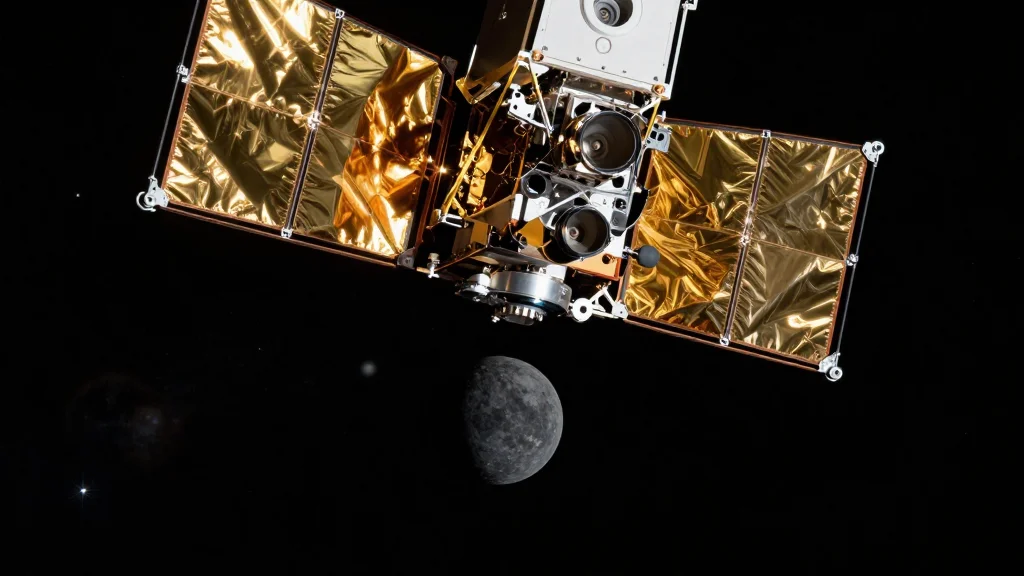
Webb Telescope Captures First Direct Look at Distant Exoplanet’s Surface
Why It Matters
Direct surface imaging validates JWST’s capability to study exoplanet geology, accelerating the search for habitable worlds and informing future telescope designs.
Key Takeaways
- •JWST directly imaged surface of super‑Earth LHS 475b, 40 ly away
- •Planet appears dark, airless, with Mercury‑like rocky terrain
- •Surface temperature estimated around 600 K, too hot for life
- •Observation confirms JWST can characterize exoplanet geology, not just atmospheres
- •Findings guide future missions targeting habitable worlds
Pulse Analysis
The James Webb Space Telescope’s first direct view of an exoplanet surface marks a pivotal moment for astrophysics. While previous missions inferred planetary characteristics from transit spectroscopy, JWST’s high‑resolution imaging captured reflected light from LHS 475b, a super‑Earth orbiting a nearby red dwarf. This achievement showcases the telescope’s advanced coronagraphic techniques and infrared sensitivity, proving that distant rocky worlds can be studied in unprecedented detail.
Scientifically, the dark, airless landscape of LHS 475b offers a rare glimpse into planetary formation processes. Its Mercury‑like appearance suggests a history of intense stellar radiation stripping away any atmosphere, leaving a barren, high‑temperature crust. By comparing its surface albedo and thermal emission to solar‑system analogs, researchers can refine models of atmospheric loss, mantle composition, and tectonic activity on worlds that lie beyond the traditional habitable zone. These insights are crucial for distinguishing truly Earth‑like planets from rocky impostors.
From an industry perspective, the success fuels demand for next‑generation space observatories capable of direct imaging at even finer scales. Private aerospace firms and government agencies are likely to prioritize missions that build on JWST’s coronagraphic architecture, such as the proposed Habitable Worlds Observatory. The data also provide valuable validation for high‑contrast imaging technologies, potentially accelerating commercial ventures in exoplanet exploration and related sensor development. As the scientific community digests these findings, the market for advanced optics and data‑processing pipelines is set to expand.
Webb Telescope Captures First Direct Look at Distant Exoplanet’s Surface
Comments
Want to join the conversation?
Loading comments...