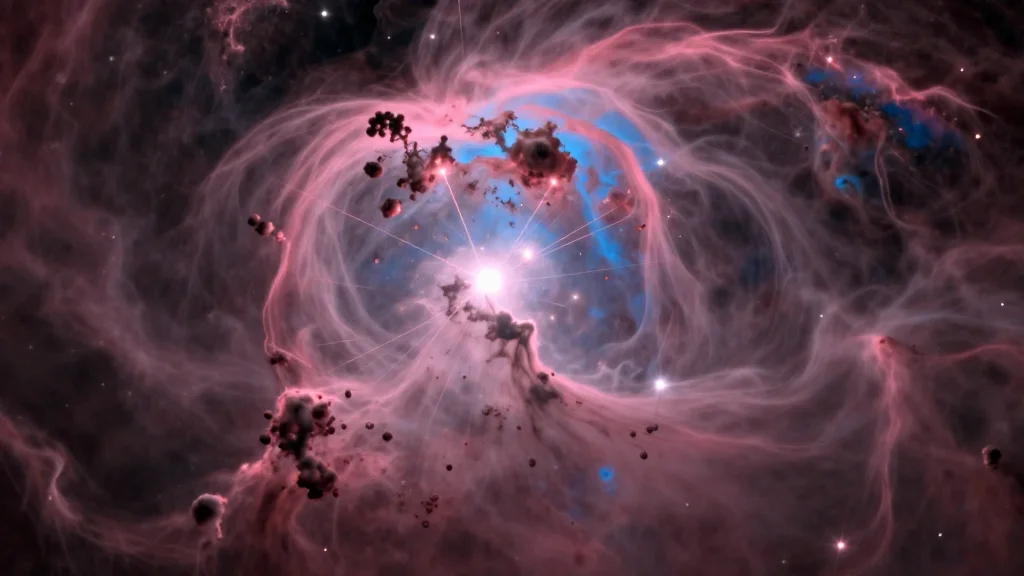
Webb Unveils Young Stars Across Every Stage of Formation
Why It Matters
By exposing the full life cycle of stars in a single, nearby region, Webb provides critical empirical data that refines models of stellar birth and planet‑forming disk evolution, influencing both astrophysics research and future mission planning.
Key Takeaways
- •Webb's NIRCam captures OMC‑2 protostars in infrared.
- •OMC‑2 spans 150 light‑years, showing full star‑formation sequence.
- •Jets from protostars create shock‑heated ridges visible in red.
- •Program #5804 data will probe outflow effects on circumstellar disks.
- •Orion’s closeness makes OMC‑2 an ideal early‑stellar laboratory.
Pulse Analysis
The James Webb Space Telescope’s Near‑Infrared Camera (NIRCam) has turned Orion’s hidden filament, OMC‑2, into a laboratory for stellar birth. By observing at wavelengths that pierce the dense dust, Webb reveals dozens of protostars that are invisible to optical telescopes. The image spans roughly 150 light‑years, encompassing everything from embryonic cores to fully fledged pre‑main‑sequence stars, and demonstrates JWST’s unprecedented spatial resolution and sensitivity. This capability not only enriches our visual catalog of the Orion complex but also validates the telescope’s design goals for probing the earliest phases of star formation across the Milky Way.
Within the infrared view, the physics of accretion and feedback become tangible. Protostars feed on surrounding material through rotating disks, while bipolar jets carve shock‑heated ridges that glow in red emission lines. These outflows regulate the mass budget of neighboring cores, influencing how many stars ultimately emerge from the cloud. Moreover, the ultraviolet radiation from the youngest massive stars begins to alter the chemistry of circumstellar disks, setting the stage for planet‑forming environments. Observing this full evolutionary sequence in a single field offers a rare, coherent snapshot of the mechanisms that shape stellar populations.
The data, collected under program #5804, will be mined for quantitative measurements of outflow momentum, disk temperature gradients, and molecular abundances. Researchers aim to link jet activity to disk dispersal rates, a key factor in models of planet formation. Because OMC‑2 lies only 1,280 light‑years away, its proximity allows astronomers to test theoretical predictions with unprecedented precision. Insights gained here will inform studies of more distant star‑forming regions and improve simulations of galaxy‑scale star formation, reinforcing JWST’s role as a cornerstone for next‑generation astrophysics.
Webb unveils young stars across every stage of formation
Comments
Want to join the conversation?
Loading comments...