Why It Matters
The measurement confirms that black‑hole‑galaxy scaling relations were already in place early in cosmic history, and demonstrates a powerful new method for building a census of ancient black holes.
Key Takeaways
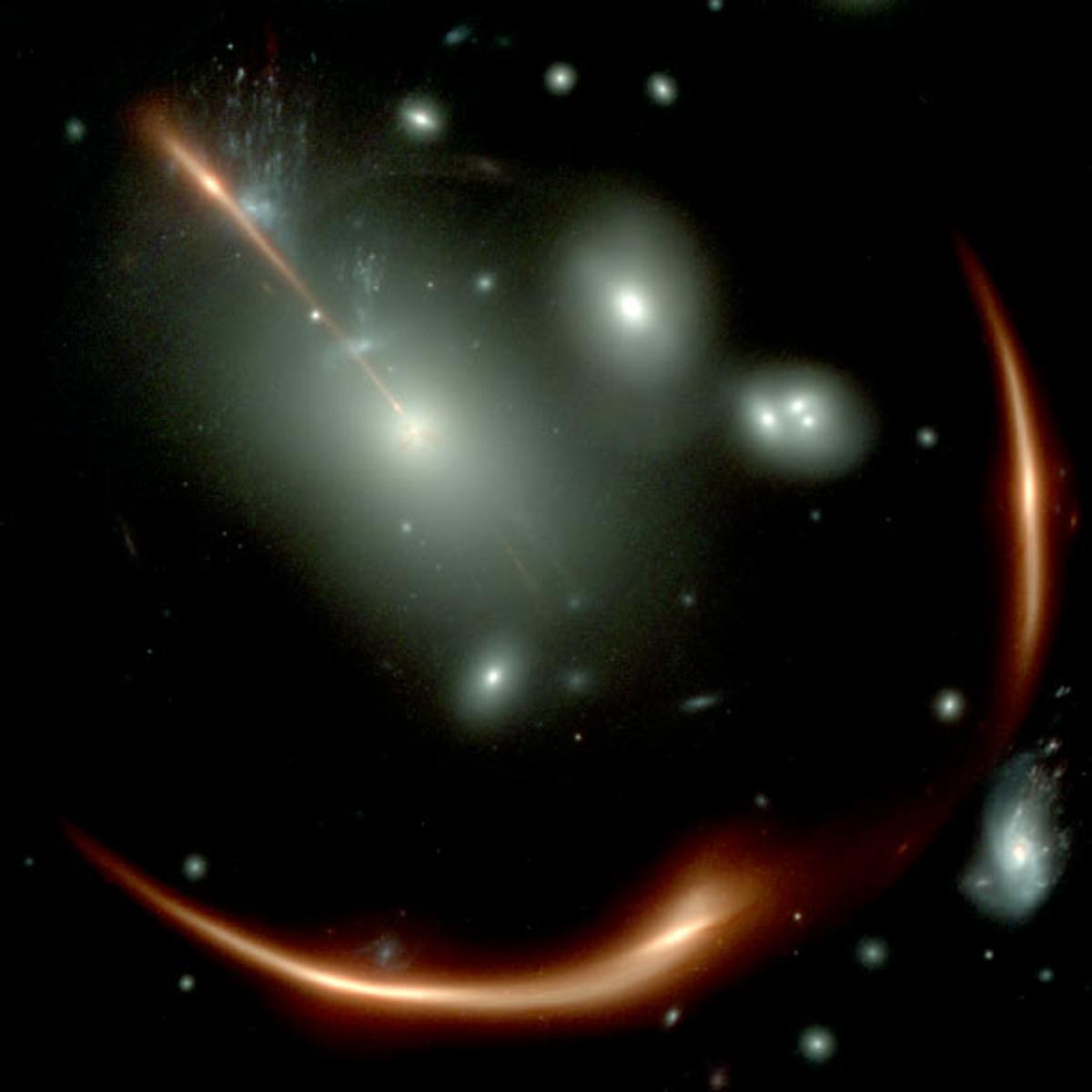
- •Webb measured 6 billion‑solar‑mass black hole at 10 billion light‑years.
- •Gravitational lensing magnified galaxy MRG‑M0138 by ~30×.
- •First dormant supermassive black hole weighed beyond redshift 2.
- •Findings support early rapid black‑hole growth in dense galaxies.
- •Technique opens census of early‑universe black holes.
Pulse Analysis
The James Webb Space Telescope has once again proven its unique capability to push the frontiers of extragalactic astronomy. By pairing its high‑resolution NIRSpec Integral Field Spectrograph with the natural magnification of a massive foreground galaxy cluster, researchers were able to resolve stellar motions within MRG‑M0138’s core. This approach—stellar dynamical modeling under strong gravitational lensing—provides a direct mass estimate for a black hole that is otherwise invisible, sidestepping the need for bright accretion signatures that dominate most high‑redshift detections.
Beyond the technical triumph, the discovery reshapes our understanding of black‑hole and galaxy co‑evolution. Local galaxies exhibit tight correlations between central black‑hole mass and host‑galaxy properties, yet it has been unclear whether such relationships were already established when the universe was a fraction of its current age. The 6 billion‑solar‑mass black hole in a dormant, dense galaxy at redshift 2 suggests that massive black holes grew rapidly alongside their stellar bulges, possibly during an earlier quasar phase now faded. This evidence supports models where early, gas‑rich mergers fuel both star formation and black‑hole accretion, locking the two components together from the outset.
Looking forward, the successful application of this lens‑assisted dynamical technique opens a pathway to systematically survey dormant black holes across cosmic time. Upcoming JWST programs targeting additional strongly lensed quiescent galaxies could populate a statistically meaningful sample, enabling astronomers to map the evolution of black‑hole scaling laws. Such a census will refine theoretical frameworks for galaxy formation, inform simulations of early structure growth, and ultimately help answer how supermassive black holes became the engines of modern galaxies.
Webb Weighs Most Distant Inactive Black Hole Ever Found
Comments
Want to join the conversation?
Loading comments...