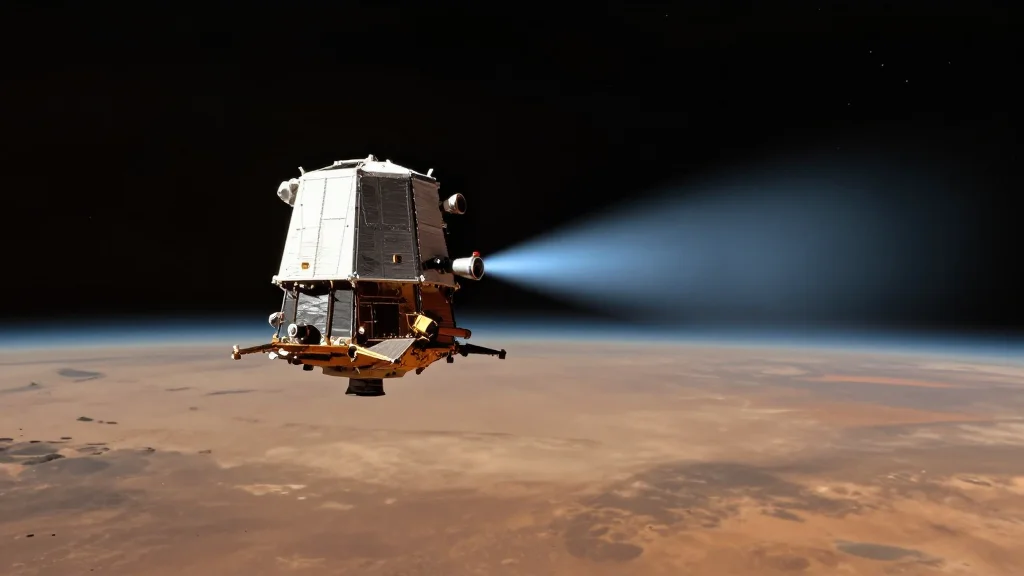
What Makes Mars' Magnetotail Flap? Two Spacecraft Point to Magnetic Reconnection
Why It Matters
Understanding reconnection‑driven flapping clarifies how Mars loses atmospheric ions to space, informing models of planetary evolution and space weather forecasting for future missions.
Key Takeaways
- •MAVEN detected reconnection signatures upstream of Mars' magnetotail
- •Tianwen‑1 observed downstream flapping events coincident with reconnection
- •Flux ropes formed upstream may propagate and destabilize plasma sheets
- •Mars' crustal fields still shape its magnetotail despite lacking global field
- •Dual‑spacecraft observations open new path for comparative planetary magnetotail studies
Pulse Analysis
Magnetotails are ubiquitous features of planets exposed to the solar wind, but the mechanisms that energize and shape them differ across worlds. On Earth, magnetic reconnection—where oppositely directed field lines snap and release stored energy—has long been recognized as a catalyst for tail flapping and substorm activity. By contrast, Mars lost its global dynamo billions of years ago, leaving only localized crustal magnetic anomalies and an induced magnetosphere formed by its thin atmosphere. This unique environment has made it difficult to determine whether reconnection can operate without a planet‑wide field, a question that the latest dual‑spacecraft study now addresses.
The breakthrough came from synchronizing measurements from MAVEN, which samples the upstream region of the Martian tail, with Tianwen‑1, which monitors downstream plasma dynamics. Researchers found that bursts of reconnection‑related signatures—such as rapid magnetic field reversals and energetic particle spikes—preceded flapping motions captured by Tianwen‑1. Moreover, the detection of flux ropes, compact bundles of twisted magnetic field lines, suggests a conduit for transporting reconnection energy far down the tail, where it can destabilize the plasma sheet and generate the observed oscillations. These findings align Mars' tail behavior with terrestrial analogs, despite the planet's lack of a global dipole.
The implications extend beyond academic curiosity. Magnetotail flapping influences how atmospheric ions escape Mars, a key factor in the planet's long‑term climate evolution. By confirming reconnection as a driver, scientists can refine atmospheric loss models and improve space weather predictions for future crewed and robotic missions. Additionally, the success of coordinated observations underscores the value of international collaboration, paving the way for multi‑point studies of other magnetized bodies such as Venus or the icy moons of Jupiter, where similar processes may shape their plasma environments.
What makes Mars' magnetotail flap? Two spacecraft point to magnetic reconnection
Comments
Want to join the conversation?
Loading comments...