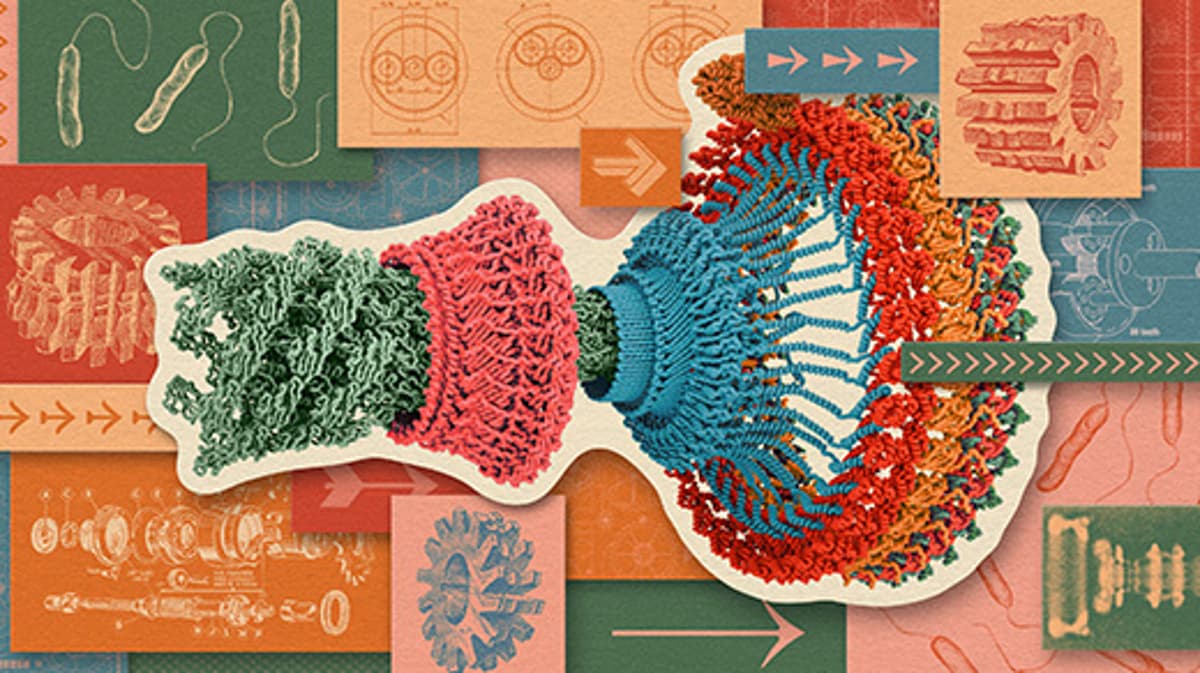
What Physical ‘Life Force’ Turns Biology’s Wheels?
Why It Matters
The insight transforms our understanding of bacterial navigation, opening new avenues for antimicrobial strategies and the design of synthetic nanomotors that mimic nature’s efficient energy conversion.
Key Takeaways
- •Cryo‑EM solved flagellar motor structure by March 2026.
- •Proton motive force drives >2,000 protons per second through stator turnstiles.
- •Counter‑clockwise rotation propels bacteria; clockwise causes tumbling via CheY phosphorylation.
- •Stator count varies (10–12 in E. coli) and adapts to load.
- •Understanding motor informs bio‑engineered nanomachines and antibiotic targets.
Pulse Analysis
The bacterial flagellar motor has long been a poster child for molecular complexity, captivating biologists since Howard Berg’s pioneering tracking experiments in the 1970s. While early work established the run‑and‑tumble behavior, the precise architecture remained elusive, fueling debates from evolutionary biology to intelligent‑design arguments. Over the past decade, advances in cryogenic electron microscopy finally delivered atomic‑resolution snapshots, allowing researchers to map the stator‑C‑ring interface and confirm the motor’s gear‑like operation. This historical arc underscores how a blend of physics, genetics, and imaging can solve problems that have persisted for half a century.
At the heart of the motor lies the proton motive force, a transmembrane electrochemical gradient that drives more than two thousand protons per second through pentagonal stator turnstiles. Each proton’s passage generates torque, turning the stator’s ring and, via interlocking gears, rotating the larger C‑ring and attached filament. The system’s elegance extends to its bidirectional control: phosphorylation of the CheY protein triggers a rapid conformational flip in the C‑ring, reversing rotation and causing the bacterium to tumble. By March 2026, the complete structural model confirmed these dynamics, providing a unified physical explanation for bacterial chemotaxis and linking energy conversion to cellular decision‑making.
Beyond basic science, the clarified mechanism has practical implications. Knowing exactly how protons power a nanoscale rotary engine opens pathways for novel antibiotics that disrupt stator function, potentially crippling pathogenic bacteria’s motility. Simultaneously, engineers are eyeing the motor as a blueprint for synthetic nanomachines capable of converting chemical gradients into mechanical work, a prospect that could revolutionize drug delivery and micro‑robotics. As researchers explore variations across species, the flagellar motor stands as a testament to evolution’s capacity to engineer efficient, adaptable machines, and a promising template for future bio‑inspired technologies.
What Physical ‘Life Force’ Turns Biology’s Wheels?
Comments
Want to join the conversation?
Loading comments...