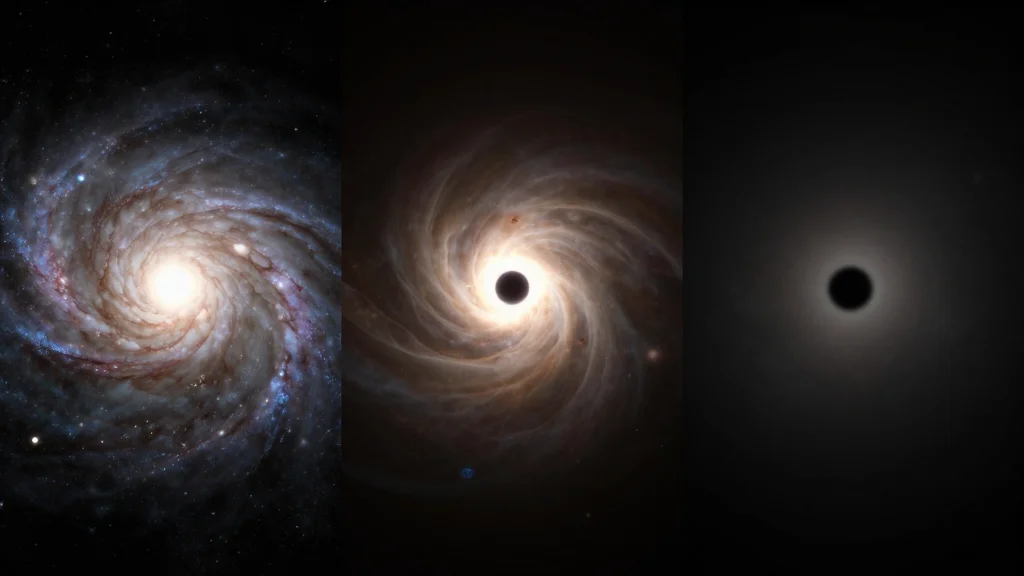
Where Are All the Intermediate Mass Black Holes? Microlensing Fast Radio Bursts Might Reveal Them
Why It Matters
Detecting IMBHs would fill a critical gap in the black‑hole mass hierarchy and inform dark‑matter models that invoke primordial black holes. The CHIME‑FRB microlensing technique offers a scalable, observational path to uncovering a population that has so far evaded conventional surveys.
Key Takeaways
- •CHIME FRB catalog reveals two microlensing events consistent with IMBH masses
- •Inferred lens masses range from ~540 to ~2,600 solar masses
- •Findings suggest primordial black holes could account for ~4% of dark matter
- •If signals are false, IMBH-mass PBHs limited to ≤13% of dark matter
- •Microlensing FRBs provides a new tool to detect hidden intermediate-mass black holes
Pulse Analysis
The hunt for intermediate‑mass black holes has been hampered by the limits of traditional detection methods, which excel at spotting stellar remnants or supermassive cores but struggle with objects in the 10²‑10⁵ M☉ gap. Past claims, such as the disputed Omega Centauri candidate, have highlighted the need for a technique that can isolate compact masses without relying on luminous accretion signatures. Gravitational microlensing of fast radio bursts (FRBs) meets that need, leveraging the brief, bright flashes that travel across cosmological distances and can be subtly split by intervening massive objects.
Using the extensive CHIME/FRB catalog, Zhou and colleagues identified two FRBs whose light curves exhibit the characteristic echo of a microlensing event. The derived lens masses—approximately 540 M☉ and 1,600‑2,600 M☉—sit squarely in the IMBH regime, suggesting the lenses could be primordial black holes (PBHs) that formed in the early universe. If these detections are genuine, the implied PBH abundance would represent roughly four percent of the total dark‑matter budget, a non‑trivial fraction that reshapes constraints on PBH‑driven cosmology.
Even if the signals turn out to be astrophysical false positives, the analysis imposes a robust upper bound: IMBH‑mass PBHs cannot exceed about 13 % of dark matter at 95 % confidence. This dual outcome—potential discovery or tighter limits—demonstrates the power of FRB microlensing as a complementary probe to gravitational‑wave surveys and stellar dynamics studies. Future high‑time‑resolution FRB observations, combined with refined models of intrinsic burst structure, could turn this method into a routine census tool, unlocking insights into black‑hole formation pathways and the composition of the dark sector.
Where are all the intermediate mass black holes? Microlensing fast radio bursts might reveal them
Comments
Want to join the conversation?
Loading comments...