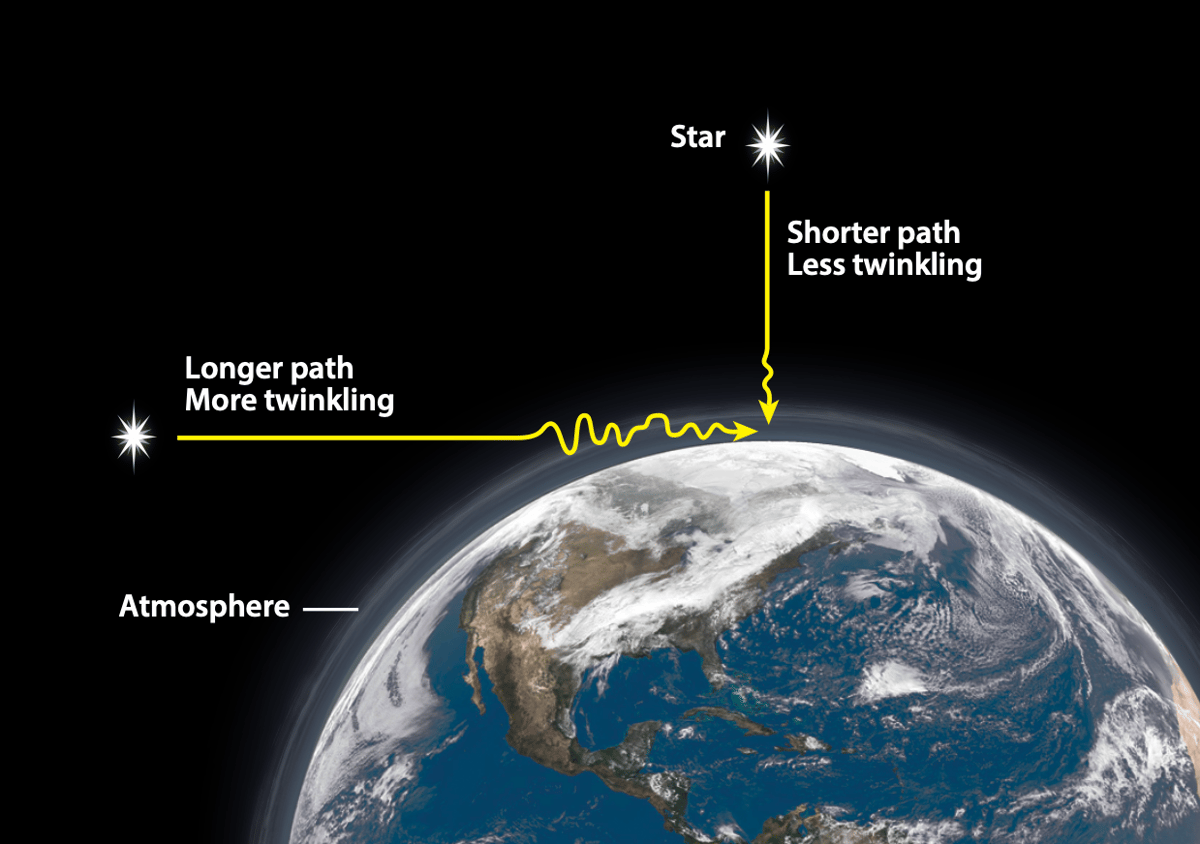
Why Do some Stars Appear to Twinkle While Others Don’t?
Why It Matters
Understanding scintillation is crucial for astronomers, satellite‑imaging firms, and optical‑communication providers, as atmospheric distortion directly impacts image clarity and data transmission reliability.
Key Takeaways
- •Bright stars scintillate more due to eye sensitivity.
- •Low‑altitude stars pass through thicker atmosphere, increasing twinkle.
- •Ground heat creates localized turbulence, affecting nearby stars.
- •Wind, humidity, and temperature shifts alter scintillation nightly.
- •Adaptive optics mitigate twinkling for professional observatories.
Pulse Analysis
Atmospheric scintillation occurs when varying temperature and density layers bend starlight, creating rapid fluctuations in brightness and color. The effect is most pronounced for luminous stars because the human eye can detect subtle intensity changes, while dimmer stars remain visually steady. Stars near the horizon travel through a longer atmospheric path, amplifying turbulence‑induced refraction. This basic physics explains why a single bright star can appear to dance across the sky while its fainter neighbors stay fixed.
For professional astronomy and related industries, scintillation is more than a curiosity—it limits the resolution of ground‑based telescopes and degrades free‑space optical links. Adaptive‑optics systems counteract atmospheric distortion by measuring wavefront errors with guide stars or lasers and applying real‑time corrections, restoring near‑diffraction‑limited performance. Satellite‑imaging companies also factor scintillation into sensor design, as atmospheric turbulence can blur high‑resolution Earth observations and affect laser communication reliability.
Amateur observers can mitigate twinkling by targeting stars at higher elevations, allowing the light to pass through less air, and by avoiding views over heated surfaces. Portable heated‑air fans or low‑profile domes can reduce local turbulence around small telescopes. As urban development expands, understanding and managing scintillation will remain essential for both hobbyists and enterprises that rely on precise optical measurements.
Why do some stars appear to twinkle while others don’t?
Comments
Want to join the conversation?
Loading comments...