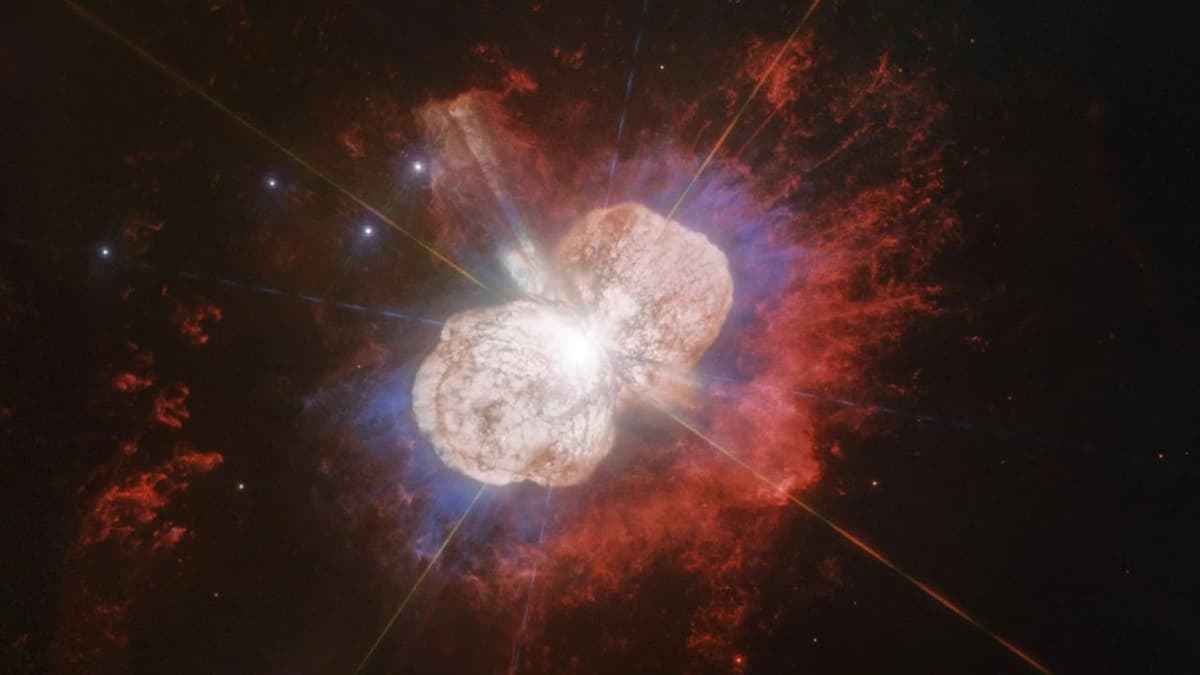
Why Do some Stars Become 'Supernova Impostors'? Astronomers Still Don't Quite Know
Why It Matters
Understanding eruptive mass loss reshapes predictions of massive‑star lifecycles and the rates of true supernovae, directly affecting galactic chemical‑evolution models and transient‑survey strategies.
Key Takeaways
- •Eruptive mass‑loss efficiency rises with stellar metallicity
- •Stars >20 M☉ lose enough mass to skip red‑supergiant phase
- •Study calibrated models using red supergiants in SMC, LMC, M31
- •Findings rely on wide‑field surveys like Pan‑STARRS1
- •Future work must test trend in more distant galaxies
Pulse Analysis
Supernova impostors have puzzled astronomers for decades because they mimic the brilliance of true supernovae without destroying the star. The transient outbursts eject massive shells of gas, yet traditional infrared and radio techniques only capture a snapshot of ongoing mass loss. This episodic behavior makes it difficult to quantify the total material expelled over a star’s lifetime, leaving a major gap in our understanding of how the most massive stars evolve and enrich their surroundings.
The recent paper from Cheng, Conroy, and Goldberg tackles the problem by turning to a statistical census of red supergiants across nearby galaxies. Leveraging the Pan‑STARRS1 Medium‑Deep Survey, the team compiled brightness distributions for red supergiants in the Small and Large Magellanic Clouds and Andromeda (M31). They then ran a suite of MESA stellar‑evolution simulations, adjusting the previously unconstrained eruptive‑mass‑loss efficiency parameter until the synthetic populations matched the observed data. The result is a robust, metallicity‑dependent calibration: higher heavy‑element abundances drive more energetic eruptions.
This calibrated relationship has profound implications for stellar‑evolution theory. In the revised models, stars exceeding roughly 20 solar masses shed enough mass during eruptive phases to avoid the red‑supergiant stage, instead evolving along alternative pathways that may culminate in different supernova types or direct collapse to black holes. Accurate predictions of these pathways are essential for forecasting supernova rates, interpreting gravitational‑wave progenitors, and modeling galactic chemical enrichment. Future work will need to extend the metallicity test to more distant, diverse galaxies and explore the physical triggers behind the eruptions, ensuring the new parameter remains reliable across the cosmos.
Why do some stars become 'supernova impostors'? Astronomers still don't quite know
Comments
Want to join the conversation?
Loading comments...