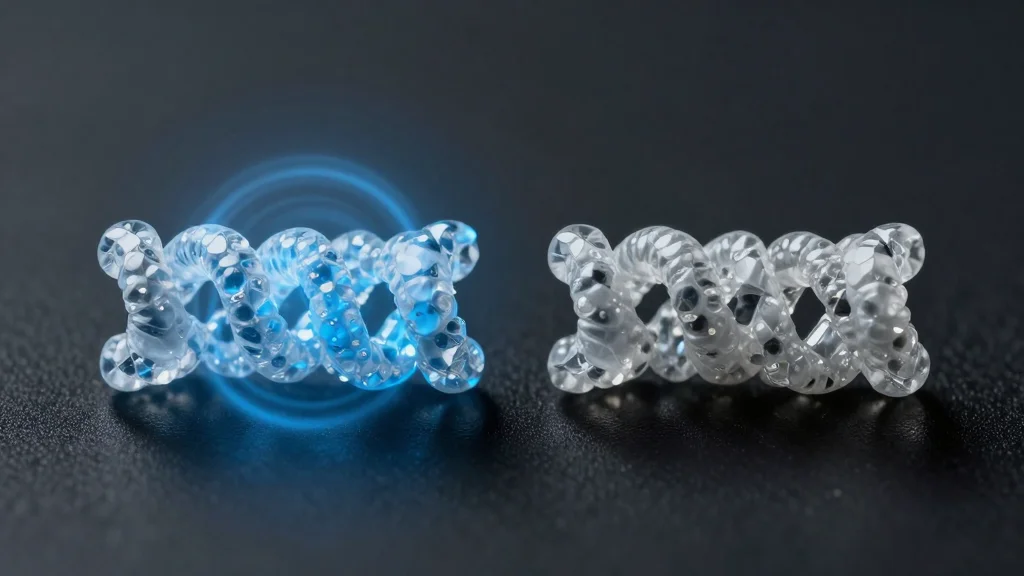
Why Does Life Prefer One 'Hand' Over the Other? New Study Points to Electron Spin
Why It Matters
If spin‑dependent electron transport consistently favors one enantiomer, even tiny efficiencies could amplify, explaining why life universally adopts a single molecular handedness. The insight reshapes theories of biochemical origin and opens new avenues for spin‑controlled technologies.
Key Takeaways
- •Electron spin creates measurable polarization differences between chiral enantiomers
- •Dynamic spin effects can favor one enantiomer during electron transport
- •Findings link quantum spin to the origin of biological homochirality
- •Research opens pathways for spin‑controlled chiral catalysts and materials
Pulse Analysis
The mystery of biological homochirality—why amino acids and sugars exist almost exclusively in one handedness—has long vexed chemists and biologists. Traditional explanations focus on asymmetric synthesis or environmental biases, yet they struggle to account for a universal selection across diverse ecosystems. Recent advances in quantum chemistry suggest that electron spin, a fundamental property of subatomic particles, may introduce subtle asymmetries when electrons traverse chiral molecules. By coupling spin orientation with molecular geometry, these interactions break the perfect mirror symmetry assumed in static energy calculations, providing a fresh perspective on molecular evolution.
In the study published in Science Advances, Paltiel, Naaman and collaborators combined theoretical modeling with precision electron‑transport experiments to demonstrate that chiral enantiomers generate distinct spin‑polarization signatures. When electrons flow through a left‑handed molecule, their spins align differently than through its right‑handed counterpart, leading to measurable differences in transport efficiency. Over geological timescales, such minute advantages could accumulate, biasing the prevalence of one enantiomer in prebiotic chemistry. The researchers argue that early Earth’s magnetic fields and mineral surfaces could have amplified these spin‑dependent effects, offering a plausible route from quantum phenomena to macroscopic biological asymmetry.
Beyond its implications for the origin of life, the discovery fuels a burgeoning field at the intersection of spintronics and chiral chemistry. Engineers can now envision catalysts that exploit spin selectivity to drive enantioselective reactions, while material scientists explore chiral magnets for next‑generation information storage. Moreover, the findings encourage interdisciplinary collaborations, uniting physicists, chemists and biologists to probe how quantum properties shape complex systems. As the scientific community delves deeper into spin‑dependent chemistry, the prospect of harnessing molecular handedness for sustainable synthesis and quantum technologies becomes increasingly tangible.
Why does life prefer one 'hand' over the other? New study points to electron spin
Comments
Want to join the conversation?
Loading comments...