Why Does One Side of the Moon Have a Lot of Craters, While the Other Does Not?
Why It Matters
Understanding why impact basins are unevenly distributed reveals how planetary bodies interact gravitationally during early solar system formation, informing models of crater chronology and lunar resource mapping.
Key Takeaways
- •Earth-facing side received more early large impact basins.
- •Lunar maria are lava plains filling ancient impact basins.
- •North Polar Basin is the largest farside basin, now eroded.
- •Oceanus Procellarum and Imbrium basins dominate nearside geology.
- •Earth's gravity may have steered early asteroids toward near side.
Pulse Analysis
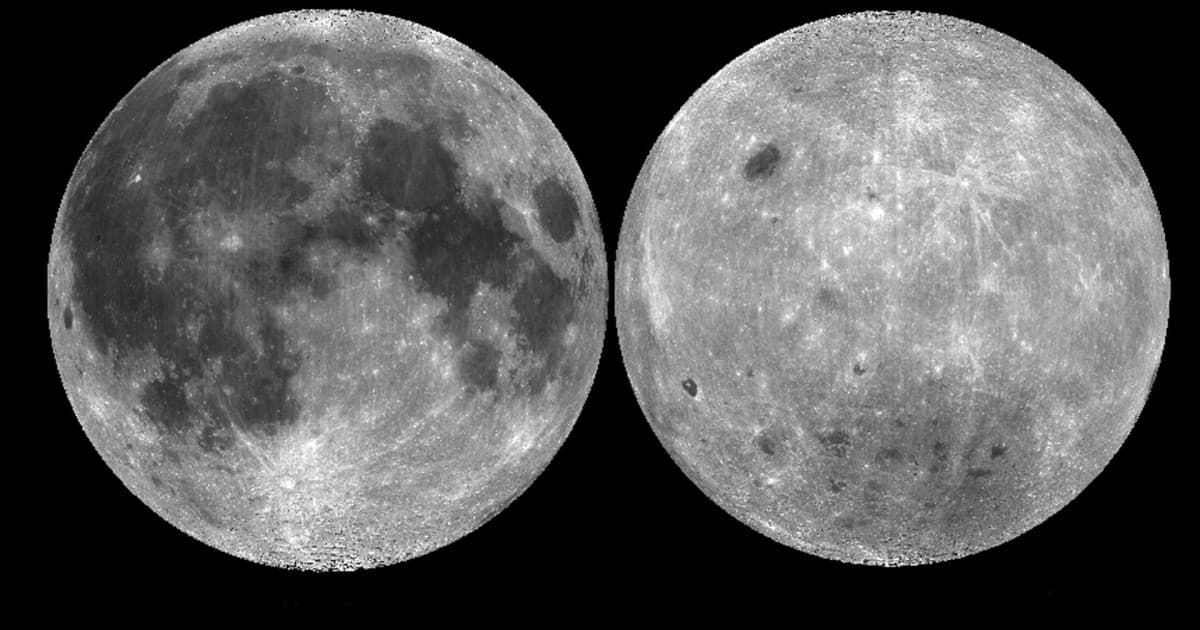
The stark contrast between the Moon’s nearside and farside has long fascinated scientists and the public alike. While the far side is peppered with countless craters, the near side is scarred by vast, dark maria—lava‑filled basins that give the lunar face its familiar pattern. These plains are not volcanic eruptions in the modern sense; they are the aftermath of colossal impacts that melted the Moon’s mantle, allowing basaltic lava to flood the depressions. The most prominent examples, Oceanus Procellarum and Mare Imbrium, dominate the Earth‑facing hemisphere and are visible even to the naked eye.
Recent research points to a gravitational bias in the Moon’s early bombardment history. In the first few hundred million years after its formation, the Moon orbited much closer to Earth, placing the near side within a stronger gravitational well. Simulations suggest that Earth’s pull could have redirected incoming asteroids toward the lunar hemisphere that faced our planet, increasing the frequency of large basin‑forming impacts there. Evidence for this hypothesis includes the concentration of the largest basins—such as the Imbrium and Procellarum structures—on the nearside, while the farside’s biggest basin, the North Polar Basin, is older and heavily degraded.
These insights have practical implications for lunar exploration and planetary science. A better grasp of impact distribution helps refine crater‑count dating techniques, crucial for establishing the Moon’s geological timeline. It also guides resource prospecting, as maria regions are rich in basaltic material that could be mined for construction or fuel. Moreover, the Moon serves as a natural laboratory for studying how planetary bodies influence each other's early evolution, offering clues that extend to exoplanet systems where close‑orbiting moons may experience similar gravitational steering of impactors.
Why does one side of the Moon have a lot of craters, while the other does not?
Comments
Want to join the conversation?
Loading comments...