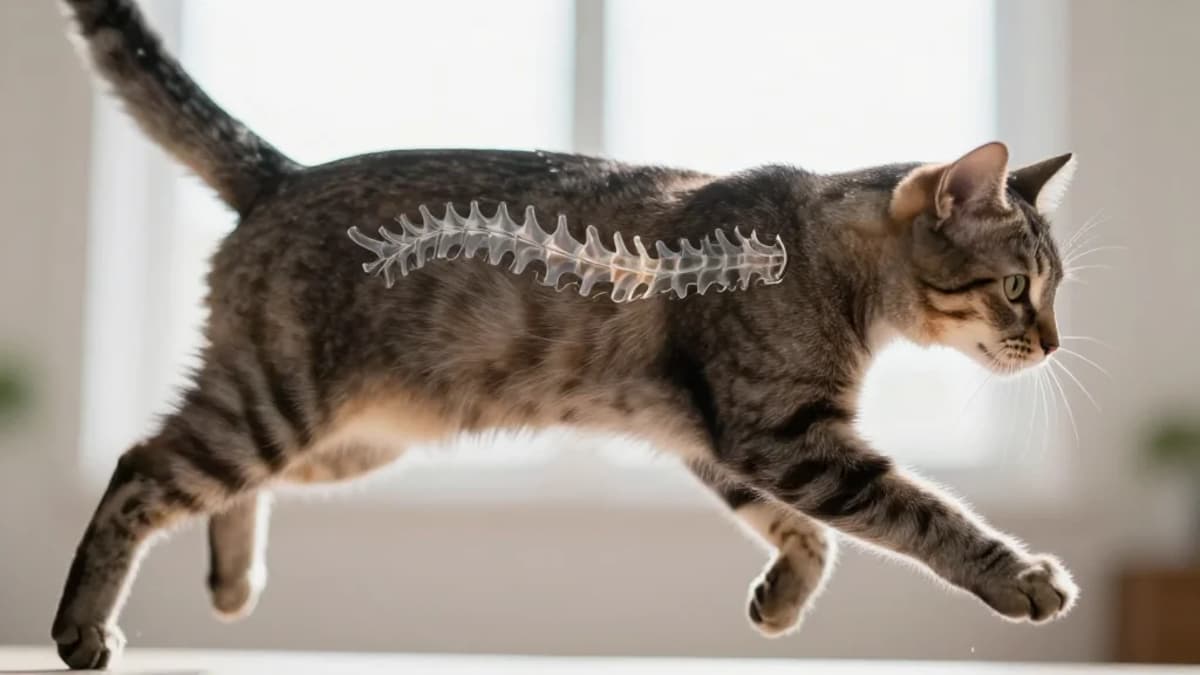
Why Falling Cats Always Seem to Land on Their Feet
•March 11, 2026
0
Why It Matters
Understanding the biomechanical basis of feline righting reflexes informs physics models, improves robotic locomotion design, and deepens comparative anatomy knowledge.
Key Takeaways
- •Upper thoracic vertebrae rotate up to 360 degrees
- •Lower lumbar spine remains comparatively stiff
- •Cats twist front half before hindquarters
- •Study supports "legs in, legs out" model
- •Observed right‑side bias in turning direction
Pulse Analysis
The mystery of how cats always land on their feet has intrigued scientists for over a century, from Étienne‑Jules Marey’s early high‑speed photography to modern biomechanics. The latest research from Yamaguchi University bridges a critical gap by directly measuring spinal flexibility in cadaver specimens and correlating those data with live‑cat drop experiments. By quantifying the rotational capacity of the upper thoracic vertebrae, the study provides concrete anatomical evidence that explains the rapid aerial adjustments cats perform, moving beyond speculative physics equations.
Beyond satisfying curiosity, these findings have practical implications for engineering and robotics. Engineers designing agile, self‑righting machines can mimic the cat’s segmented spine strategy—using a highly flexible front segment coupled with a sturdier rear—to achieve rapid orientation changes without external actuators. The documented 360‑degree twist capability offers a benchmark for material scientists seeking bio‑inspired flexibility while maintaining structural integrity, potentially influencing the next generation of drones, rescue robots, and prosthetic devices.
The research also raises new questions about lateral asymmetry in animal locomotion. The observed right‑side bias, though based on a small sample, suggests underlying neural or muscular preferences that could affect how animals navigate complex environments. Future work aiming to expand the dataset and develop three‑dimensional computational models will not only refine the “legs in, legs out” versus “tuck and turn” debate but also enhance our broader understanding of vertebrate motor control. Such interdisciplinary insights underscore the value of integrating anatomy, physics, and robotics to solve long‑standing biological puzzles.
Why Falling Cats Always Seem to Land on Their Feet
0
Comments
Want to join the conversation?
Loading comments...