Why the Most Massive Galaxies in the Early Universe Stopped Forming Stars Prematurely
Why It Matters
Understanding how massive galaxies shut down early reshapes theories of galaxy formation and informs predictions for future deep‑sky surveys.
Key Takeaways
- •86‑96% of massive quiescent galaxies once were dusty star‑forming
- •Violent early‑mass mergers trigger starbursts and supermassive black hole growth
- •AGN feedback heats halo gas, halting star formation within a billion years
- •James Webb reveals more DSFGs than models predicted, prompting revisions
Pulse Analysis
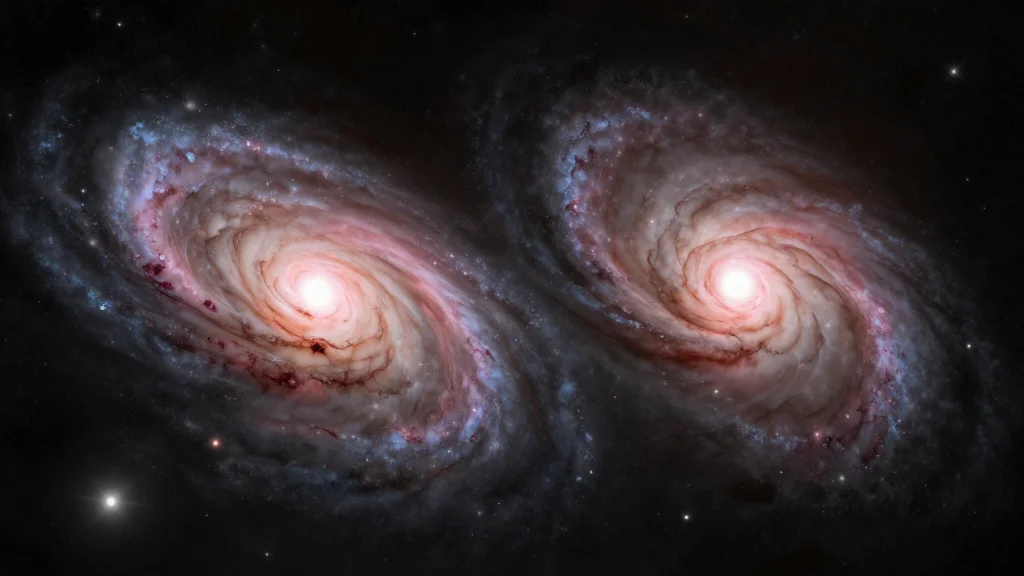
The early universe hosted a surprising class of massive galaxies that quenched their star formation within a few hundred million years after birth. A new study from the University of São Paulo, published in *Astronomy & Astrophysics*, links these massive quiescent galaxies (MQs) to an earlier dusty star‑forming phase (DSFGs). By applying a semi‑analytical model to redshifts 2–4, the authors show that up to 96 % of MQs passed through an intense DSFG stage, reconciling two previously disjoint populations observed by ALMA and the James Webb Space Telescope.
The researchers attribute the rapid shutdown to violent, near‑equal‑mass mergers that funnel gas into galactic cores. The resulting starburst can reach 500 solar masses per year, while the central supermassive black hole accretes at a furious rate. Energy released by the active nucleus heats the surrounding halo, preventing cooling flows and starving the galaxy of fresh fuel. This AGN‑driven feedback can quench star formation in less than one billion years, explaining why MQs appear “dead” while their DSFG ancestors shine brightly in the infrared.
James Webb observations have already uncovered a surplus of DSFGs and early‑time MQs, challenging existing simulations that underpredict their numbers. The discrepancy underscores the need for higher‑resolution modeling of merger dynamics and black‑hole feedback. The upcoming Giant Magellan Telescope, with its 24.5‑meter aperture, promises three‑to‑four‑fold sharper images, enabling direct study of merger remnants at redshifts beyond 4. As data improve, astronomers expect to refine the timeline of galaxy evolution and better constrain how the most massive structures in the cosmos assembled.
Why the most massive galaxies in the early universe stopped forming stars prematurely
Comments
Want to join the conversation?
Loading comments...