You Want Your Moon Landings in HD? So Does NASA—Here's How It's Happening.
Companies Mentioned
Why It Matters
High‑bandwidth laser links will transform how NASA and commercial partners downlink imagery and science, reducing latency and power needs while supporting more ambitious lunar and deep‑space missions. Scaling the network to a global constellation of ground stations is essential for reliable, cloud‑free operations.
Key Takeaways
- •Orion laser link achieved 260 Mbps, 100× faster than radio
- •Three ground stations received laser data; 40 needed for global coverage
- •Off‑the‑shelf 70 cm telescope delivered full 260 Mbps rate
- •Laser transmitters use ~1 W power versus 5‑20 W for S‑band
Pulse Analysis
The Artemis II mission marked a turning point for space communications by swapping traditional radio for optical‑laser links. While the crew’s low‑definition video satisfied public curiosity, the laser terminal’s 260 Mbps throughput meant a full‑HD movie could be beamed to Earth in seconds—a stark contrast to the 3‑5 MB s⁻¹ S‑band rates used most of the flight. This leap in bandwidth is not just about prettier footage; it enables rapid transmission of high‑resolution scientific datasets, crucial for lunar geology, solar observations, and future crewed landings.
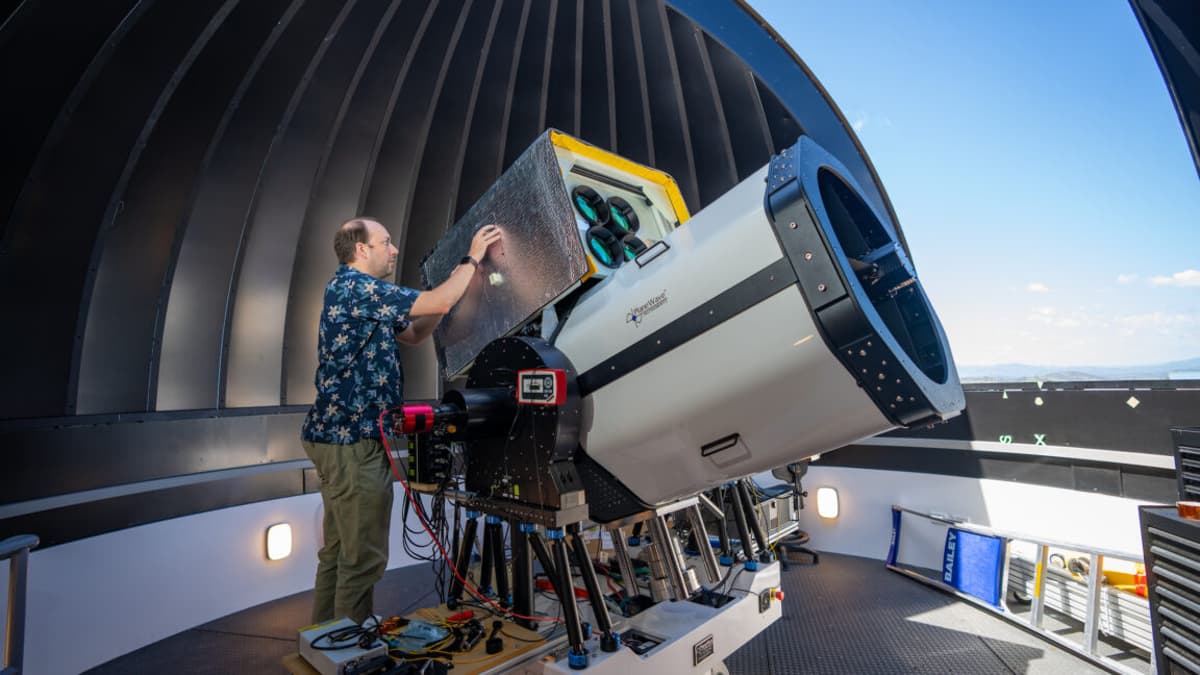
Laser communications offer dramatic efficiency gains. The Orion laser transmitter consumed roughly one watt, compared with the 5‑20 W required for the S‑band radio, and the smaller optics reduce spacecraft mass and power budgets. However, the technology is weather‑sensitive; clouds can block the 1550 nm photons, demanding a distributed network of clear‑sky ground stations. NASA’s three existing optical stations proved the concept, but analysts estimate a global mesh of about 40 sites will be needed for uninterrupted service. To lower deployment costs, NASA partnered with Observable Space, which fielded a commercial 70 cm telescope that matched the system’s 260 Mbps ceiling, demonstrating that off‑the‑shelf hardware can meet mission standards.
The commercial angle signals a broader shift toward private‑sector participation in deep‑space infrastructure. Companies like Quantum Opus and Observable Space are delivering turnkey photon‑detection systems, leveraging superconducting nanowire detectors that can count single photons without cryogenic expertise. Their involvement accelerates the rollout of a resilient laser‑ground network, opening doors for high‑definition broadcasts of Artemis IV’s lunar landing and future Mars missions. Beyond entertainment, the same photon‑counting tech underpins quantum‑computing research, positioning the laser‑link ecosystem as a strategic asset for both exploration and emerging terrestrial applications.
You want your Moon landings in HD? So does NASA—here's how it's happening.
Comments
Want to join the conversation?
Loading comments...