Astronomers Discover the 'Growing Pains' Of Teenage Exoplanets
•January 27, 2026
0
Companies Mentioned


Why It Matters
Understanding the violent teenage stage clarifies how planetary architectures form, informing models of exoplanet diversity and our own Solar System’s history. It also guides future searches for young planets by highlighting debris‑disk signatures.
Key Takeaways
- •ALMA imaged 24 faint debris disks around infant stars.
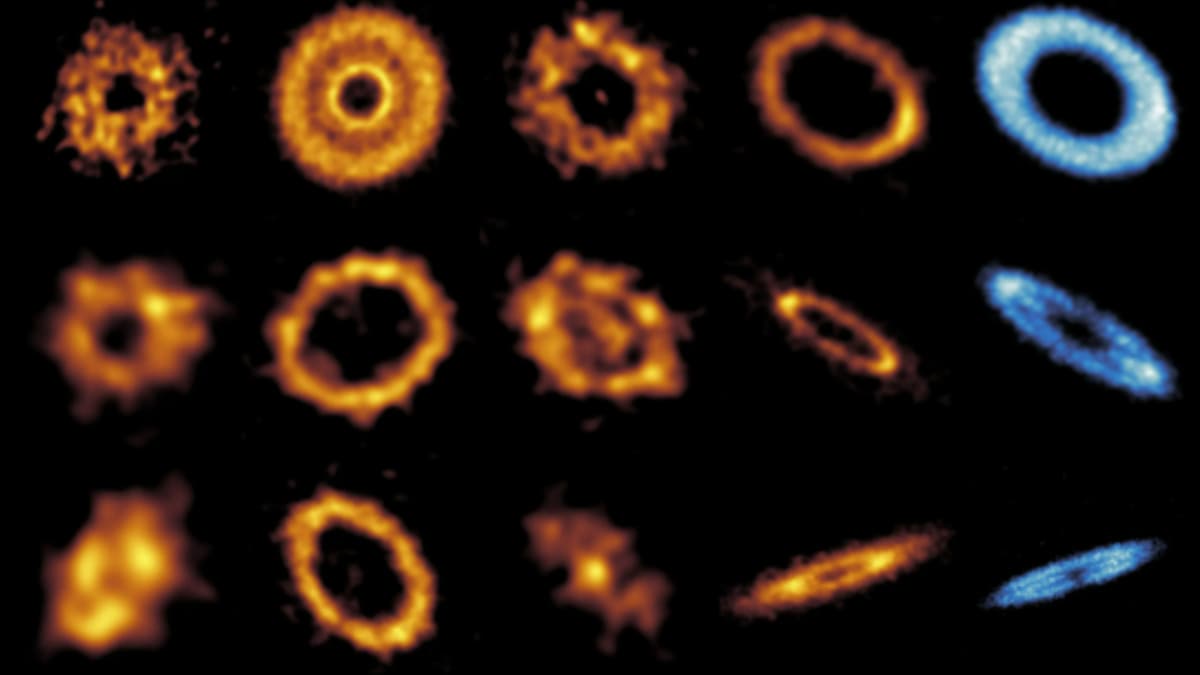
- •Disks display rings, halos, arcs, and clumps.
- •Structures indicate frequent collisions during planetary adolescence.
- •Findings link Moon‑forming impact to observed disk dynamics.
- •Data improve models of planet formation and migration.
Pulse Analysis
The Atacama Large Millimeter/submillimeter Array (ALMA) has long been the workhorse for probing the earliest stages of planet formation, yet its ability to resolve the faint, dust‑laden debris disks of adolescent systems marks a pivotal advance. By targeting 24 young stellar objects, the ARKS collaboration leveraged ALMA’s 66‑antenna interferometer to map subtle structures—multiple rings, expansive halos, and asymmetric clumps—that were previously invisible. These features betray a period of intense dynamical activity, where planetesimals collide, migrate, and reshape their orbits, mirroring the chaotic environment that likely forged Earth’s Moon.
From a scientific perspective, the new images provide a missing evolutionary bridge between bright, gas‑rich protoplanetary disks and the settled planetary systems observed around mature stars. The observed asymmetries and arc‑like formations suggest that massive impacts and orbital resonances are common, offering a tangible analogue for the early Solar System’s Kuiper Belt and the late‑heavy bombardment epoch. By correlating debris‑disk morphology with direct imaging and radial‑velocity detections, researchers can refine models of planetary migration, core accretion, and the timing of giant‑planet formation, thereby improving predictions of exoplanet demographics across the galaxy.
Looking ahead, the study underscores the strategic value of high‑resolution radio interferometry for exoplanet discovery pipelines. Industry stakeholders in telescope instrumentation and data‑processing pipelines can capitalize on the demonstrated demand for deeper, fainter observations, spurring investment in next‑generation arrays and AI‑driven image reconstruction. Moreover, the insights into planetary chaos have practical implications for mission planning, as understanding where and when planets experience violent reshaping can inform target selection for future habitability studies. The teenage‑planet paradigm thus reshapes both academic inquiry and commercial space exploration strategies.
Astronomers discover the 'growing pains' of teenage exoplanets
0
Comments
Want to join the conversation?
Loading comments...