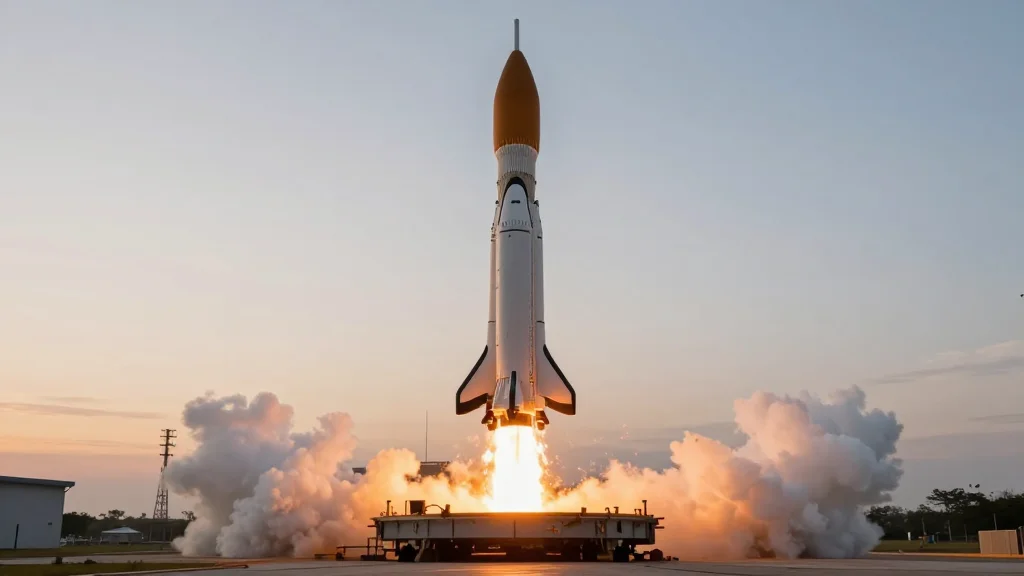
Blue Origin New Glenn Test Explosion Halts Amazon Leo Satellite Launch Plans

Companies Mentioned


Why It Matters
The explosion of Blue Origin’s New Glenn rockets the timeline for Amazon’s Leo broadband constellation, a direct competitor to SpaceX’s Starlink, into uncertainty. A delayed Leo rollout could shift market share in the rapidly growing satellite‑internet sector, affecting pricing, coverage, and the strategic positioning of both Amazon and its rivals. Beyond commercial broadband, the incident jeopardizes NASA’s Artemis lunar‑landing roadmap, where New Glenn is slated to launch cargo landers and support crewed missions. Any prolonged gap in New Glenn availability may force NASA to lean more heavily on SpaceX, reshaping the competitive dynamics of U.S. lunar‑flight contracts and potentially influencing future policy and funding decisions.
Key Takeaways
- •New Glenn exploded during a hot‑fire test, destroying the vehicle and damaging launch pad LC‑36
- •The loss delays the launch of 48 Amazon Leo broadband satellites and threatens a 24‑mission rollout
- •Each New Glenn costs >$100 million; the destroyed rocket represents a major financial hit
- •Blue Origin holds a $188 million NASA contract for lunar lander deliveries, now at risk
- •European Ariane 6 may see increased demand as customers seek alternatives to New Glenn
Pulse Analysis
Blue Origin’s New Glenn failure is a watershed moment for the commercial heavy‑lift market, underscoring the fragility of ambitious, vertically integrated launch programs. The company has poured over a decade and billions of dollars into a reusable, 29‑story rocket that promised to undercut SpaceX’s Falcon Heavy and Starship offerings. The explosion not only wipes out a $100 million asset but also erodes confidence among satellite operators and government customers who have bet on New Glenn’s cadence to deliver large constellations and lunar payloads.
Historically, heavy‑lift setbacks have reshaped the industry—think of the Challenger disaster’s impact on NASA’s shuttle program or the delays that plagued Ariane 5’s early flights. In each case, the market adjusted, with competitors gaining market share while the affected firm regrouped. For Blue Origin, the path forward will hinge on the speed and transparency of its investigation, the ability to rebuild LC‑36, and whether it can retain Amazon’s Leo contract without resorting to external launch services. A prolonged outage could push Amazon to diversify its launch providers, potentially signing with Arianespace, SpaceX, or emerging players like Rocket Lab, thereby diluting Blue Origin’s strategic advantage.
From a policy perspective, the incident highlights the interdependence of commercial launch providers and government lunar initiatives. NASA’s Artemis program, already under pressure to meet tight timelines, now faces a potential bottleneck. If Blue Origin cannot deliver its lunar landers on schedule, the agency may accelerate its reliance on SpaceX’s proven capabilities, consolidating launch authority in a single commercial partner. This concentration could raise concerns about supply‑chain resilience and competition, prompting policymakers to reconsider how contracts are structured and diversified across multiple providers.
In the short term, the market will watch for the FAA’s findings and the repair schedule for LC‑36. A swift, transparent response could restore some confidence, but the longer‑term narrative will be defined by whether Blue Origin can re‑establish its launch cadence and keep Amazon’s Leo constellation on track. The stakes are high: a successful rebound could reaffirm the viability of a third major U.S. heavy‑lift contender, while a protracted delay may cement SpaceX’s dominance in both satellite broadband and lunar logistics.
Blue Origin New Glenn Test Explosion Halts Amazon Leo Satellite Launch Plans
Comments
Want to join the conversation?
Loading comments...