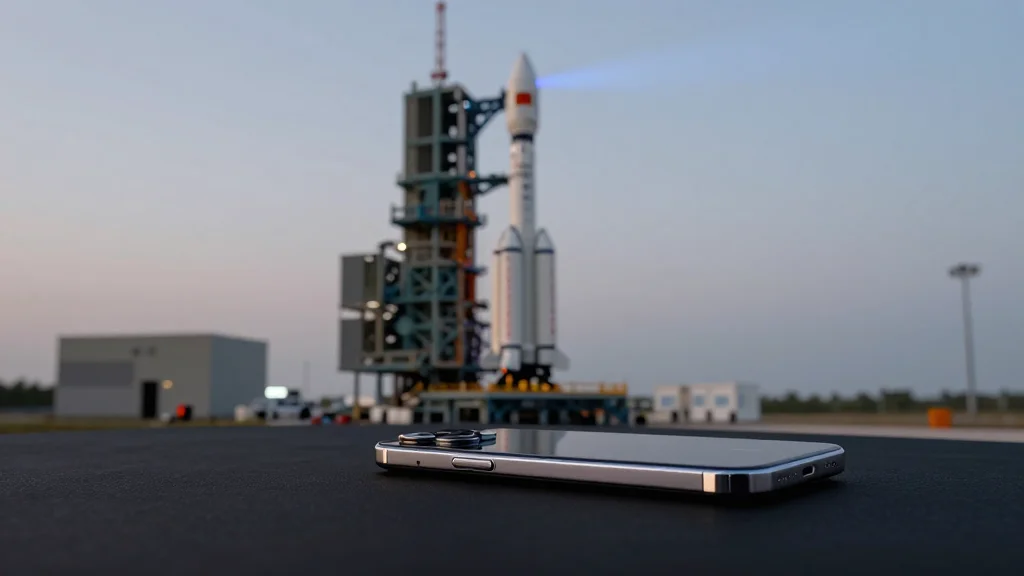
China Launches Four Direct‑to‑device Test Satellites on Long March 2D

Companies Mentioned
Why It Matters
The direct‑to‑device test marks a potential shift in how satellite internet is delivered, moving from specialized ground terminals to everyday smartphones. If the technology matures, it could dramatically expand broadband access in China’s remote interiors and set a template for other nations seeking low‑cost, high‑coverage connectivity solutions. Moreover, the involvement of both state‑run and private firms signals a maturing Chinese space ecosystem where commercial ambition is increasingly intertwined with national strategic goals. Internationally, the development adds pressure on incumbent satellite‑internet providers such as SpaceX’s Starlink and OneWeb, which rely on user terminals. A successful DtD service could erode their market share in Asia and force a reevaluation of pricing and terminal strategies worldwide. The launch also underscores the growing opacity of Chinese satellite programs, complicating efforts by foreign regulators to assess spectrum usage and orbital congestion risks.
Key Takeaways
- •Four direct‑to‑device test satellites launched on May 30 via Long March 2D from Xichang.
- •Payloads involve CASC, CASIC, Landspace’s Hongqing Technology, and an unidentified developer.
- •Satellites aim to prove broadband links directly to mobile phones and tighter space‑ground integration.
- •Launch follows a series of recent Chinese missions, including Qianfan’s 162‑satellite constellation.
- •Successful tests could enable low‑cost satellite internet for remote Chinese regions and challenge global providers.
Pulse Analysis
China’s DtD experiment reflects a strategic pivot toward user‑centric satellite services. Historically, Chinese satellite broadband has relied on ground terminals similar to those used by Starlink. By eliminating the terminal, the cost barrier drops dramatically, opening a massive addressable market in rural China where 5G rollout remains uneven. The involvement of Landspace, a private launch firm, suggests the state is leveraging commercial innovation to accelerate this shift, a pattern seen in other sectors like electric vehicles.
From a competitive standpoint, the test could force Western satellite operators to reconsider their hardware‑heavy models. Starlink’s user terminal, while compact, still represents a significant upfront expense for consumers. A direct‑to‑phone solution could undercut that price point, especially if China subsidizes the service as part of its digital inclusion agenda. The move also aligns with Beijing’s broader push to dominate the low‑Earth‑orbit (LEO) communications arena, complementing its massive Guowang megaconstellation plans.
However, the path forward is not without hurdles. Regulatory approval for DtD services will require coordination with the ITU to avoid spectrum conflicts, and the technology must demonstrate reliable performance in diverse atmospheric conditions. Additionally, the opaque nature of Chinese satellite projects makes it difficult for external analysts to gauge timelines and scale. If China can surmount these challenges, the DtD model could redefine global satellite internet economics, prompting a new wave of innovation and competition in the SpaceTech sector.
China launches four direct‑to‑device test satellites on Long March 2D
Comments
Want to join the conversation?
Loading comments...