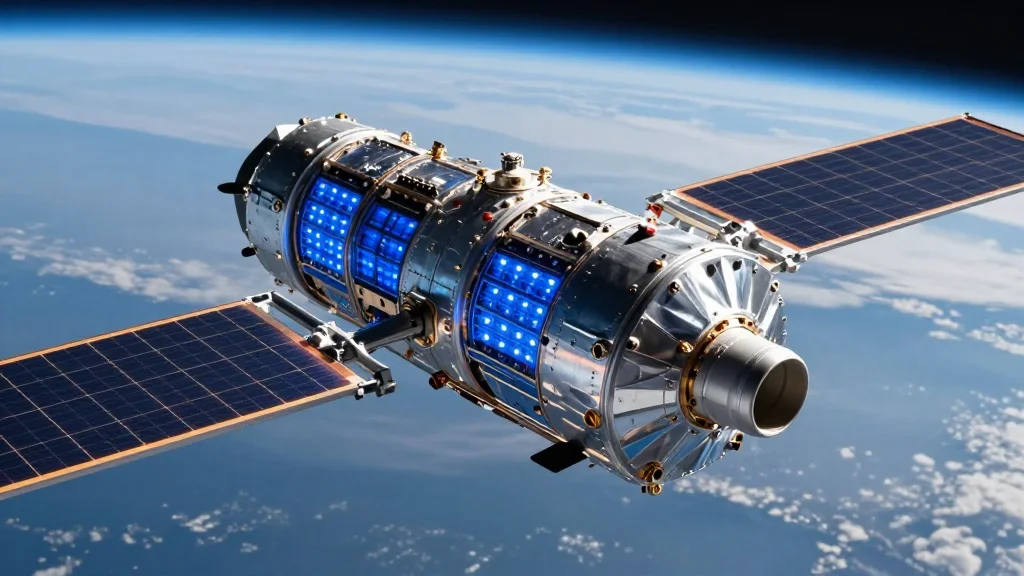
Elon Musk Labels China's $8.4 B Orbital Data Center Push "Interesting"

Companies Mentioned
Why It Matters
Orbital data centers could redefine the economics of AI training by moving compute off‑planet, where solar power is abundant and cooling is free. If China secures a lead, it may tilt the global AI balance toward Beijing, affecting everything from national security to commercial AI services. For the United States, the challenge is to protect its leadership in high‑performance computing while navigating the regulatory and diplomatic complexities of space‑based infrastructure. The race also highlights a broader shift in the space economy: hardware and services that once served only communications or Earth observation are now being repurposed for data processing. This convergence of AI and space technology is likely to spawn new business models, attract venture capital, and reshape supply chains for semiconductors, launch vehicles, and satellite components.
Key Takeaways
- •Elon Musk replied "Interesting" to China's $8.4 billion credit line for orbital data centers.
- •Orbital Chenguang aims for a gigawatt‑scale space data center by 2035, using sun‑synchronous satellites at 700‑800 km altitude.
- •Google CEO Sundar Pichai responded "Space FTW!" indicating industry interest in orbital compute.
- •China filed with the ITU for spectrum rights covering two constellations of ~200,000 satellites.
- •Technical hurdles include launch costs, radiation hardening, thermal management, and high‑speed downlink reliability.
Pulse Analysis
The Chinese investment marks the first large‑scale, state‑backed financial commitment to orbital compute, moving the concept from speculative research to a funded program with a clear timeline. Historically, breakthroughs in space‑based services—such as GPS and satellite communications—were driven by government funding before commercial markets matured. The $8.4 billion line suggests China is attempting to replicate that model for AI, leveraging its deep pockets to outpace private competitors.
For the United States, the response will likely be a mix of accelerated private investment and strategic government support. SpaceX’s reusable launch architecture already reduces per‑kilogram costs, but scaling to a gigawatt constellation will require new manufacturing pipelines and possibly government‑backed subsidies similar to the U.S. Space Development Agency’s recent initiatives. The competitive pressure could also spur policy discussions about export controls on high‑performance computing hardware destined for orbit, echoing past debates over satellite launch licensing.
In the longer term, the winner of the orbital compute race could command a decisive edge in AI‑driven sectors ranging from autonomous weapons to climate forecasting. The ability to run massive models in space, insulated from terrestrial power grid constraints, would lower operational costs and increase resilience against cyber‑physical attacks. As nations and corporations scramble to secure orbital bandwidth and launch slots, we may see a new layer of geopolitics emerge—one where orbital real estate becomes as contested as sea lanes and airspace today.
Elon Musk labels China's $8.4 B orbital data center push "Interesting"
Comments
Want to join the conversation?
Loading comments...