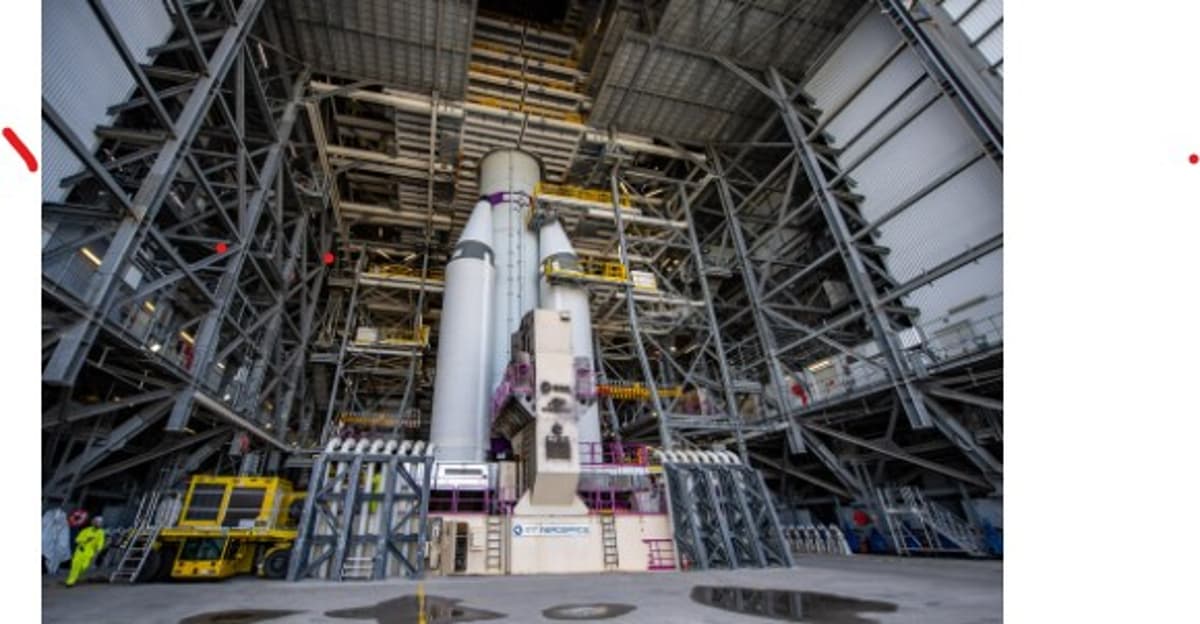
ESA Plans Next Ariane 6 Launch For 17th June
Companies Mentioned

Why It Matters
The enhanced booster configuration raises Ariane 6’s payload capacity, strengthening Europe’s competitive stance in the growing commercial launch market and supporting Amazon’s effort to expand global satellite internet coverage.
Key Takeaways
- •Ariane 6 launch scheduled for 17 June 2026 from French Guiana
- •Mission VA269 will deploy 36 Amazon Leo satellites
- •First Ariane 6 flight using four P160C solid boosters
- •Each P160C adds ~14 tonnes of propellant over P120C
- •European collaboration spans 13 nations; parts built in Italy, France, Norway
Pulse Analysis
Ariane 6’s upcoming flight on 17 June represents a pivotal step in Europe’s launch vehicle evolution. The integration of four P160C solid‑propellant boosters, each carrying an additional 14 tonnes of fuel, pushes the rocket’s thrust envelope beyond its initial configuration. This upgrade not only improves payload margins for heavy‑lift missions but also validates the modular architecture that Ariane 6 was designed around, allowing rapid adaptation to diverse customer needs. By demonstrating the new booster cluster, ESA and ArianeGroup signal readiness for more demanding missions, from deep‑space probes to large constellations.
The VA269 mission will insert 36 satellites into orbit for Amazon’s Leo broadband network, the third batch the company has launched on Ariane 6. Leo aims to provide low‑latency, high‑throughput internet to underserved regions, directly challenging rivals such as SpaceX’s Starlink and OneWeb. Each satellite adds capacity to a constellation that seeks to deliver gigabit‑class speeds worldwide, a critical component of Amazon’s broader cloud and e‑commerce strategy. The successful deployment will reinforce confidence among commercial operators that European launch services can reliably support large‑scale, time‑critical deployments.
Beyond the immediate payload, the launch showcases a pan‑European supply chain that spans 13 nations. Europropulsion’s P160C motor combines Italian structural expertise, a French‑manufactured nozzle, and a Norwegian igniter, illustrating the depth of Europe’s aerospace ecosystem. This collaborative model not only spreads economic benefits across the continent but also reduces reliance on external suppliers. As the market tightens with new entrants and cost pressures, Europe’s ability to field a more powerful, flexible launcher positions it to retain a meaningful share of the global launch market, especially for customers seeking a non‑American alternative.
ESA Plans Next Ariane 6 Launch For 17th June
Comments
Want to join the conversation?
Loading comments...