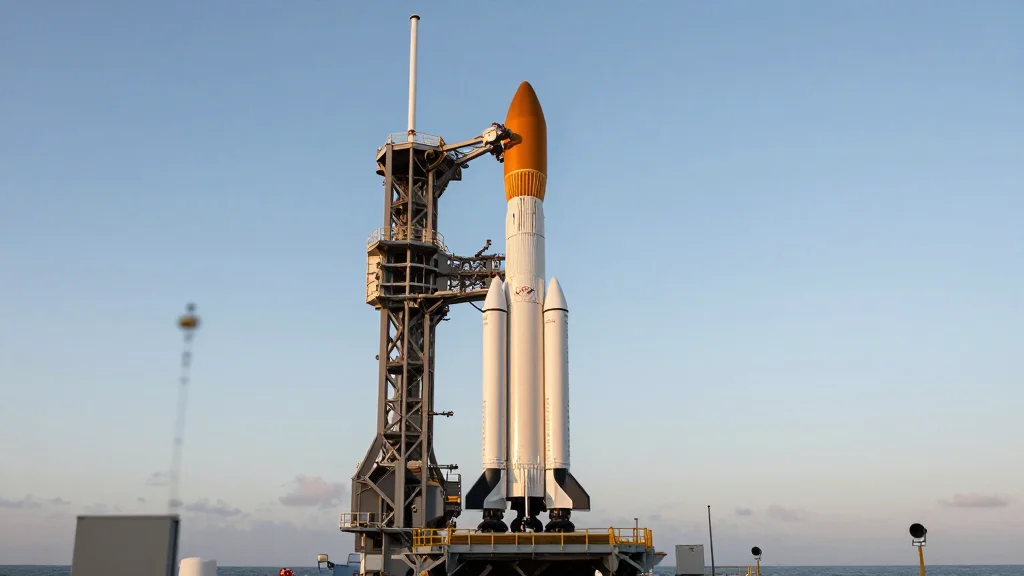
Falcon Heavy Returns, Lifts ViaSat‑3 F3 Broadband Satellite Into 22,000‑mile Orbit

Companies Mentioned

Why It Matters
The return of Falcon Heavy restores a critical heavy‑lift option for large geostationary satellites, a segment that has been underserved since the retirement of legacy rockets. By delivering a terabit‑scale broadband satellite, the mission advances the goal of closing the digital divide in the Asia‑Pacific, where terrestrial infrastructure remains sparse. Moreover, the launch underscores the competitive tension between geostationary and low‑Earth‑orbit broadband strategies, shaping how governments and enterprises allocate satellite bandwidth. For the launch ecosystem, the successful recovery of all side boosters demonstrates that reusability can be extended to the most powerful rockets, potentially lowering the cost barrier for future heavy‑payload missions. This could influence procurement decisions by defense agencies and commercial operators, who may now consider Falcon Heavy alongside emerging heavy‑lift contenders for next‑generation space assets.
Key Takeaways
- •Falcon Heavy launched from KSC LC‑39A on April 27, 2026, after an 18‑month hiatus.
- •ViaSat‑3 F3 offers >1 Tb/s throughput, built on Boeing’s 702MP+ platform.
- •All three side boosters landed successfully; payload reached a 22,000‑mile orbit.
- •ViaSat expects the satellite to be fully operational by end of summer 2026.
- •Launch reaffirms heavy‑lift reusability, challenging upcoming rockets like Vulcan Centaur and New Glenn.
Pulse Analysis
SpaceX’s decision to reactivate Falcon Heavy at this juncture reflects a strategic pivot toward high‑value, high‑margin contracts that cannot be serviced by medium‑lift vehicles. The ViaSat‑3 F3 payload, with its terabit‑scale capacity, is a textbook example of a mission that justifies the expense of a heavy‑lift launch: the satellite’s mass and power requirements exceed the capabilities of Falcon 9, while the need for a geostationary slot demands a precise insertion that Falcon Heavy can deliver.
From a market perspective, the launch rebalances the competitive dynamics between geostationary (GEO) and low‑Earth‑orbit (LEO) broadband providers. While LEO constellations promise low latency, GEO platforms like ViaSat‑3 F3 excel in coverage continuity and service reliability for niche sectors such as aviation and maritime. The success of this mission may encourage other operators to invest in next‑generation GEO satellites, potentially slowing the rush toward LEO dominance.
Finally, the operational data from ViaSat‑3 F3 will serve as a benchmark for future high‑throughput GEO satellites. If the satellite meets its >1 Tb/s target, it could catalyze a wave of similar high‑capacity platforms, prompting launch providers to refine their heavy‑lift offerings. In the short term, the industry will watch closely for the satellite’s performance metrics and the next Falcon Heavy manifest, which could include classified defense payloads that further cement the rocket’s strategic relevance.
Falcon Heavy Returns, Lifts ViaSat‑3 F3 Broadband Satellite into 22,000‑mile Orbit
Comments
Want to join the conversation?
Loading comments...