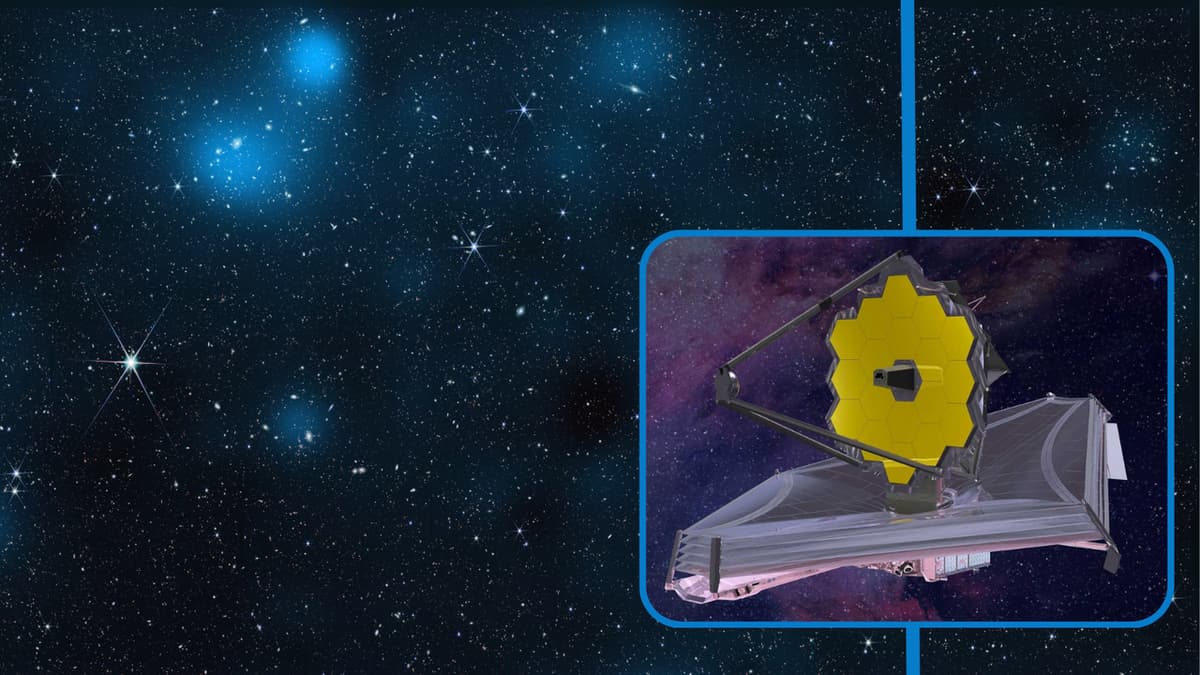
James Webb Space Telescope's View of 800,000 Galaxies Paints a Detailed Picture of Dark Matter
•February 5, 2026
0
Companies Mentioned

Astronomy

Newsweek

New Scientist

ZME Science

All About Space

Elsevier

Physics World
European Journal of Physics

X (formerly Twitter)
Why It Matters
The map delivers an unprecedented view of dark‑matter distribution, sharpening models of galaxy evolution and demonstrating JWST’s transformative power for cosmology.
Key Takeaways
- •JWST mapped dark matter across 800,000 galaxies via weak lensing.
- •Survey covers area 2.5 times full Moon in Sextans.
- •255 hours of NIRCam data produced ten‑times galaxy density.
- •Map exceeds Hubble's resolution, doubling galaxy count.
- •Findings refine models of cosmic structure and dark matter role.
Pulse Analysis
The James Webb Space Telescope’s recent dark‑matter survey showcases how infrared sensitivity and high‑resolution imaging can turn the invisible into a measurable landscape. By exploiting weak gravitational lensing—subtle distortions in background galaxy shapes—JWST traced the gravitational imprint of dark matter across a field equivalent to 2.5 full Moons. This approach builds on decades of optical surveys but pushes the frontier by capturing ten times more galaxies than ground‑based instruments and twice the detail of the Hubble‑based map, offering a richer statistical foundation for cosmological analysis.
Beyond the visual triumph, the new map carries profound scientific weight. Dark matter’s distribution governs how galaxies cluster and evolve, so a high‑fidelity map sharpens constraints on theoretical models, from cold dark‑matter scenarios to alternative gravity theories. The integration of NIRCam and MIRI data also refines distance estimates, reducing uncertainties that have long hampered large‑scale structure studies. Coupled with the broader COSMOS effort—leveraging data from fifteen observatories—the JWST findings provide a multi‑wavelength cross‑check that strengthens confidence in derived mass‑density fields.
Looking ahead, this breakthrough sets a benchmark for upcoming surveys such as Euclid and the Vera C. Rubin Observatory, which will rely on JWST‑validated techniques to interpret their own lensing data. Moreover, the detailed dark‑matter map can guide particle‑physics experiments by pinpointing regions where dark‑matter density peaks, informing indirect detection strategies. In essence, JWST is not only expanding our cosmic map but also tightening the bridge between observational astronomy and fundamental physics, cementing its role as a cornerstone of 21st‑century science.
James Webb Space Telescope's view of 800,000 galaxies paints a detailed picture of dark matter
0
Comments
Want to join the conversation?
Loading comments...