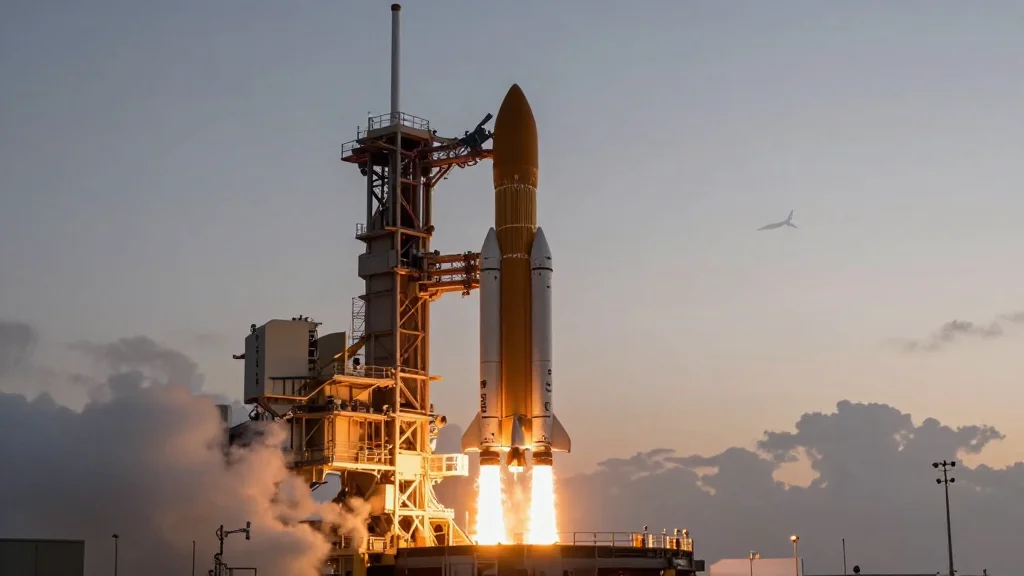
NASA Science, Cargo Launch on 34th SpaceX Resupply Mission to Station
Companies Mentioned
Why It Matters
The mission sustains the ISS crew’s research pipeline and validates commercial low‑Earth‑orbit logistics, a cornerstone for NASA’s Artemis lunar gateway and eventual Mars ambitions.
Key Takeaways
- •Dragon carries ~6,500 lb of cargo and scientific payloads.
- •Experiments test bone scaffolds, blood cell changes, and microgravity simulators.
- •Charged‑particle instrument will improve space weather forecasting for power grids.
- •Resupply contract reinforces NASA‑SpaceX partnership for Artemis and beyond.
Pulse Analysis
The launch of SpaceX’s 34th Commercial Resupply Services (CRS) flight marks another milestone in NASA’s transition to a commercially driven logistics model. By leveraging the Falcon 9’s proven reusability, the agency reduces launch costs while maintaining a reliable cadence of deliveries to the International Space Station. The CRS contract, now in its third decade, has created a competitive market that attracts new providers and spurs innovation in payload integration, autonomous docking, and rapid turnaround. This private‑sector backbone not only keeps the ISS operational but also frees NASA resources for deep‑space exploration.
Beyond food and spare parts, Dragon’s manifest includes a suite of high‑impact experiments. A wood‑based bone scaffold aims to mimic human osteogenesis, potentially accelerating treatments for osteoporosis and fracture recovery. Parallel studies will compare Earth‑based microgravity simulators with actual orbital conditions, refining ground‑test fidelity for future missions. Hematology researchers will monitor red‑blood‑cell dynamics and spleen function, addressing the anemia that astronauts routinely face. A new charged‑particle detector will feed space‑weather models, safeguarding satellite constellations and terrestrial power grids, while an Earth‑Moon reflectance instrument sharpens climate‑monitoring algorithms.
The CRS payloads also serve as a proving ground for technologies slated for NASA’s Artemis program and eventual Mars ventures. Data on bone regeneration, blood health, and radiation exposure directly inform habitat design and crew‑health protocols for the lunar gateway and long‑duration surface stays. Moreover, the sustained flow of commercial cargo underscores the emerging low‑Earth‑orbit economy, where private firms can offer services ranging from satellite servicing to in‑orbit manufacturing. As the ISS approaches its retirement window, the reliability of missions like CRS‑34 will be critical to preserving scientific continuity and commercial momentum.
NASA Science, Cargo Launch on 34th SpaceX Resupply Mission to Station
Comments
Want to join the conversation?
Loading comments...