Companies Mentioned


Why It Matters
By turning the oceans into flexible, high‑performance spaceports, the industry can sustain the launch cadence required for mega‑constellation deployment and reduce reliance on congested terrestrial sites. This shift reshapes cost structures, safety considerations, and geopolitical dynamics in the commercial space sector.
Key Takeaways
- •Ocean platforms add 17‑25% payload to GEO launches
- •Mobile sea ports alleviate land spaceport congestion
- •Autonomous drone ships enable routine booster recovery
- •High maintenance costs demand high launch cadence
- •Regulatory and environmental challenges still unresolved
Pulse Analysis
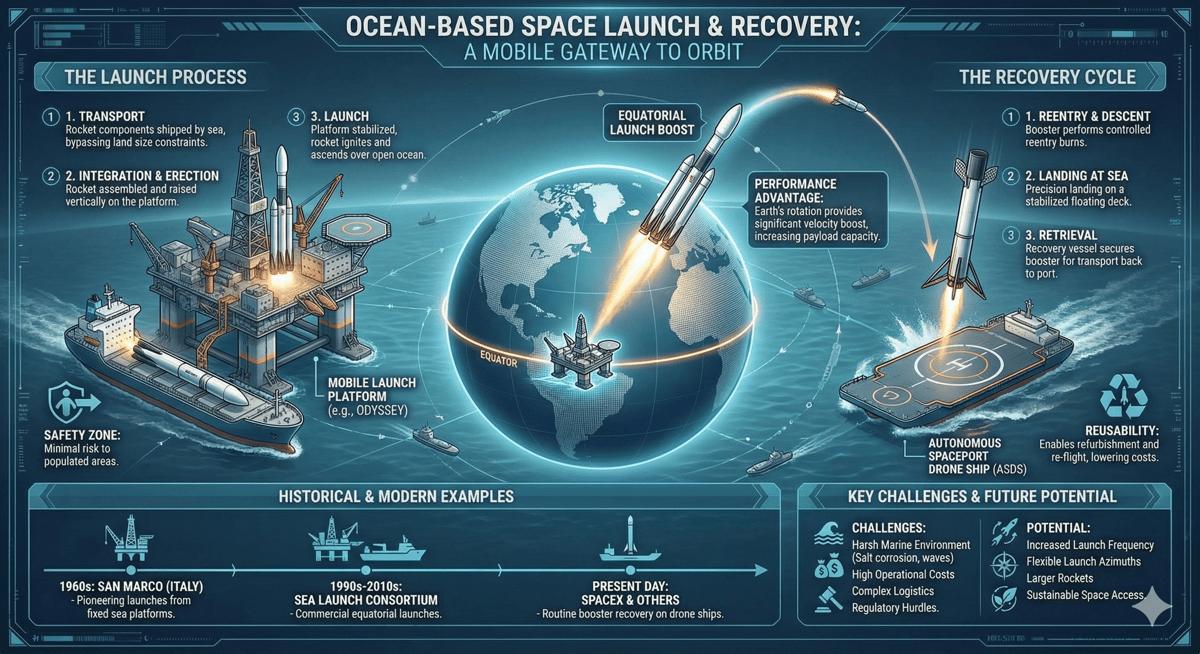
The move toward ocean‑based spaceflight reflects a broader market pressure: launch demand is outpacing the capacity of traditional launch complexes. Equatorial sea platforms exploit Earth’s rotational speed, delivering a natural velocity boost that translates into significant payload gains for geostationary missions. This performance edge, combined with the ability to position vessels anywhere on the globe, gives operators unprecedented flexibility to serve niche orbital inclinations and rapid‑response customers, a competitive advantage that land‑locked sites cannot match.
Technologically, the evolution has progressed from the costly, semi‑submersible rigs of the original Sea Launch to the lean, GPS‑guided drone ships that now recover Falcon boosters. Companies such as SpaceX, Blue Origin, and Rocket Lab have demonstrated that autonomous maritime platforms can reliably capture high‑energy stages, dramatically reducing refurbishment cycles and launch costs. Meanwhile, emerging entrants are targeting the small‑to‑medium launch market with converted barges and purpose‑built semi‑submersibles, creating a layered ecosystem where integrated recovery firms coexist with launch‑as‑a‑service providers.
Despite these advances, the ocean environment imposes harsh engineering and regulatory challenges. Salt‑induced corrosion, unpredictable weather, and the need for robust station‑keeping drive up operational expenditures, often exceeding $30 million annually per platform. Additionally, compliance with the Outer Space Treaty, UNCLOS, and national licensing frameworks adds legal complexity, especially regarding autonomous vessels and marine environmental impact. Continued progress will hinge on breakthroughs in corrosion‑resistant materials, AI‑driven ship autonomy, and the establishment of an international regulatory consensus that balances commercial ambition with ecological stewardship.
Ocean-Based Space Launch and Recovery
0
Comments
Want to join the conversation?
Loading comments...