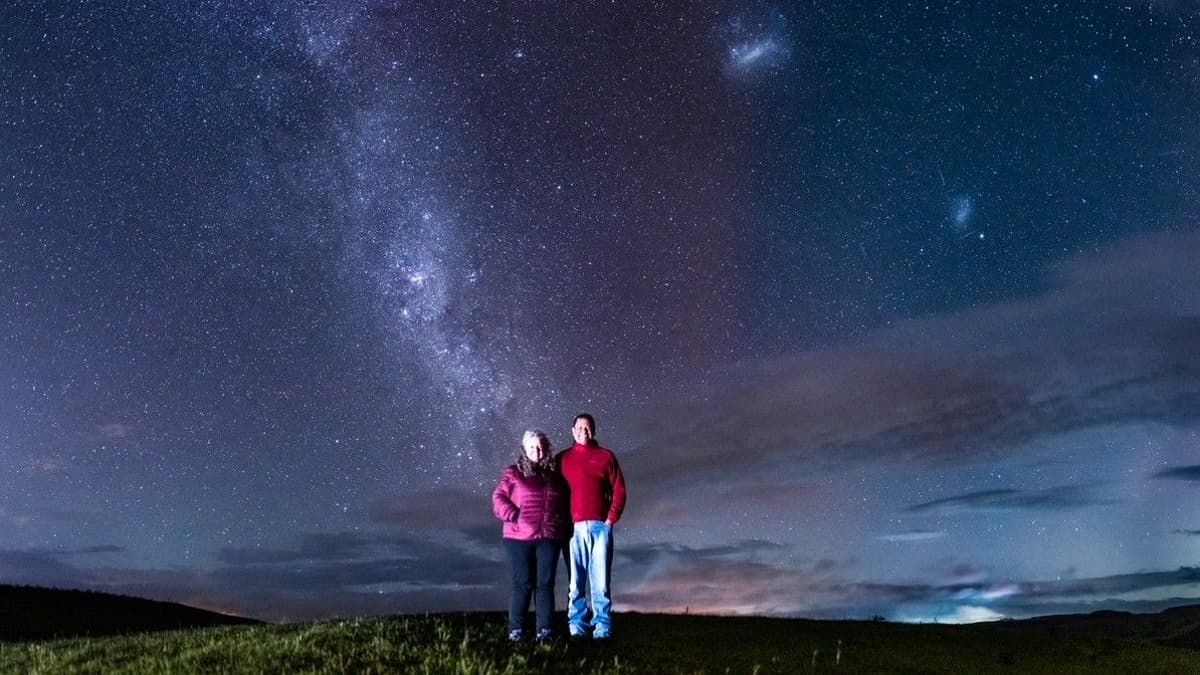
Photographer Captures Rare Aurora over Brazil During Intense Geomagnetic Storm (Photo)
•February 4, 2026
0
Companies Mentioned


Why It Matters
The sighting demonstrates that extreme space‑weather events can reach regions previously considered safe, prompting renewed focus on forecasting and protecting satellite and communication infrastructure. It also fuels public interest in auroral tourism at unexpected latitudes.
Key Takeaways
- •Jan 19 geomagnetic storm produced aurora visible in southern Brazil
- •Photographer Egon Filter captured faint purple‑red glow in Cambará
- •Event occurred within South Atlantic Anomaly, a weak magnetic region
- •Scientists label phenomenon as diffuse equatorial aurora, not SAR arc
- •Low‑latitude auroras indicate rising solar activity and space‑weather threats
Pulse Analysis
Geomagnetic storms, driven by intense solar eruptions, typically illuminate skies near Earth’s magnetic poles where charged particles funnel along field lines. When the Sun releases a coronal mass ejection, the resulting plasma cloud can compress the magnetosphere, expanding the auroral oval toward lower latitudes. The January 19 event was one of the strongest of the current solar cycle, pushing the auroral boundary far enough south to be seen over Brazil, a region that rarely experiences such displays. This rare occurrence highlights how solar dynamics can temporarily rewrite the geographic limits of space‑weather phenomena.
The South Atlantic Anomaly (SAA) plays a pivotal role in this low‑latitude spectacle. The SAA is an area where Earth’s magnetic field is unusually weak, allowing higher‑energy particles to penetrate deeper into the atmosphere. Researchers suggest that the faint, diffuse glow observed was a form of equatorial aurora generated within the SAA, rather than the more common stable auroral red (SAR) arcs that hug the horizon. This distinction matters because diffuse equatorial auroras indicate a different particle acceleration mechanism, offering scientists a natural laboratory to study magnetospheric dynamics under extreme conditions.
For industry and policymakers, the Brazilian aurora serves as a reminder that space‑weather risks are not confined to polar regions. Satellite operators, aviation routes, and power grids at mid‑latitudes must account for heightened radiation exposure and geomagnetically induced currents during such storms. As solar activity ramps up toward the next solar maximum, forecasting models will need to incorporate anomalies like the SAA to predict where and when similar events might occur. The public’s fascination with unexpected auroral sightings also opens new opportunities for astrotourism, expanding economic prospects for regions previously outside the aurora‑watching map.
Photographer captures rare aurora over Brazil during intense geomagnetic storm (photo)
0
Comments
Want to join the conversation?
Loading comments...