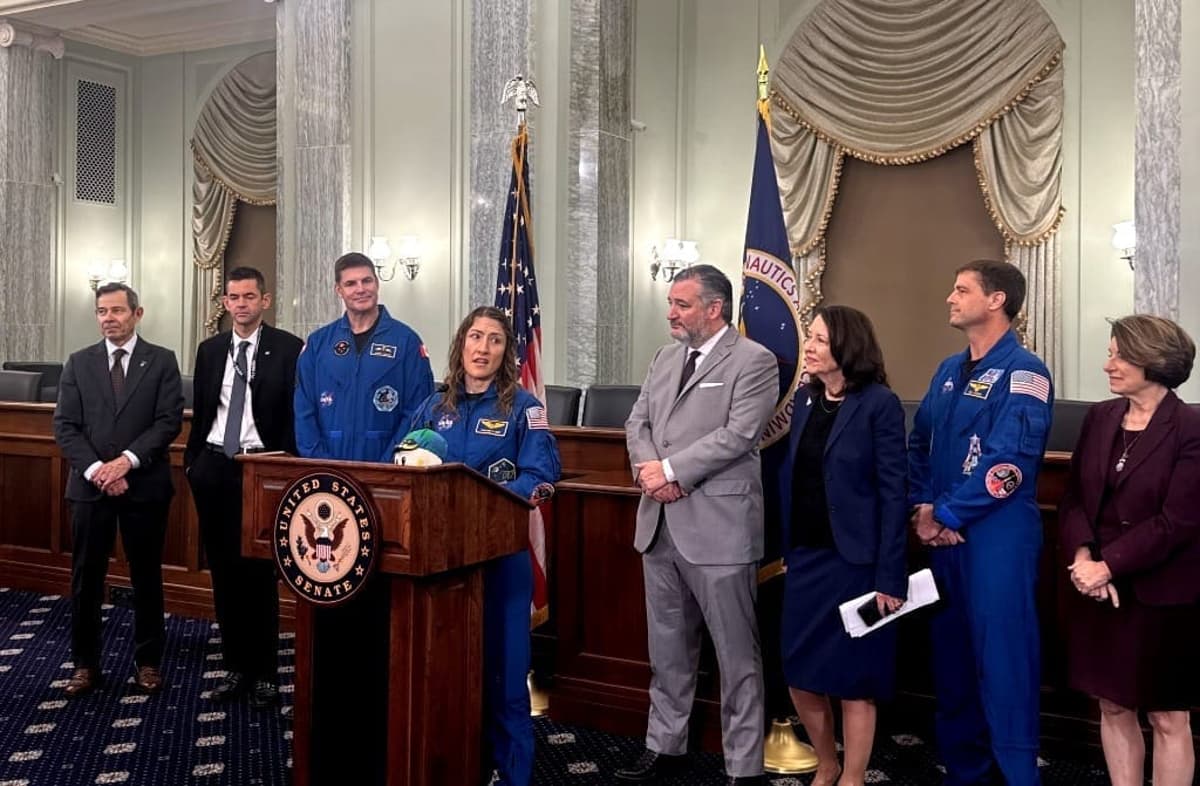
Senators Affirm Need For U.S. Dominance In Space Exploration
Companies Mentioned
Why It Matters
Sustained federal funding and regulatory reforms ensure the United States retains a competitive edge in the global space race, while unlocking commercial growth and technological innovation.
Key Takeaways
- •NASA Reauthorization Act 2026 funds Artemis lunar missions.
- •Senators cite Artemis II as launchpad for Mars ambitions.
- •Over 2,700 U.S. companies support NASA’s crewed missions.
- •Satellite Streamlining Act aims to speed next‑gen space communications.
- •Artemis IV will test SpaceX and Amazon lunar infrastructure.
Pulse Analysis
The passage of the NASA Reauthorization Act of 2026 marks a decisive congressional commitment to keep the United States at the forefront of space exploration. By earmarking billions of dollars for Artemis lunar operations and future deep‑space endeavors, the legislation signals a long‑term strategy to outpace rivals such as China and Russia. This policy continuity not only safeguards critical research and development pipelines but also reinforces America’s geopolitical standing, as space increasingly becomes a domain of national security and economic influence.
Commercial participation has evolved from peripheral support to a central pillar of NASA’s mission architecture. The Senate’s acknowledgment of more than 2,700 U.S. firms underscores a vibrant ecosystem that supplies propulsion, habitats, and communications technology. Recent optical downlink tests achieving 260 Mbps demonstrate how private innovation can boost data capacity for crewed missions, while the Satellite and Telecommunications Streamlining Act promises faster FCC licensing for next‑generation constellations. Together, these moves lower barriers for companies like SpaceX and Amazon to deliver lunar logistics, broadband, and navigation services.
Looking ahead, Artemis IV in 2028 will serve as a proving ground for sustained lunar presence and a springboard toward Mars. Successful integration of commercial hardware and high‑frequency Ka‑band or optical links will validate the infrastructure needed for long‑duration exploration. For investors and industry stakeholders, the combined legislative support and private‑sector momentum suggest a robust pipeline of contracts, technology spin‑offs, and new market opportunities that could reshape the aerospace landscape over the next decade.
Senators Affirm Need For U.S. Dominance In Space Exploration
Comments
Want to join the conversation?
Loading comments...