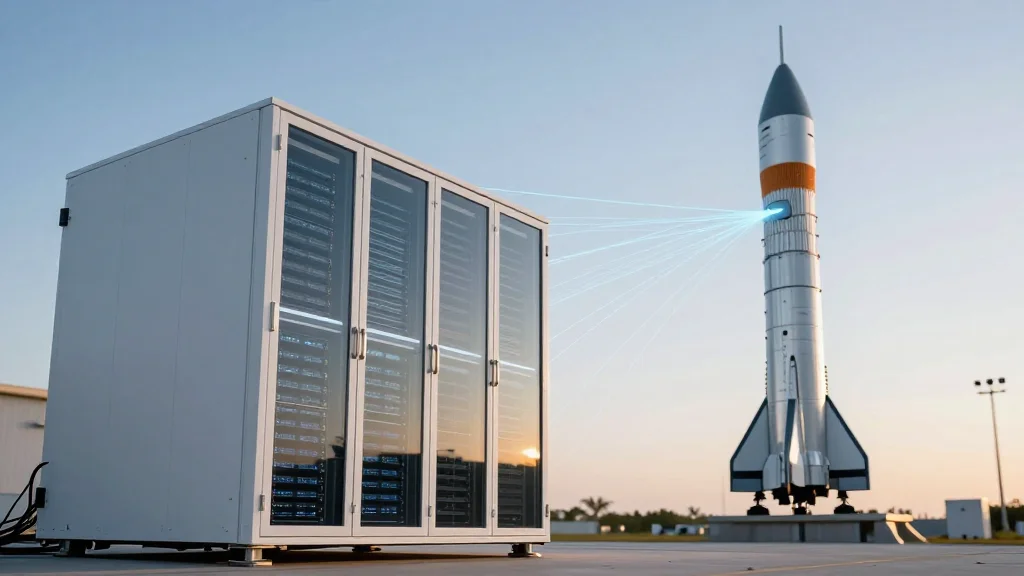
SpaceX's xAI Pursues New AI‑Compute Clients After $45 B Anthropic Deal



Why It Matters
xAI's push into AI‑compute services marks a strategic diversification for SpaceX, a company traditionally reliant on launch contracts and Starlink broadband revenue. By leveraging its massive terrestrial data centers and a future constellation of orbital compute nodes, SpaceX could capture a slice of the $200 billion AI‑infrastructure market, challenging incumbents like Amazon Web Services, Microsoft Azure, and Google Cloud. The Anthropic deal demonstrates that high‑profile AI firms are willing to pay premium rates for dedicated, high‑bandwidth compute, potentially unlocking a new, recurring‑revenue stream for SpaceX. If xAI can successfully transition from nameplate capacity to fully utilized compute power, it may validate the economic case for space‑based data centers, which promise lower latency for satellite‑generated data and reduced terrestrial energy costs. Conversely, failure to secure additional customers or to activate its installed GPUs could leave the company with under‑utilized assets and strain its balance sheet, especially given the $75 billion capital raise target tied to the upcoming IPO.
Key Takeaways
- •SpaceX's xAI signed a $1.25 bn‑per‑month, three‑year contract with Anthropic for the 300 MW Colossus I data center (~$45 bn total).
- •xAI aims to raise up to $75 bn in its June 12 IPO, the largest capital raise in the sector this year.
- •Infrastructure spending totals $12.7 bn in 2025 and $7.7 bn in Q1 2026, reflecting rapid compute build‑out.
- •Nameplate compute draw reported at 1 GW, but satellite imagery suggests only ~350 MW of cooling capacity is in place.
- •SpaceX plans to launch up to one million orbital data‑center satellites, potentially reshaping AI‑compute economics.
Pulse Analysis
SpaceX's foray into AI‑compute services via xAI is more than a revenue‑diversification play; it is a test of whether the company's core competency—mass‑scale engineering—can be transplanted into the ultra‑competitive cloud market. The Anthropic contract provides a proof point that customers will pay a premium for dedicated, high‑bandwidth compute, but the deal also highlights a key risk: the contract consumes the entire capacity of Colossus I, leaving little room for incremental revenue until new facilities come online. The rapid $20 bn+ spend on infrastructure underscores the capital intensity of the model, and the gap between nameplate and actual power draw suggests that xAI may still be in a "build‑out" phase rather than a profit‑generating one.
The orbital data‑center vision is the most speculative element. While a constellation of million satellites could theoretically deliver compute at the edge of space, the technical challenges—thermal management, power delivery, and latency trade‑offs—are non‑trivial. If xAI can demonstrate even a fraction of the promised capacity, it could create a new tier of AI services optimized for satellite‑derived data, giving SpaceX a unique niche against terrestrial cloud giants. However, the market will likely demand clear utilization metrics before committing to large‑scale leases, making the upcoming IPO a crucial litmus test for investor confidence.
In the short term, the success of xAI hinges on its ability to convert the Anthropic win into a pipeline of similar contracts and to accelerate the activation of its installed GPUs. The company's ability to deliver on its orbital ambitions will determine whether SpaceX can truly become a vertically integrated AI‑compute provider or remain a launch‑focused aerospace firm with a side‑bet in data centers.
SpaceX's xAI Pursues New AI‑Compute Clients After $45 B Anthropic Deal
Comments
Want to join the conversation?
Loading comments...