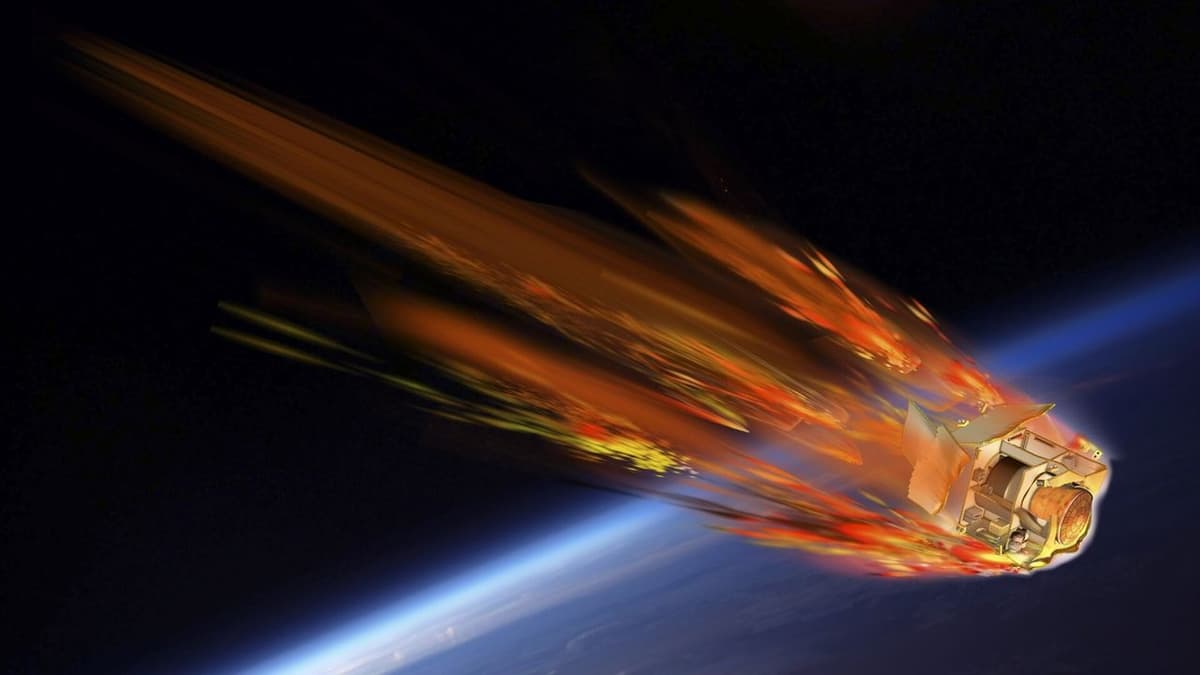
What Actually Happens to a Spacecraft During Its Fiery Last Moments? Here's Why ESA Wants to Find Out
•January 31, 2026
0
Companies Mentioned


Why It Matters
Draco provides the first in‑situ data needed to design satellites that safely burn up, reducing both space‑debris risk and potential atmospheric pollution.
Key Takeaways
- •Draco will re-enter in 2027 with 200 onboard sensors.
- •Data will validate re‑entry models for fully demisable satellites.
- •Mission aims to reduce space debris and atmospheric pollution.
- •Real‑time telemetry transmitted during 20‑minute post‑parachute window.
- •Results could inform design standards and safety regulations.
Pulse Analysis
The European Space Agency’s Destructive Reentry Assessment Container Object, known as Draco, is slated for launch in 2027 to deliberately plunge into Earth’s atmosphere. Carrying roughly 200 temperature, pressure and strain sensors plus four external cameras, the 150‑200 kg capsule will follow a controlled trajectory that ends with a parachute‑assisted splash‑down after about twelve hours in orbit. By capturing real‑time data during the 20‑minute telemetry window, Draco seeks to fill the long‑standing gap between computer simulations and wind‑tunnel tests, providing the empirical evidence needed to refine re‑entry models for future spacecraft.
The mission’s core objective is to support ESA’s ‘Zero Debris’ strategy by proving that satellites can be engineered to fully dematerialise on re‑entry, leaving no hazardous fragments in orbit or on the ground. In‑situ measurements of material ablation, fragment dispersion and emitted gases will illuminate how different alloys and composites behave under extreme heating, and how those by‑products interact with the upper stratosphere. This information is critical for assessing the trade‑off between eliminating ground‑impact risk and potentially increasing atmospheric pollution, a balance that has so far relied on limited laboratory data.
Results from Draco are expected to influence both commercial and governmental satellite programmes, guiding the adoption of ‘design‑for‑demise’ standards that could become regulatory requirements by the early 2030s. Engineers will be able to select materials and structural configurations that guarantee complete burn‑up, while policymakers can use the data to refine debris‑mitigation guidelines and air‑space safety protocols. Moreover, the mission may spark a new class of dedicated re‑entry experiments, turning what was once a rare observational opportunity into a routine part of spacecraft lifecycle planning.
What actually happens to a spacecraft during its fiery last moments? Here's why ESA wants to find out
0
Comments
Want to join the conversation?
Loading comments...