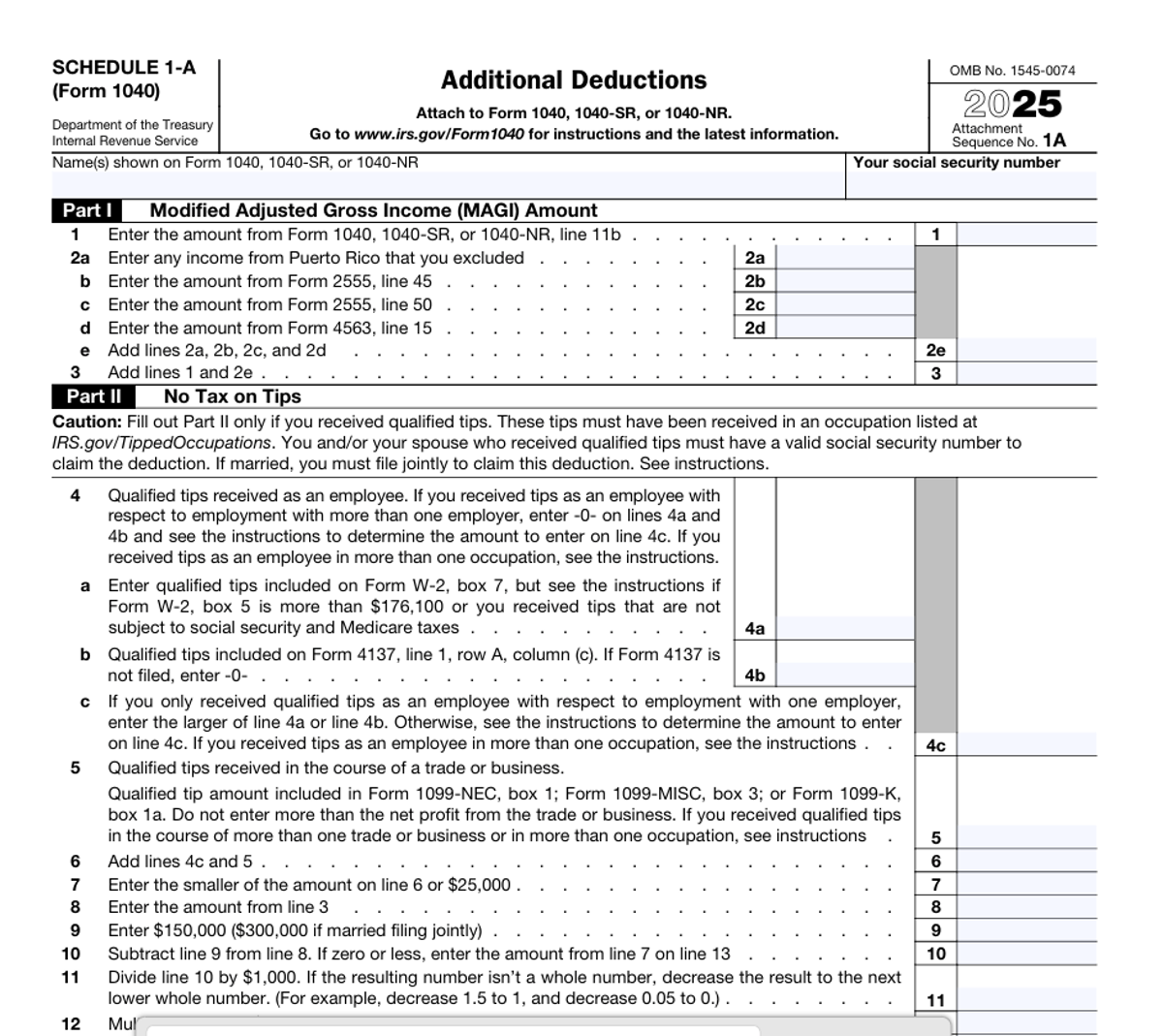
IRS Posts Form for Claiming New Tax Deductions
•March 2, 2026
0
Why It Matters
These new deductions expand tax‑saving opportunities for a broad set of workers and retirees, potentially lowering federal revenue while prompting taxpayers to adjust planning strategies. The income phase‑outs ensure the benefits target middle‑income earners, influencing payroll and retirement advice markets.
Key Takeaways
- •New Schedule 1‑A adds tip, overtime, car loan, senior deductions.
- •Tip deduction caps at $25,000, phased out above $150k MAGI.
- •Overtime deduction up to $12,500, $25,000 joint, income limits apply.
- •Senior citizens can deduct $6,000 each, reduced after $75k MAGI.
- •Deductions claimable with standard or itemized returns.
Pulse Analysis
The Internal Revenue Service’s release of Schedule 1‑A marks the first comprehensive implementation of the One Big Beautiful Bill Act’s 2025 tax incentives. By codifying separate sections for tipped income, overtime pay, passenger‑vehicle loan interest, and senior‑citizen benefits, the IRS provides clearer guidance for both taxpayers and preparers. The new forms replace the September draft and integrate detailed worksheets, occupation lists, and examples that simplify compliance, especially for workers in hospitality, transportation, and senior demographics.
From a planning perspective, the tip deduction—up to $25,000 per individual—offers a sizable reduction for service‑industry earners, but the phase‑out at $150,000 modified AGI (or $300,000 for married couples) limits its reach to middle‑income filers. Overtime compensation enjoys a similar structure, with a $12,500 cap that doubles for joint returns, encouraging employers to document extra hours accurately. The car‑loan interest provision expands deductible expenses beyond traditional mortgage interest, appealing to commuters who finance newer vehicles domestically. Meanwhile, the senior‑citizen enhancement of $6,000 per person (or $12,000 jointly) adds a targeted relief for retirees, though it tapers once MAGI exceeds $75,000, reinforcing progressive tax principles.
Beyond the immediate savings, the IRS’s push for electronic filing and direct‑deposit refunds underscores a broader modernization effort. Automated software will calculate these new deductions, reducing errors and accelerating refunds, which benefits both taxpayers and the Treasury’s processing efficiency. Tax advisors should update client checklists, incorporate the new worksheets, and assess whether standard or itemized filing yields optimal outcomes. As the 2025 filing season approaches, early adoption of Schedule 1‑A will be a differentiator for firms seeking to deliver precise, value‑added advice.
IRS posts form for claiming new tax deductions
0
Comments
Want to join the conversation?
Loading comments...