AI Found Crediting Brand Trademarks To Rivals
Companies Mentioned


Why It Matters
Misattributing trademarks can expose companies to brand dilution, false advertising claims, and regulatory scrutiny, making AI output reliability a critical risk factor for corporate communications.
Key Takeaways
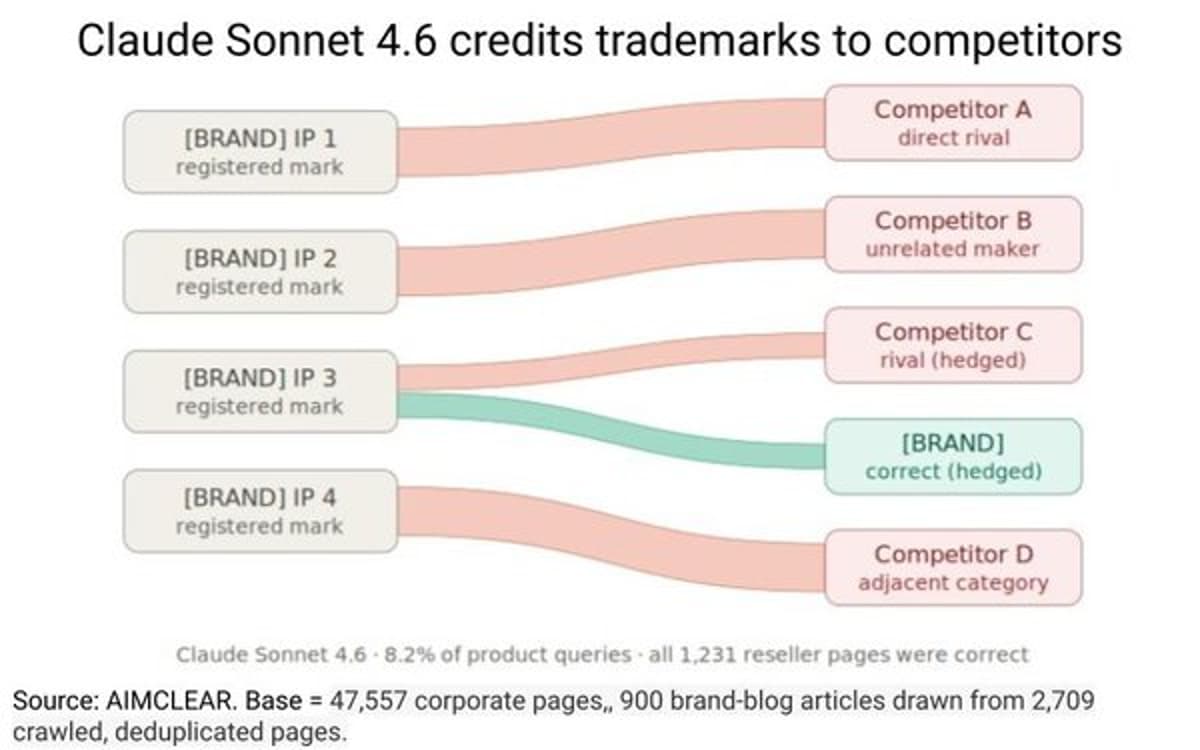
- •Claude Sonnet 4.6 misattributes trademarks in 8.2% of queries
- •Google Gemini 2.5 Pro correctly names brand in 94.9% of tests
- •GPT‑4o omits brand name in 74.2% of responses
- •Perplexity Sonar achieves 97.4% correct brand naming
- •AI misattributions pose legal risk for brand owners
Pulse Analysis
The Aimclear study underscores a growing tension between AI convenience and brand integrity. By crawling roughly 55,000 pages from a brand’s official site, reseller network, and editorial sources, the researchers could isolate where AI models draw their information. Anthropic’s Claude Sonnet 4.6 repeatedly credited rival trademarks, a flaw traced to both noisy training data and insufficient citation mechanisms. In contrast, Google Gemini 2.5 Pro and Perplexity Sonar demonstrated that higher citation rates and stricter source verification can dramatically improve brand attribution accuracy.
For legal departments, the implications are immediate. Misattributed trademarks can trigger false advertising lawsuits, erode trademark protection, and complicate compliance audits. Companies may need to implement AI‑output monitoring tools, enforce stricter prompt engineering, and demand higher citation transparency from vendors. OpenAI’s GPT‑4o, which often defaults to generic descriptions, illustrates how a model’s design choices—favoring brevity over specificity—can inadvertently sideline brand identifiers, increasing exposure to reputational risk.
The broader market signal is clear: AI providers must prioritize brand‑sensitive training pipelines and robust source‑attribution frameworks. As enterprises integrate conversational agents into customer‑facing channels, the cost of erroneous brand references could outweigh the efficiency gains. Stakeholders should watch for emerging standards around AI‑generated content verification and consider contractual clauses that hold vendors accountable for trademark misrepresentation. The study serves as a wake‑up call that reliable AI output is not just a technical challenge but a strategic business imperative.
AI Found Crediting Brand Trademarks To Rivals
Comments
Want to join the conversation?
Loading comments...