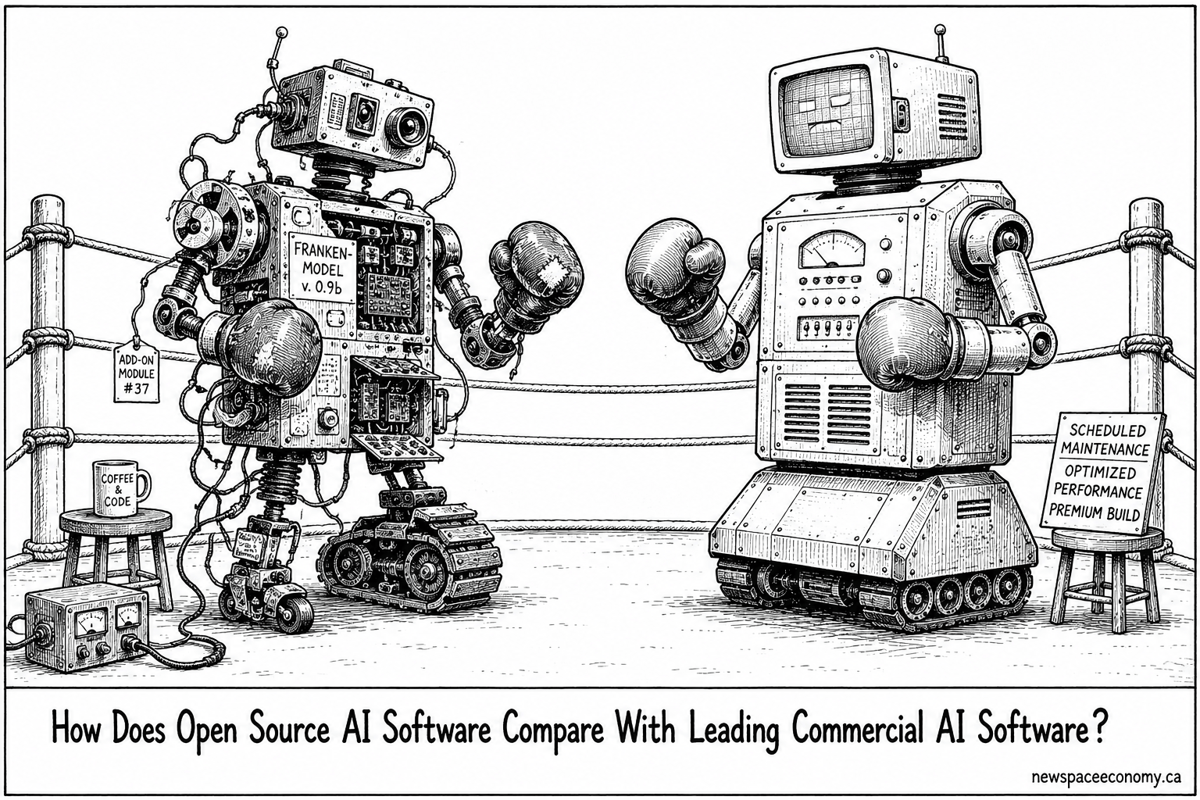
How Does Open Source AI Software Compare With Leading Commercial AI Software?
Companies Mentioned



Why It Matters
The choice between open‑source and commercial AI directly impacts total cost of ownership, data sovereignty, and speed to market, making it a strategic procurement decision for any enterprise deploying AI at scale.
Key Takeaways
- •Open‑source AI offers deployment control, lower per‑request cost at scale
- •Commercial AI provides managed security, compliance, and frontier model performance
- •Hybrid architectures route sensitive data to private models and premium APIs
- •Training‑data transparency remains limited, raising legal and bias concerns
- •Cloud platforms now host open and proprietary models, blurring the line
Pulse Analysis
The 2024 Open Source AI Definition has turned a loosely‑used buzzword into a concrete legal framework, distinguishing true open‑source projects from merely open‑weight releases. This clarity has accelerated adoption of tools like PyTorch, Hugging Face Transformers, vLLM, and Ollama, enabling organizations to build end‑to‑end pipelines without vendor lock‑in. At the same time, the rapid emergence of open‑weight foundation models—Llama 4, Mistral, Qwen, and DeepSeek—has narrowed the performance gap with closed‑source giants, giving developers viable alternatives for internal workloads and specialized fine‑tuning.
Nevertheless, the trade‑off remains stark. Open‑source stacks grant full control over data locality, model updates, and cost per inference, but they demand significant engineering resources for scaling, security hardening, and compliance monitoring. Commercial offerings bundle these operational burdens into subscription or API fees, delivering immediate access to the latest multimodal capabilities, robust SLAs, and integrated governance tools. Enterprises are therefore gravitating toward hybrid architectures: private deployments handle high‑volume, sensitive tasks, while premium APIs are invoked for complex reasoning, coding assistance, or creative generation where latency and quality outweigh cost concerns.
Market dynamics are shifting further as major cloud vendors—Amazon Bedrock, Microsoft Foundry, Google Vertex AI—now expose both open and proprietary models within a single managed environment. This convergence simplifies procurement, allowing buyers to route requests based on risk, cost, and performance criteria without maintaining separate infrastructure. However, it also introduces new governance challenges around model provenance, copyright exposure, and evolving regulatory expectations such as the EU AI Act. Companies that embed transparent evaluation, clear licensing documentation, and flexible routing logic will be best positioned to leverage the full spectrum of AI options while mitigating legal and operational risk.
How Does Open Source AI Software Compare With Leading Commercial AI Software?
Comments
Want to join the conversation?
Loading comments...