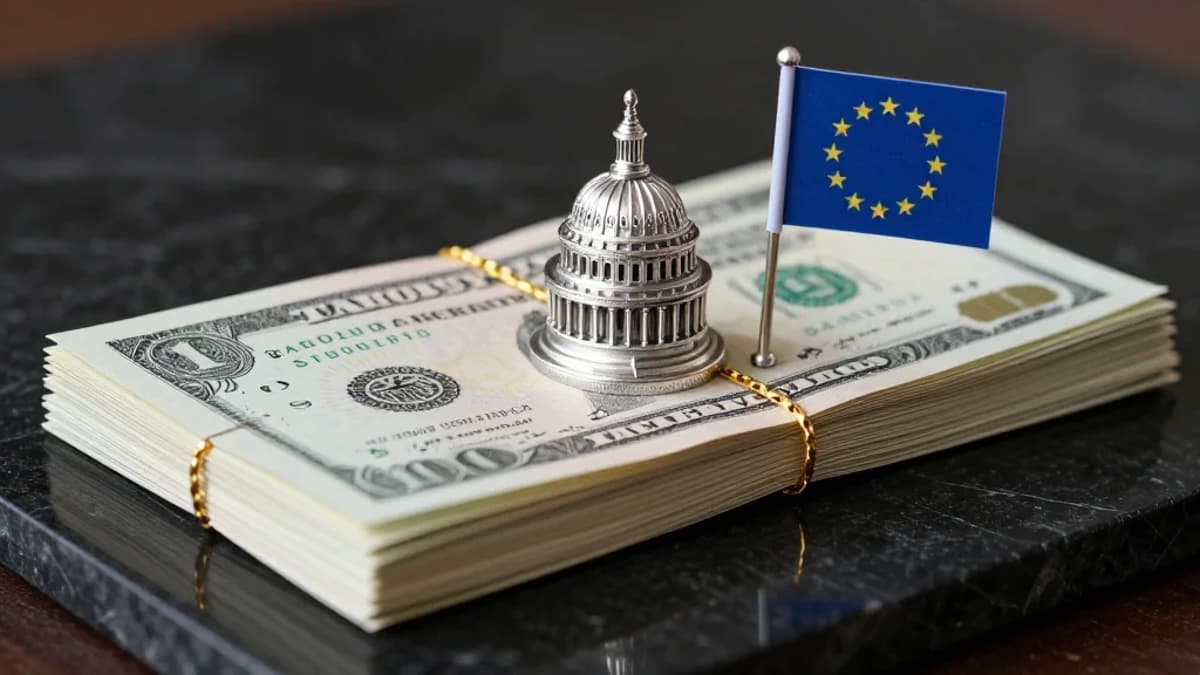
A large-scale Treasury sell‑off would raise borrowing costs globally and destabilize sovereign finances, but mutual reliance between the U.S. and Europe curtails the risk, reshaping how investors view U.S. debt as a strategic asset.
U.S. Treasury securities have long been the cornerstone of the global financial system, prized for their liquidity and perceived safety. Europe’s $8 trillion exposure reflects decades of confidence, but recent diplomatic spats—most notably President Trump’s Greenland overtures—have prompted investors like Denmark’s AkademikerPension to reconsider their positions. Such moves signal a broader reassessment of political risk embedded in sovereign debt, prompting market participants to monitor policy signals closely.
The prospect of a coordinated European sell‑off raises alarm bells for policymakers. A rapid fire sale would push Treasury yields higher, increasing borrowing costs for both foreign governments and U.S. taxpayers. Elevated yields could strain sovereign debt markets, especially for nations with large exposure to U.S. bonds, potentially triggering a cascade of credit downgrades. Yet analysts stress that fragmented ownership across banks, pension funds, and sovereign wealth funds, combined with the deep trade interdependence—$1.5 trillion in U.S.–EU trade last year—makes a deliberate weaponization of Treasuries structurally improbable.
Strategically, the episode accelerates a diversification trend already underway. China’s Treasury holdings have fallen from $1.2 trillion in 2015 to about $700 billion, while the nation bolsters gold reserves to hedge against dollar volatility. European investors are similarly exploring alternative assets, from euro‑denominated bonds to emerging‑market securities. As geopolitical friction persists, the market’s focus will shift from viewing U.S. debt solely as a safe haven to treating it as a negotiable instrument within a broader, more resilient portfolio framework.
President Donald Trump's belligerent approach to many foreign governments has stirred discussion around a previously unthinkable scenario: What if U.S. bonds could be turned into bargaining chips?
The first sign of a revolt against U.S. bonds sprung out of Denmark last month. Amid Trump's demands to grab ahold of Greenland, Danish pension fund AkademikerPension dumped $100 million in Treasuries, citing the U.S.' worsening national debt. It later said the decision was unrelated to the president's desire to annex Greenland, though the timing of the move raised eyebrows among financiers and the Trump administration.
European investors hold $8 trillion in U.S. Treasury debt, a sign of their longstanding confidence in U.S. financial assets. That amounts to a quarter of the U.S. Treasury's $34 trillion market.
Throughout Europe, though, the assumption that the U.S. is a reliable economic and security partner is quickly giving way to a new reality under the second Trump administration — one where the U.S. is viewed as a rival, not an ally.
Deutsche Bank raised the possibility of an E.U. sell‑off, until its CEO Christian Sewing called Treasury Secretary Scott Bessent to distance the bank from the analysis. Still, the step would trigger enormous financial blowback that could roil global markets already grappling with on‑again, off‑again tariffs.
"It's theoretically possible but structurally improbable," Joseph Brusuelas, chief economist for investment firm RSM, told Quartz. "The European countries could very well do this, but it would inherently cause more distortions and damage across the global financial system than any gains that would be yielded from the use of such leverage."
J.P. Morgan analysts called it "the weapon that can't be used."
Treasury bonds are the backbone of the global financial system, underpinned by the dollar's continued dominance. Japan, China, and the U.K. are the three top holders of Treasuries, which are viewed as safe bets to hedge against credit risks at home.
But all have had tensions with the White House at one point or another since Trump entered office. Japan and China are still far off from finalizing a trade agreement. The U.K. lined up behind European allies in defending Greenland's sovereignty from Trump's threats.
"They could certainly do that," said Adam Turnquist, a chief technical strategist at LPL Financial. "Whether they would or not, probably not unless things got really heated."
A J.P. Morgan analysis late last month described the scenario in which a "fire sale" of U.S. bonds quickly goes awry.
Treasury yields spike, translating to higher costs for investors and foreign governments which typically buy the bonds.
Sovereign debt burdens become harder to maintain, causing systemic shocks to nations like France that trade heavily in sovereign debt markets.
However, the threat of mutually‑assured destruction is likely to keep this option at bay, per analysts. The U.S. and E.U. traded $1.5 trillion in total goods and services in 2024, according to government data.
"The worst‑case threats are unlikely to materialize," J.P. Morgan analyst Kriti Gupta said in the late‑January note. "The United States and the E.U. are simply too interdependent, and breaking that relationship would come at too great a cost for both parties."
It's also difficult to coordinate across governments and institutions with conflicting goals and responsibilities to differing stakeholders. Asset managers, banks, and pension funds won't simply dump Treasuries if Brussels gave the order to strengthen its position in trade negotiations.
"Europe’s U.S. debt holdings offer little scope for strategic deployment as they are fragmented across jurisdictions and institutions, and efforts to weaponise them for political purposes would largely backfire," said finance experts Paola Subacchi and Paul van den Noord at the Center for Economic Policy Research in a blog post.
Other nations have already gradually shrunk their Treasury portfolios. Take China. In 2015, it had $1.2 trillion in Treasuries. Beijing's reported holdings now stand at $700 billion and it has shored up its gold reserves, which have surged to nearly $5,000 an ounce.
Comments
Want to join the conversation?
Loading comments...