

The EXACT System To Build a SaaS From 0 to $100M Exit
The video outlines a step‑by‑step framework for turning a SaaS startup into a $100 million exit‑ready company. It begins with a strategic decision—whether to chase a lifestyle business or to design an acquisition‑ready machine from day one. The speaker stresses that buyers purchase the system that generates revenue, not the founder’s personal hustle, and that early choices compound into either a high‑valuation exit or a stagnant venture. In the early phase, founders are urged to bootstrap until they reach roughly $500 k ARR, proving product‑market fit before any outside capital is introduced. The next milestone focuses on mastering unit economics—ARPA, churn, LTV, and CAC—highlighting the rule of thumb that CAC should be about 16 % of LTV (or 50‑75 % of annual contract value). Precise measurement of these metrics determines whether growth can be scaled profitably. The speaker then details a repeatable acquisition engine built on three pillars: outbound account‑based outreach, paid‑media retargeting using the same ABM list, and a weekly flagship piece of content that fuels both channels. He cites examples such as Instantly and Clearstream and drops memorable lines like “a buyer doesn’t pay $100 million for a founder” and “a 10 % funnel improvement cuts CAC by 33 %.” Finally, the roadmap shifts to scaling the organization once ARR hits $10 million. Leadership roles—head of sales, marketing, finance, product, and customer success—must be professionalized so the founder can step back. By institutionalizing these systems, a SaaS company becomes a self‑sustaining asset that commands premium valuations in the market.

How to Scale SaaS Customer Acquisiton With Paid Ads (353% Increase)
The video walks through a B2B SaaS firm that amplified its new‑customer acquisition by 350% over two years using a disciplined paid‑advertising playbook. Ryan Allis, a veteran SaaS founder and coach, frames the case study as proof that paid media...

This Week in SaaS - March 10 - 16, 2026
SaasRise launches an AI Coding Bootcamp on April 15, promising a five‑fold boost in development speed for R&D teams. The week saw massive capital inflows, highlighted by Legora’s $550 M Series D and multiple mid‑stage rounds for AI‑centric SaaS firms. Major M&A...

Why SaaS Firms Should Start Implementing MCP
Model Context Protocol (MCP) is emerging as a standardized bridge that lets AI agents such as Claude, ChatGPT, and Gemini invoke SaaS functionality directly. By wrapping existing REST APIs, MCP creates an AI‑native interaction layer without requiring a full product...

AI Coding Bootcamp Starts April 15
SaasRise is launching an eight‑week online AI Coding Bootcamp on April 15, 2026, aimed at engineers, product managers, and tech leaders. The program teaches an AI‑first, agentic engineering workflow using Claude Code and other leading tools. Participants will build, refactor,...

Copy These Tactics, New Customers Will Flood to Your SaaS
B2B SaaS firms are urged to abandon single‑channel acquisition and adopt a layered, multi‑channel portfolio. The article outlines ten tactics—including retargeting, matched‑audience ads, LinkedIn Thought Leader ads, lookalikes, paid search, high‑volume cold email, LinkedIn outreach, weekly newsletters, and content‑first warming—that...
.png)
SaasRise CEO Mastermind Recaps for the Week of Mar 9 - 12, 2026
SaasRise’s CEO outlines a roadmap for scaling a €2M+ ARR SaaS from a test market into the broader EU, emphasizing a UK‑first entry, strong case studies, and local presence. He stresses an account‑based, multi‑channel approach that educates prospects for months...
.png)
SaasRise Enterprise Mastermind Call Recap Mar 10, 2026
The SaasRise Enterprise Mastermind call highlighted four strategic challenges: centralizing internal meeting knowledge using vector‑database RAG, optimizing Facebook lookalike audience spend, selecting initial European markets for a B2B ad platform, and evaluating overseas acquisition targets. Participants recommended tools such as...
SaasRise Mastermind Recap - Mar 11, 2026
The SaasRise Mastermind on March 11, 2026 delivered a deep‑dive into practical growth levers for early‑stage SaaS firms. It emphasized installing Meta, Google, LinkedIn, and Bing pixels to retarget visitors, while pairing paid ads with cold‑email outreach to secure the...

Copy These Tactics, New Customers Will Flood to Your SaaS
The video presents ten actionable tactics that B2B SaaS firms should deploy in 2026 to flood their pipelines, arguing that reliance on a single acquisition channel leaves massive growth on the table. It stresses a portfolio-style approach—retargeting visitors across Meta, LinkedIn...

Slides & Recording From the B2B SaaS Growth System Webinar
SaasRise published the slides and recording from its “B2B SaaS Growth System” webinar, hosted by Ryan Allis and David Trachsel. The session presented four tightly‑linked acquisition tactics—ABM lead list building, weekly content marketing, AI‑personalized outbound, and digital ads on Meta,...

The 7 Steps of the B2B SaaS Growth System
The article outlines a seven‑step B2B SaaS growth system that makes a brand omnipresent for a narrowly defined market of 20‑40 k decision influencers. It starts with building a comprehensive ABM lead list, then adds a weekly content engine, AI‑personalized outbound...

Case Study: How a B2B SaaS Firm Scaled New Customer Acquisition 353% From Ads
A B2B SaaS firm increased monthly new customers from ads from ~82 to over 370 in 27 months, a 353% rise. The growth came from moving from a Google‑only strategy to a multichannel omnipresent campaign while keeping CAC at 33%...

Webinar Recap: The 4 Customer Acquisition Techniques Working for B2B SaaS in 2026
The recent B2B SaaS growth webinar broke down a four‑step acquisition system that’s delivering predictable growth in 2026. A case study showed a company scaling ad spend ten‑fold while keeping CAC at roughly 33% of ACV and maintaining a four‑month...

The Results Achieved From Implementing the B2B SaaS Growth System
Implementing the B2B SaaS Growth System delivers measurable, profitable ad‑driven growth. In a flagship case, monthly new customers from ads rose from 82 to over 370 within 27 months, while CAC remained at roughly 33 % of ACV and spend stayed...
.png)
SaasRise CEO Mastermind Recaps for the Week of Mar 2 - 5, 2026
The SaasRise CEO Mastermind weekly recap outlines a comprehensive playbook for outbound sales, churn mitigation, and AI‑driven growth. It stresses using dedicated email sequencers, warming domains, and short, value‑focused sequences to protect deliverability, while shifting metric focus to clicks and...
.png)
SaasRise Mastermind Recap - Mar 4, 2026
The SaasRise Mastermind on March 4, 2026 tackled churn mitigation for usage‑based SaaS, the evolving role of integrators, and building AI‑driven competitive moats. Participants were urged to monitor 20‑25% usage drops, set custom alerts, and run Quarterly Business Reviews to protect net...
.png)
SaasRise Enterprise Mastermind Call Recap Mar 3, 2026
The SaasRise Enterprise Mastermind call covered three growth pillars for a $6 M ARR SaaS. First, it detailed cold‑email tactics, urging teams to track click‑through rates (target 3% of 13,000 contacts) and follow up every click with multi‑touch outreach before asking...

This Week in SaaS - Feb 24 - March 2, 2026
SaasRise CEO Ryan Allis announced a Thursday webinar on a 7‑step B2B SaaS growth system and opened applications for a 16‑week, $5k‑per‑month growth program. The week also featured a surge of AI‑focused SaaS funding, highlighted by $75 M for UpGuard and...

Webinar Invitation: The B2B SaaS Growth Program
The webinar introduces a B2B SaaS Growth Program that replaces fragmented marketing tactics with a coordinated, account‑based system. It outlines seven core techniques—including ABM list building, AI‑personalized outbound, matched‑audience ads, and integrated sales teams—to create omnipresence across a target market....
The B2B SaaS Growth System: A 7-Step Engine for Predictable Customer Acquisition
SaaSrise launched its Done‑With‑You B2B SaaS Growth Program, a seven‑step system that synchronizes account‑based marketing, AI‑personalized outbound, omnichannel content, and sales execution. The framework begins with building a comprehensive ABM list, then creates brand omnipresence, layers AI‑driven email and LinkedIn...
.png)
SaasRise CEO Mastermind Recaps for the Week of Feb 23 - 26, 2026
SaastRise’s weekly mastermind distilled actionable tactics across customer success, go‑to‑market, product leadership, compliance, engineering, and channel experimentation for SaaS firms. It emphasizes onboarding‑driven churn prevention, tiered health playbooks, and split CSM compensation to keep churn near 2 %. The advice also...
How to Get Millions in Founder Liquidity Without Giving Up Control of Your SaaS Business
Founders of high‑growth SaaS firms can unlock millions of dollars without surrendering control by first proving durable metrics such as predictable revenue growth, low churn, and strong LTV‑to‑CAC. Once the business runs like a machine, three non‑dilutive or minority‑equity structures—secondary...
.png)
SaasRise Mastermind Recap - Feb 25, 2026
The SaasRise Mastermind highlighted a multi‑pronged growth playbook for a mid‑stage SaaS firm. It emphasized building a tiered customer‑success framework, centralizing data in HubSpot, and deploying health‑index playbooks to keep churn near 2%. The discussion also covered repositioning a legacy...
How to Get Millions in Founder Liquidity Without Giving Up Control of Your SaaS Business
The video explains how SaaS founders can obtain substantial liquidity through a minority secondary recapitalization, selling a small portion of their equity to growth investors while retaining majority control. Using his own company iContact as a case study, the presenter raised...
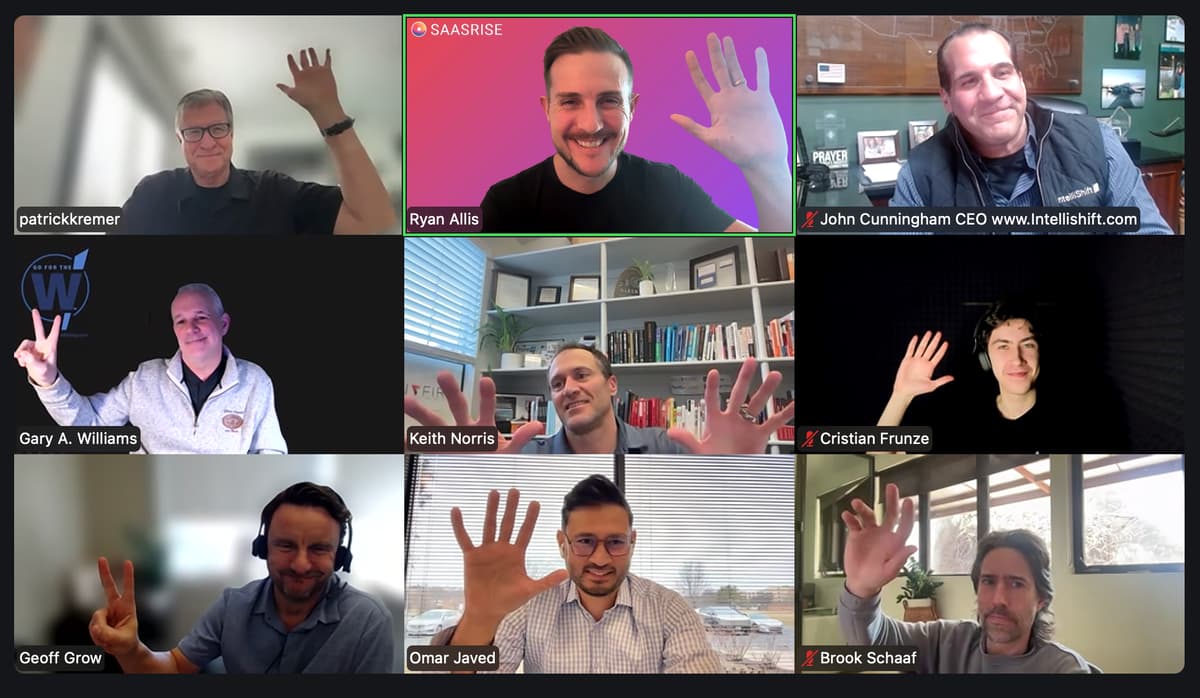
SaasRise Enterprise Mastermind Call Recap Feb 24, 2026
The SaasRise Enterprise Mastermind call on Feb 24, 2026 tackled four core challenges for early‑stage SaaS founders. It warned against offering equity to new hires until delivery, support, and sales bottlenecks are resolved, and suggested using consultants to test fit. The discussion...
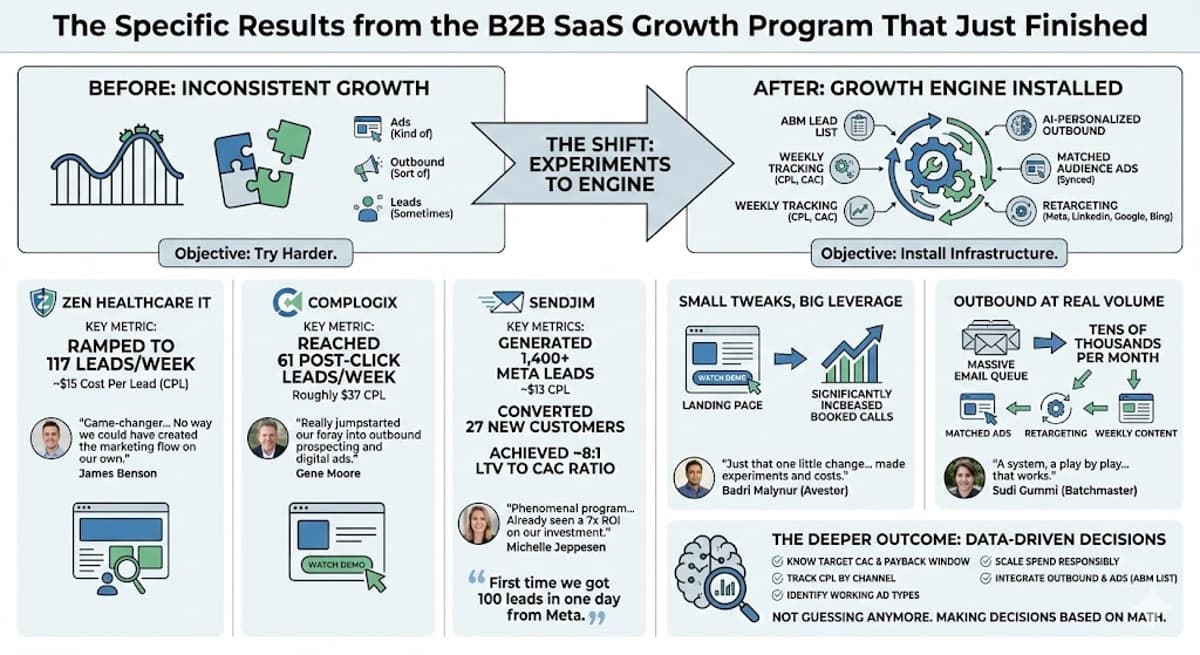
The Specific Results From the B2B SaaS Growth Program That Just Finished
The B2B SaaS Growth Program transformed a cohort of founders from ad‑hoc experiments into a coordinated growth engine within sixteen weeks. Participants built ABM lead lists, AI‑personalized outbound sequences, matched‑audience and retargeting ads, and began weekly tracking of CPL and...
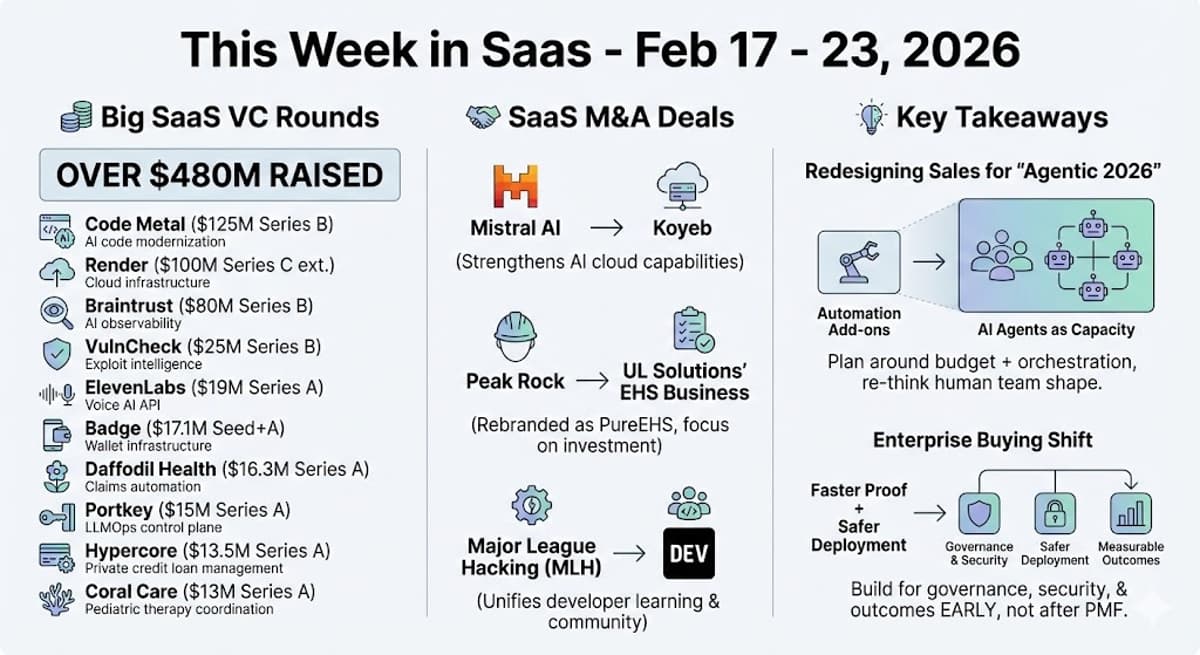
This Week in SaaS - Feb 17 - 23, 2026
SaasRise announced its 16‑week B2B SaaS Growth Program, opening applications until Feb 28 with only five spots available. The week also featured sizable VC investments, notably Code Metal’s $125 M Series B and Render’s $100 M Series C extension, highlighting strong capital flow into AI‑enabled...
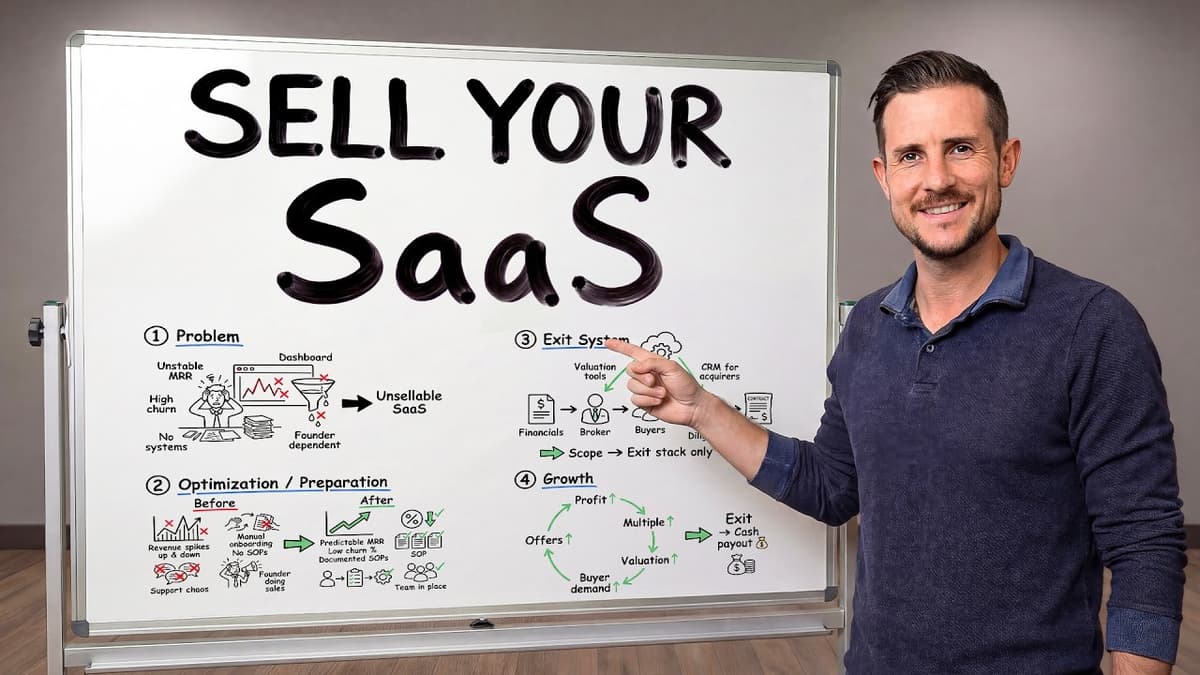
How to Sell Your SaaS (From a Founder with a $169m Exit)
The founder of iContact shares how a $169 million exit was the result of building an exit‑ready SaaS, not a lifestyle venture. He stresses designing for scalable growth, strong unit economics, and leadership depth that can operate without the founder. Mastering...
.png)
SaasRise CEO Mastermind Recaps for the Week of Feb 16 - 19, 2026
The SaasRise CEO Mastermind covered ten high‑impact topics for SaaS leaders, from navigating 9‑12‑month enterprise sales cycles to modernizing AI‑assisted development workflows. Participants received tactical advice on measuring GTM performance early, maintaining CRM data hygiene, and leveraging retargeting over broad...
SaasRise Mastermind Recap - Feb 18, 2026
The SaaS mastermind on Feb 18, 2026 delivered a playbook for scaling fast‑growth companies, covering AI‑assisted coding, go‑to‑market metrics, CRM hygiene, cold‑email infrastructure, and enterprise sales tactics. Leaders were urged to mandate AI tools, appoint champions, and track productivity dashboards while protecting...
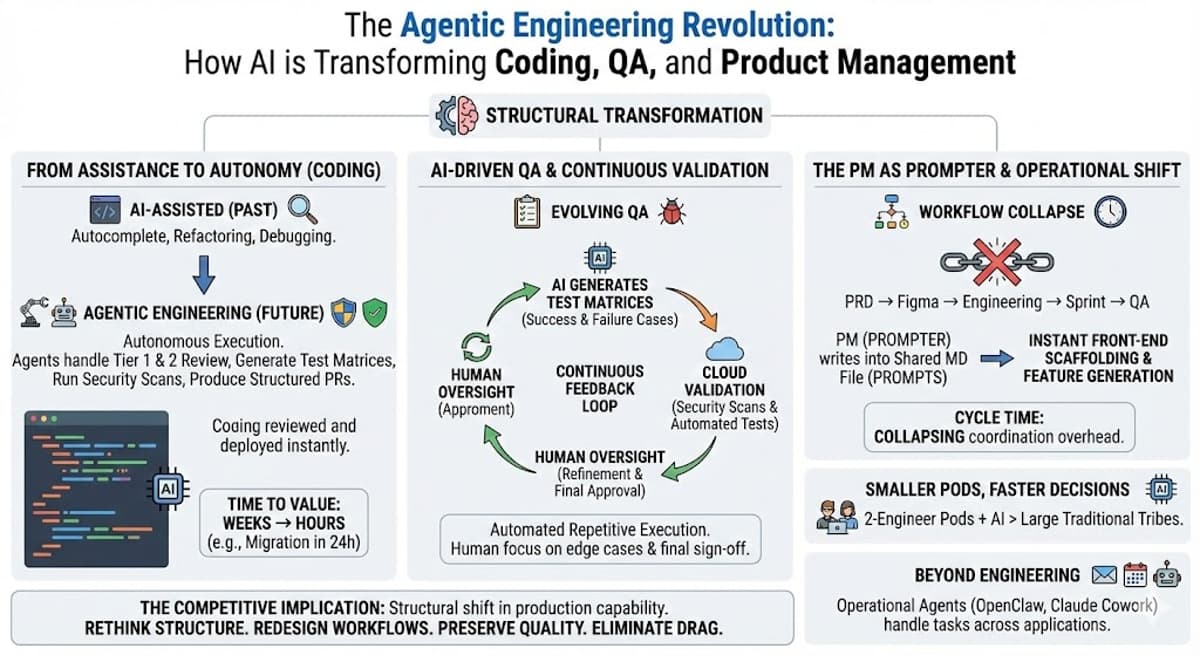
The Agentic Engineering Revolution: How AI Is Transforming Coding, QA, and Product Management
Software teams are moving from AI‑assisted coding to "agentic engineering," where autonomous AI agents handle code reviews, test generation, security scans, UI scaffolding, and pull‑request creation. A reported Angular migration that once required months was completed in 24 hours, illustrating the...
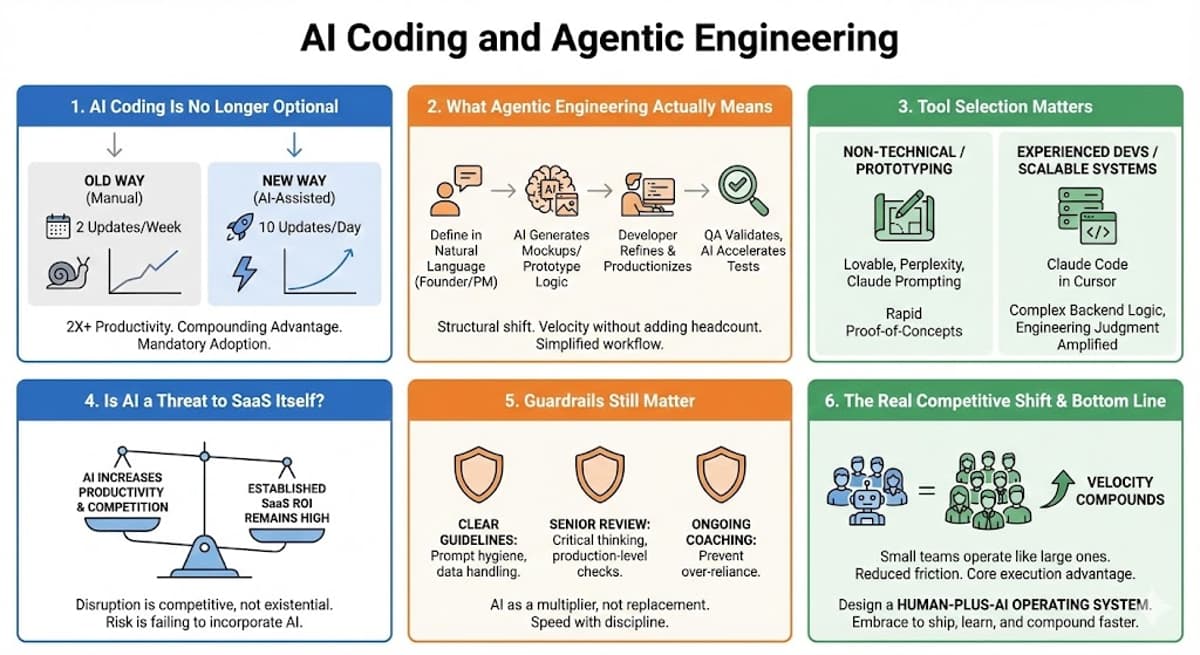
AI Coding and Agentic Engineering
AI coding has shifted from an experimental tool to a mandatory capability, delivering at least a two‑fold boost in developer productivity. Teams using assistants like Cursor with Claude are turning weeks‑long feature cycles into hours, enabling small groups to ship...
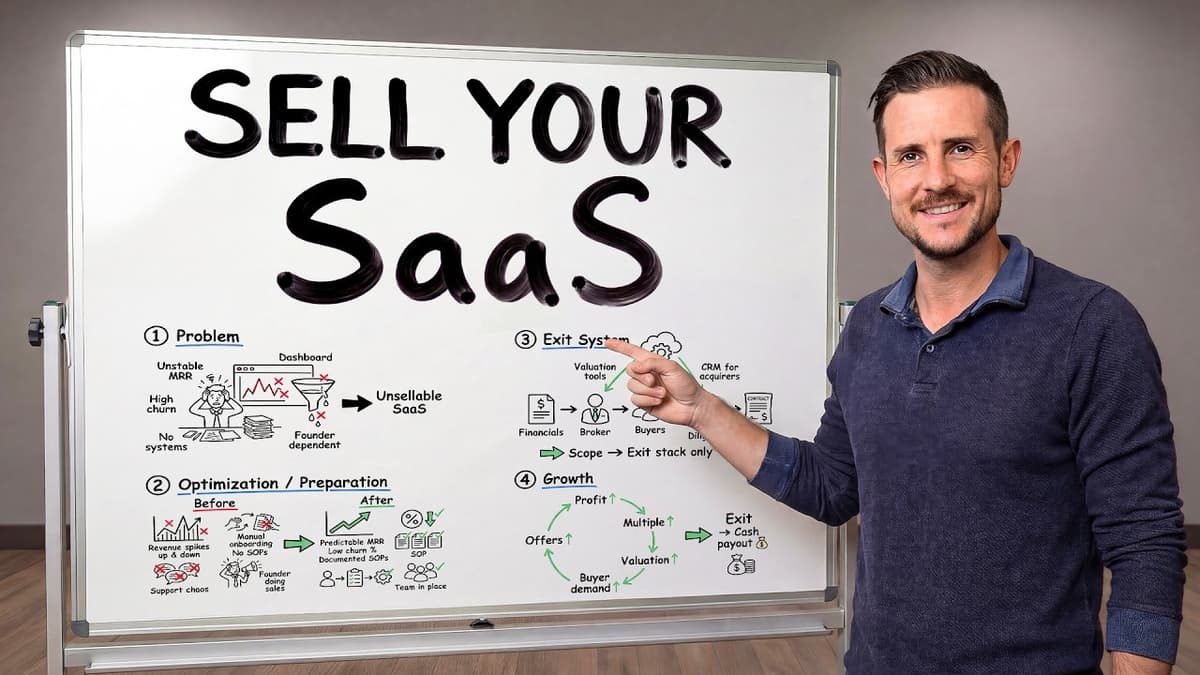
How to Sell Your SaaS (From a Founder with a $169m Exit)
In a detailed video, Ryan Allis, the founder who exited iContact for $169 million, walks SaaS CEOs through a step‑by‑step playbook for selling a software company. He draws on his own decade‑long build‑out, Harvard MBA, and years of advising unicorn founders...
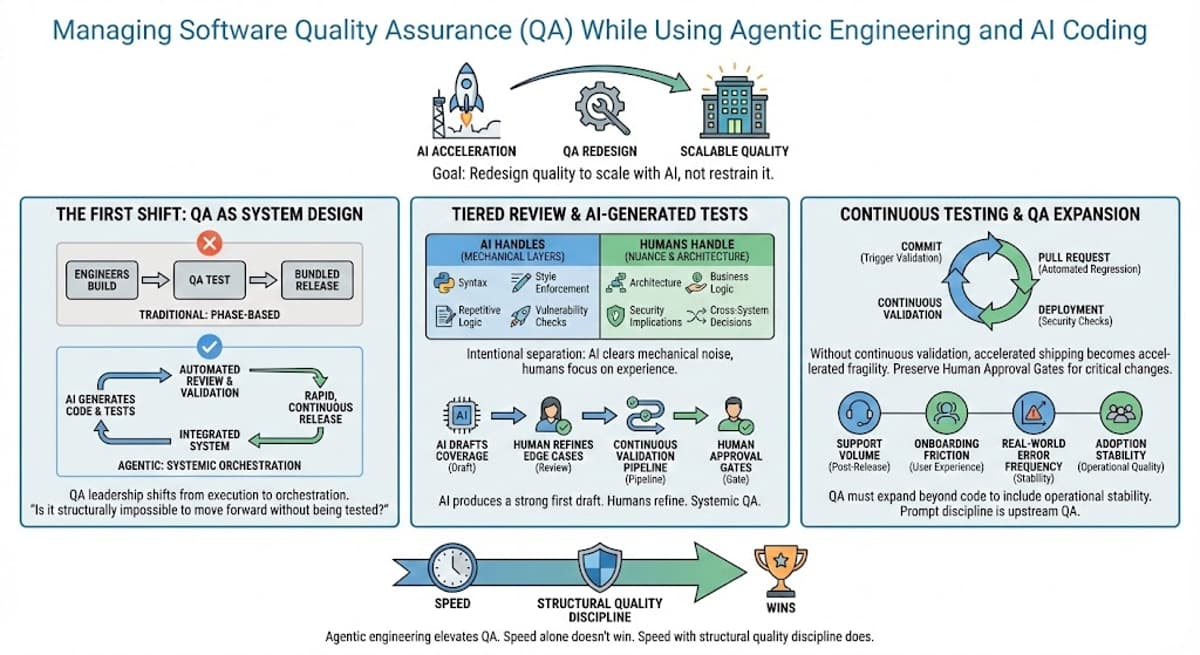
Managing Software Quality Assurance (QA) While Using Agentic Engineering and AI Coding
AI‑driven agentic engineering is slashing software delivery from weeks to days, enabling code, tests, and refactoring to be generated automatically. This acceleration forces a fundamental shift in quality assurance, moving QA from a downstream checkpoint to an integrated system‑design function....
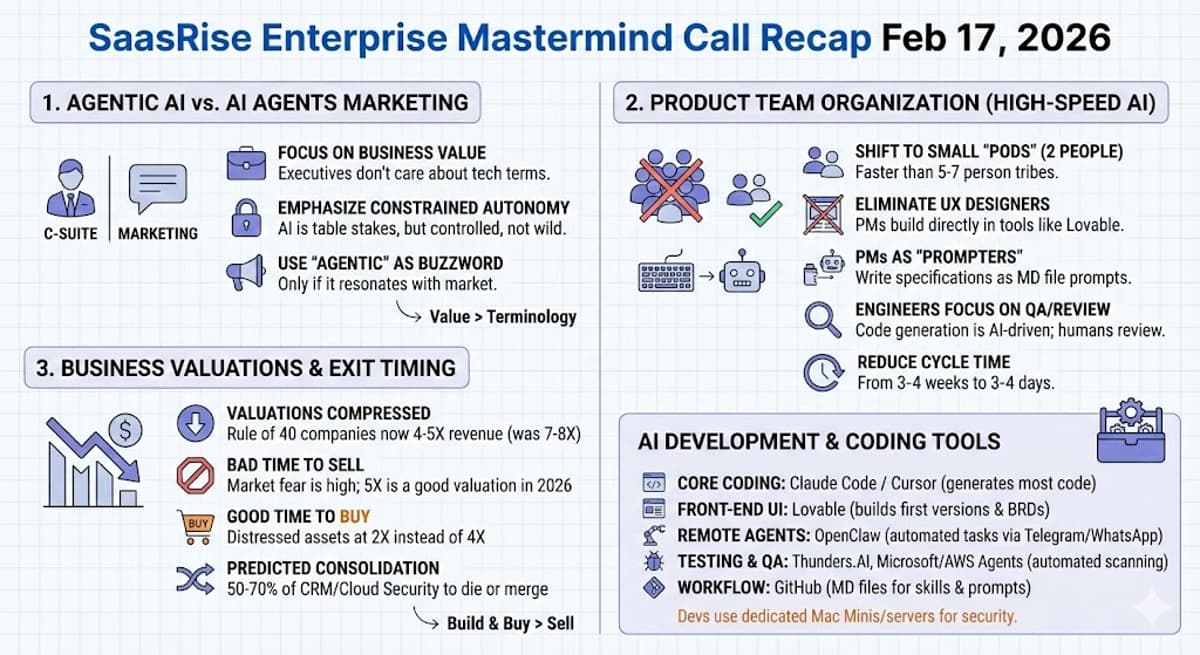
SaasRise Enterprise Mastermind Call Recap Feb 17, 2026
During the SaasRise Enterprise Mastermind call, executives were advised to market AI‑enabled workflow products using business‑focused language, favoring “agentic” terminology only if it resonates. Product teams are shifting from traditional tribes to two‑person pods, eliminating UX designers, and using AI...
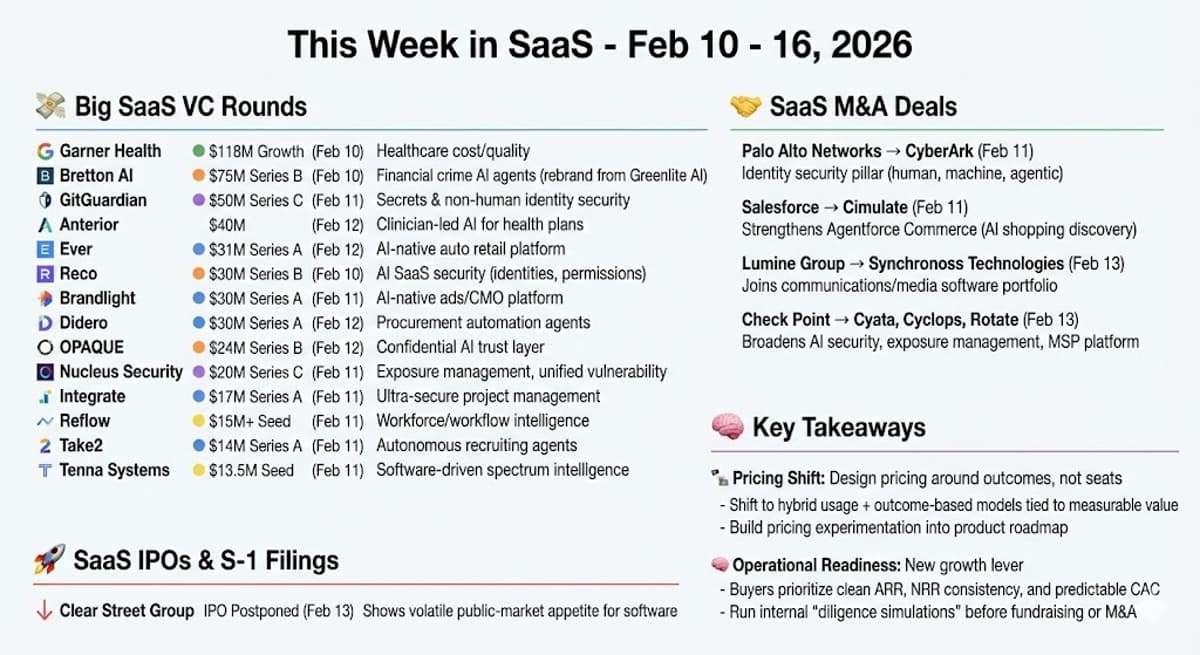
This Week in SaaS Feb 10 - 16, 2026
SaasRise launched a 16‑week, $5k‑per‑month B2B SaaS Growth Program for companies with $1M+ ARR, focusing on ABM, outbound, and paid‑media scaling. February saw a wave of large AI‑centric SaaS funding rounds, highlighted by Garner Health’s $118M and Bretton AI’s $75M...
The New Way to Build a SaaS with AI Coding
The video introduces a radical AI‑driven workflow that promises to accelerate SaaS product development by an order of magnitude. By replacing the traditional chain of product managers, designers, and engineers with AI‑assisted coding, companies can move from idea to production‑ready...
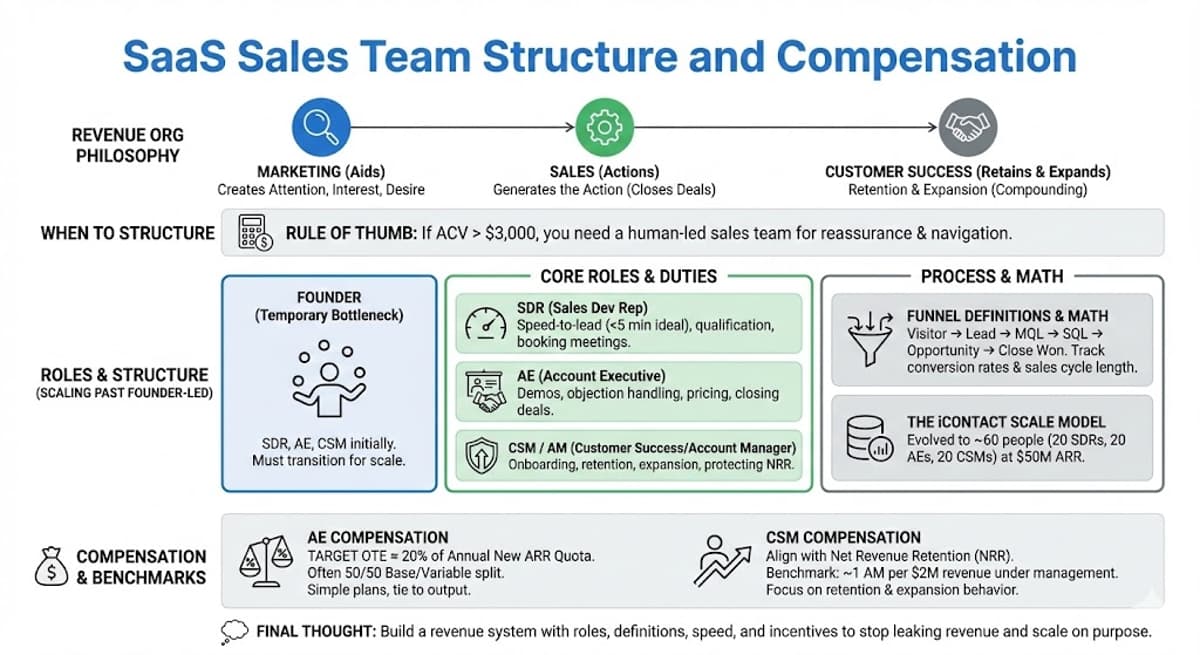
SaaS Sales Team Structure and Compensation
After months of marketing effort, SaaS firms often hit a bottleneck in converting leads to revenue. The article outlines a clear revenue‑org model: marketing creates demand, sales closes deals, and customer success drives retention and expansion. It recommends adding a...
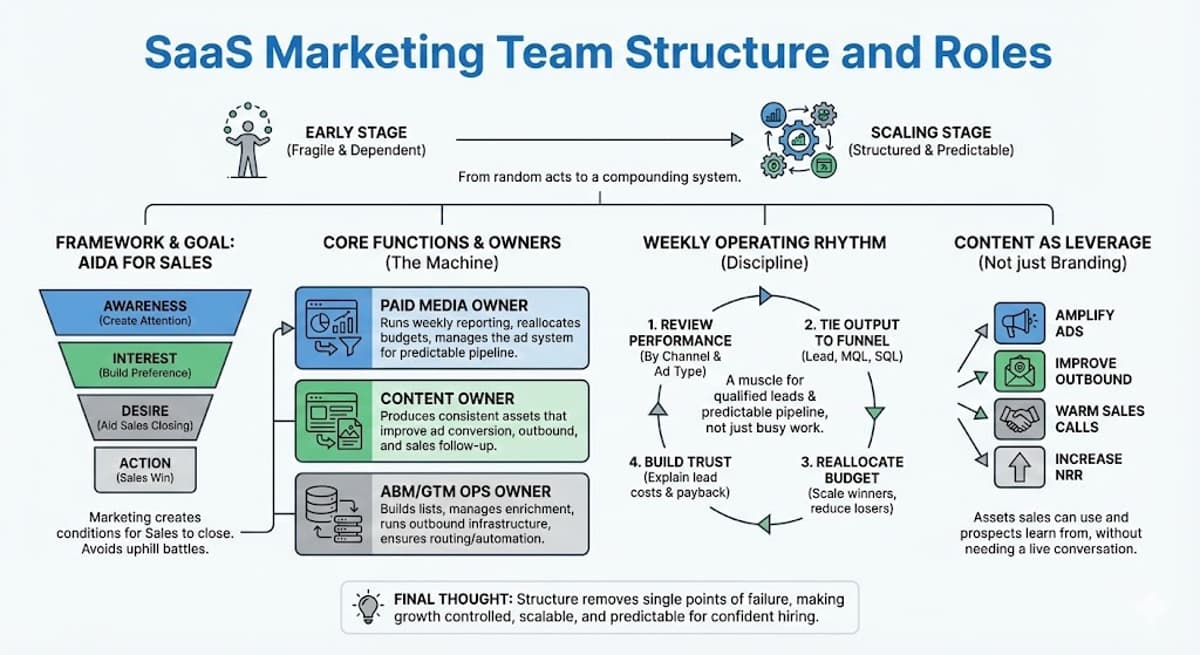
SaaS Marketing Team Structure and Roles
Early‑stage SaaS founders often run marketing as a one‑person, ad‑hoc function, which works at half‑million ARR but becomes fragile at $5 M and dangerous beyond $15 M. The article argues that marketing should be treated as a system that builds awareness and...
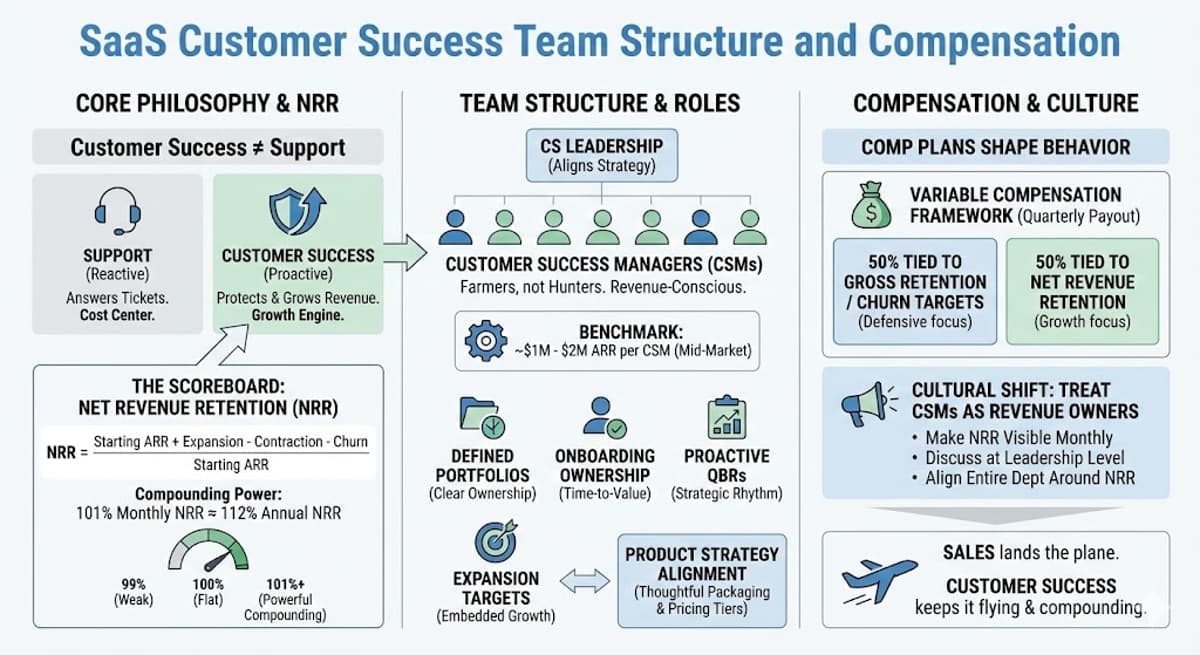
SaaS Customer Success Team Structure and Compensation
Most SaaS founders focus on sales while neglecting customer success, a misstep that limits net revenue retention (NRR). The article explains that a dedicated CSM team, sized at roughly $1‑2 million ARR per manager, is essential for reducing churn and driving...
.png)
SaasRise CEO Mastermind Recaps for the Week of Feb 9 - 12, 2026
The weekly SaaS CEO Mastermind covered a breadth of operational challenges, from cleaning HubSpot CRM data to automating AI‑generated landing pages. Participants received concrete tactics for a $6 million ARR company to build a disciplined go‑to‑market motion, restructure unsustainable affiliate commissions,...
SaasRise Mastermind Recap - Feb 11, 2026
During the Feb 11 SaaS mastermind, CEOs exchanged concrete tactics to tighten CRM data, automate landing‑page production, and scale go‑to‑market motions for high‑ticket enterprise software. The session highlighted hiring a HubSpot integrator ($10‑20K) and quarterly deduping, leveraging Claude‑driven static site generators...
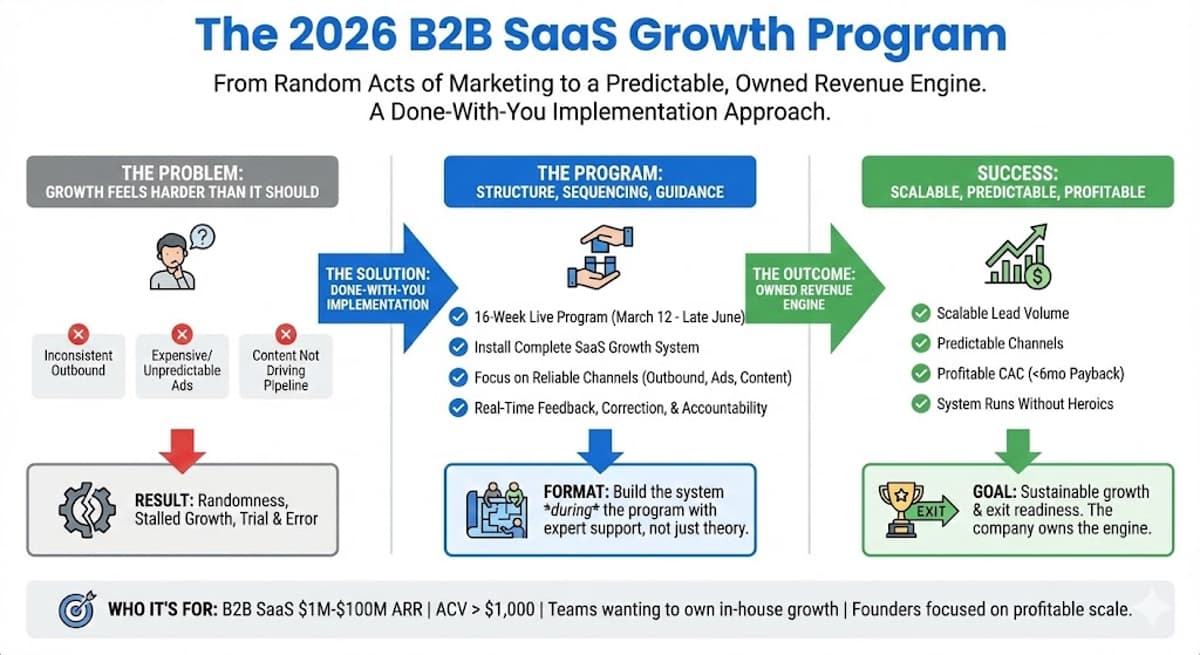
The 2026 B2B SaaS Growth Program
The 2026 B2B SaaS Growth Program launches on March 12, 2026, offering a 16‑week, done‑with‑you experience for SaaS firms with $1M‑$100M ARR. It moves beyond theory, guiding teams week‑by‑week to build a predictable, repeatable revenue engine covering outbound, paid ads,...
%20(1)%20(1).png)
SaasRise Enterprise Mastermind Call Recap Feb 10, 2026
The SaasRise Enterprise Mastermind call highlighted three critical challenges facing SaaS firms: a senior developer juggling two full‑time jobs, a hotel‑software API provider transitioning to a self‑serve model, and a company negotiating earnout terms amid multiple acquisition offers. For the...
.jpg)
Step by Step: How I’d Build and Sell a $100M SaaS If Starting Again
The author outlines a step‑by‑step playbook for building a SaaS company that can command a $100M‑plus exit. He advises bootstrapping to roughly $500K‑$1M ARR before raising capital, mastering unit economics, and making outbound and paid acquisition core growth engines. Community,...
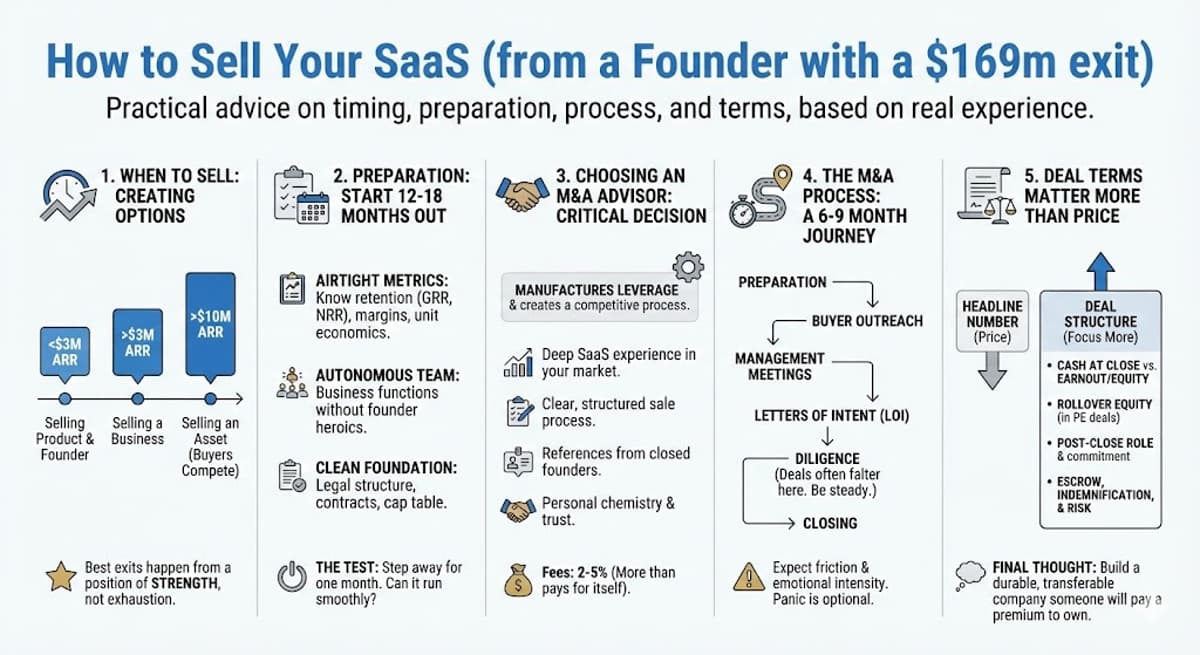
How to Sell Your SaaS (From a Founder with a $169m Exit)
In 2012 the iContact founder sold the company for $169 million after growing ARR to over $50 M. He explains that SaaS exits differ by size: below $3 M ARR you sell a product and founder, above $10 M ARR you attract competing asset...
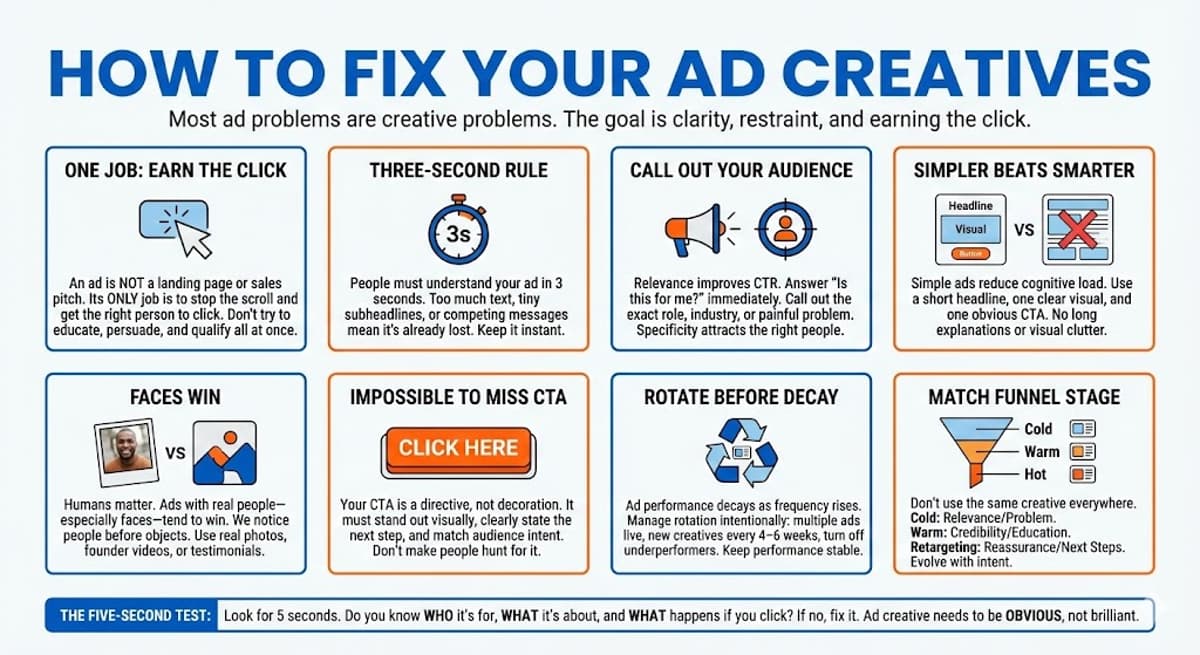
How to Fix Your Ad Creatives
SaaS marketers often blame targeting or budget for low ad performance, but the real issue is creative. Ads that are cluttered, generic, or try to do too much fail to capture attention within three seconds. The session highlighted that clear,...
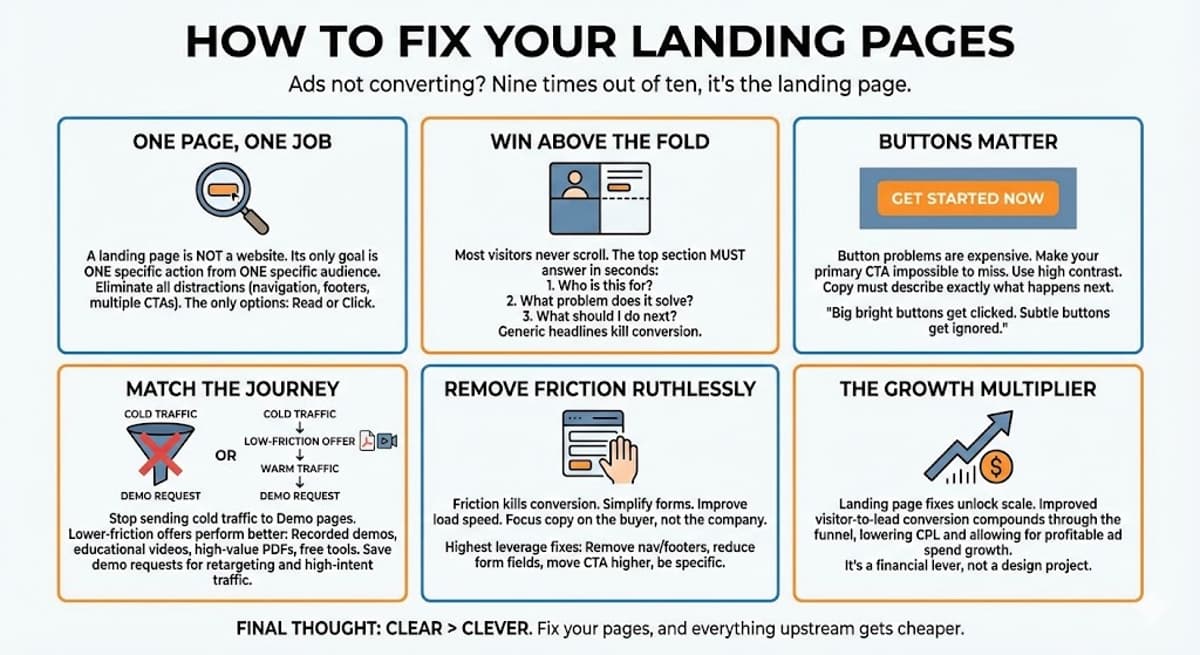
How to Fix Your Landing Pages
Most ad spend failures stem from poorly designed landing pages, not the ads themselves. The article outlines how distractions, weak headlines, and ineffective CTA buttons leak conversions, especially above the fold. It advises aligning offers with visitor intent, removing navigation,...
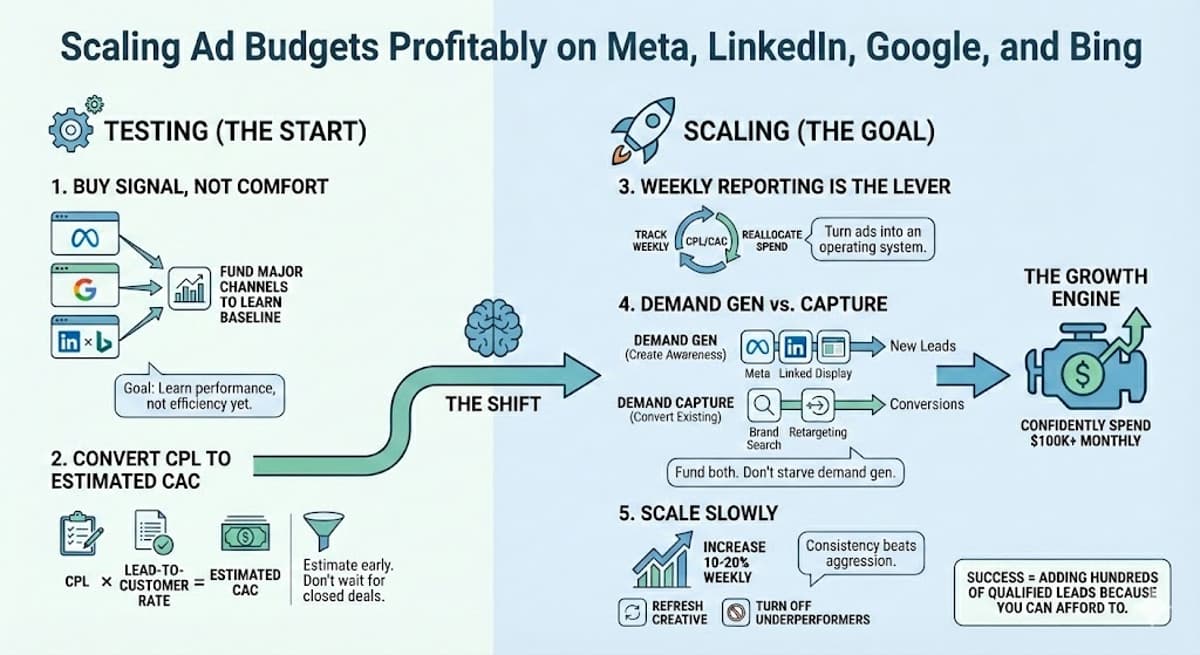
Scaling Ad Budgets Profitably on Meta, LinkedIn, Google, and Bing
Most SaaS teams stall not because ads are bad, but because they never shift from testing to scaling. The article stresses buying enough signal across Meta, LinkedIn, Google, and Bing to calculate reliable CPL and estimate CAC early. Weekly, cross‑channel...