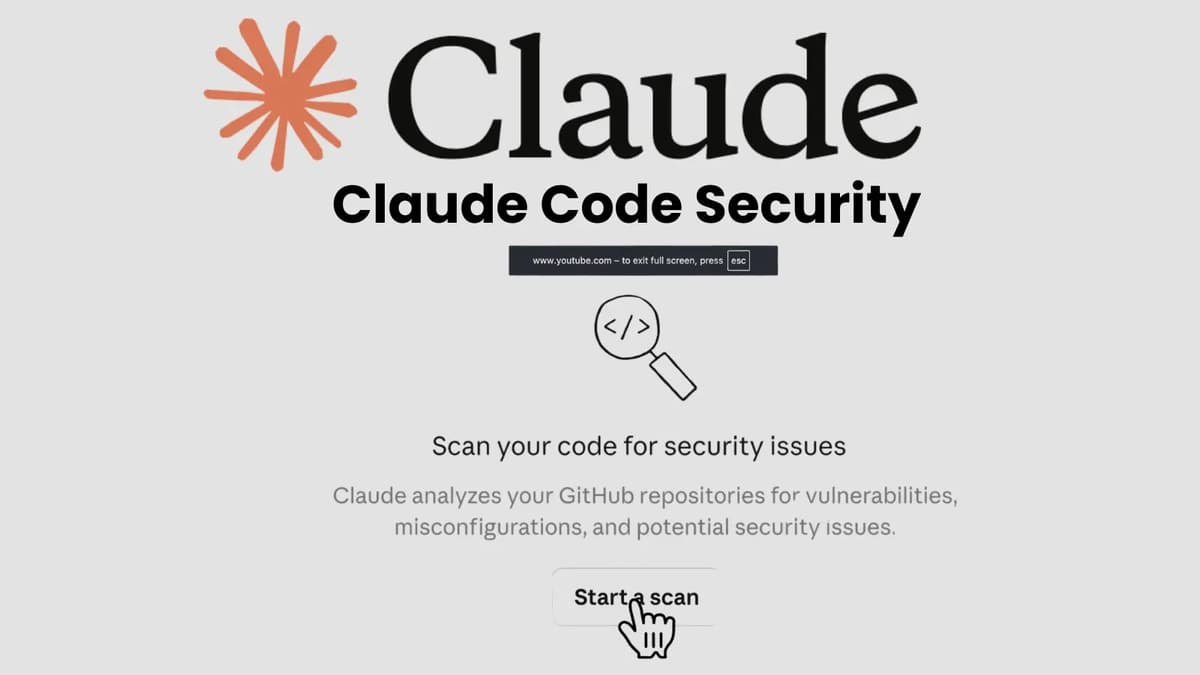
Anthropic Debuts Claude Code Security – AI Now Scan Vulnerabilities in Your Entire Codebase
•February 21, 2026
0
Companies Mentioned


Why It Matters
It gives security teams a scalable, high‑accuracy way to remediate code risks, potentially reshaping the cybersecurity market and pressuring incumbent SAST vendors.
Key Takeaways
- •Claude Code Security scans entire repositories automatically.
- •Uses Claude Opus 4.6 reasoning, reduces false positives.
- •Discovered 500+ high‑severity bugs in open‑source projects.
- •Cybersecurity stocks fell 8‑9% on launch news.
- •Preview limited to enterprise and team plans, open‑source access pending.
Pulse Analysis
The rise of generative AI is redefining how organizations protect software. Traditional static‑application‑security testing (SAST) tools rely on pattern matching and often miss business‑logic errors or multi‑file injection paths. Anthropic’s Claude Code Security embeds the latest Claude Opus 4.6 model directly into its Claude Code platform, allowing the system to reason about data flow, architectural context, and attack vectors across an entire repository. By generating findings, self‑critiquing them, and proposing human‑reviewable patches, the service promises far fewer false positives while delivering actionable remediation at scale.
The market reacted instantly. Shares of established cybersecurity firms such as CrowdStrike, Cloudflare, Okta and Palo Alto Networks slipped between 8 % and 9 % after the launch, and the Global X Cybersecurity ETF fell nearly 5 %. Analysts see Claude Code Security as the first commercial deployment of a frontier‑model that can autonomously conduct vulnerability research, threatening the revenue streams of legacy SAST vendors. Anthropic is rolling the product out as a limited research preview for enterprise and team customers, while offering free access to open‑source maintainers on a case‑by‑case basis.
Beyond the immediate stock wobble, the technology signals a longer‑term shift in software risk management. AI‑powered code auditors can keep pace with the velocity of modern development, especially as organizations ship AI‑generated code at unprecedented speed. However, the same models could eventually be weaponized by threat actors, making the “human in the loop” safeguard critical. For security teams, adopting Claude Code Security means reallocating resources from manual triage to strategic threat modeling, while vendors must innovate or partner to stay relevant in a market that increasingly values autonomous, reasoning‑based defenses.
Anthropic Debuts Claude Code Security – AI Now Scan Vulnerabilities in Your Entire Codebase
0
Comments
Want to join the conversation?
Loading comments...