AVCRAD’s capability cuts acquisition costs while bolstering Army aviation readiness, and it cultivates a technically proficient workforce that feeds the broader U.S. aerospace supply chain.
Depot‑level maintenance facilities like AVCRAD are critical cost‑control levers for the U.S. military. By disassembling helicopters to the bolt level and rebuilding them to original specifications, the depot eliminates the need for new airframes, delivering savings that can run into the tens of millions per platform. The 2019‑2021 CH‑47 overhaul exemplifies how rapid, high‑precision refurbishment can return battle‑damaged assets to operational status, preserving fleet size without inflating procurement budgets.
Beyond fiscal benefits, AVCRAD strengthens the regional defense ecosystem in Connecticut, a state already home to industry giants such as Sikorsky and Pratt & Whitney. Holding ISO 9000:2015 and AS 9110 certifications signals adherence to rigorous quality management standards, positioning the depot to win additional Army contracts and collaborate with commercial aerospace partners. The blend of uniformed mechanics and civilian specialists creates a talent pipeline where military‑trained technicians acquire skills directly applicable to civilian manufacturing, aerospace, and heavy‑industry roles.
Strategically, the presence of the 1109th Theater Aviation Support Maintenance Group (TASMG) adds a deployable element capable of delivering depot‑level repairs in forward operating areas. This flexibility enhances the Army’s global readiness, ensuring that critical rotary‑wing assets can be restored close to the point of need. As the Department of Defense emphasizes sustainment and lifecycle management, facilities like AVCRAD will likely see expanded missions, increased funding, and deeper integration with both defense contractors and the civilian aerospace workforce.
By Timothy Koster · January 23, 2026
GROTON, Conn. – At the Connecticut National Guard’s 1109th Aviation Classification and Repair Depot, or AVCRAD, workers refurbish and maintain the U.S. Army’s fleet of rotary‑wing aircraft, a unique job that can save the Department of War, or DOW, millions of dollars a year.
Unlike field units that are trained and equipped to conduct basic maintenance on their aircraft, the AVCRAD is capable of stripping a helicopter—whether it’s a UH‑60 Black Hawk, a CH‑47 Chinook or an AH‑64 Apache—to its nuts and bolts and rebuilding it to factory standards as if it just rolled off the assembly line.
“Generally speaking, there are two levels of maintenance when it comes to Army aviation,” said 1st Sgt. Jarod Meekhoff, a quality control inspector for aircraft and aviation maintenance. “There is field‑level maintenance and sustainment‑level maintenance. We are considered a sustainment‑level facility in that we can do the highest level maintenance comparable with any Army aviation depot … That being said, the kind of work that we do is highly technical, which is why we have a lot of specialized tools, equipment and specialized individuals here with the knowledge and skills capable of doing that.”
Connecticut is home to some of the country’s largest military‑industrial businesses, including Sikorsky, General Dynamics Electric Boat and Pratt & Whitney. It is fitting, then, that Connecticut is also home to the AVCRAD. The Groton‑based facility employs highly skilled uniformed mechanics and some of the industry’s most talented civilian contractors to refurbish and maintain the aircraft.
“In doing depot maintenance, we can basically take an aircraft and overhaul it from the ground up,” Meekhoff said. “That’s removing all the components, stripping all the paint, doing significant structural upgrades, structural repairs, component repairs [and] component overhauls.”
One of the best examples of this cost‑saving capability came in 2019 when the AVCRAD received two battle‑damaged CH‑47s that were deemed severely damaged and inoperable. In just two years, even with the constraints imposed by the COVID‑19 pandemic, these two helicopters were stripped down, analyzed, repaired, repainted and returned to the fleet as fully functional machines, sparing the military millions in the cost of buying new helicopters.
Holding ISO 9000:2015 and AS 9110 certifications qualifies the AVCRAD to bid on special aviation maintenance projects offered by the Army. This allows Soldiers and contractors at the facility to develop skills and knowledge comparable to those of their civilian defense‑industry counterparts.
Working at the AVCRAD provides an opportunity for those interested in the aviation or aerospace industries to acquire skills and experience that will help advance their careers in the civilian sector after their military service, because of the high‑level depot maintenance and the technical training the Army provides its aviation mechanics.
“Because of the level of maintenance and the kind of very technical maintenance that we do, our maintainers will walk away with a much better understanding of not just helicopters and aircraft, but general maintenance and procedures which absolutely translate to all the civilian companies that do any sort of production, manufacturing or assembly,” Meekhoff said. “But they’re not going to take a brand new person with no experience and hire them at $75‑$80 k a year … What we will do is take that brand new person, we will train them, put them through all the professional development they need to be technically competent in their job.”
In addition to the AVCRAD, the facility is also home to the 1109th Theater Aviation Support Maintenance Group, or TASMG, the traditional National Guard unit to which many of the uniformed personnel at the AVCRAD belong. These Soldiers are capable of going down‑range and performing high‑level depot maintenance on aircraft on the front lines of the United States’ efforts to maintain peace and stability worldwide.
Image captions:
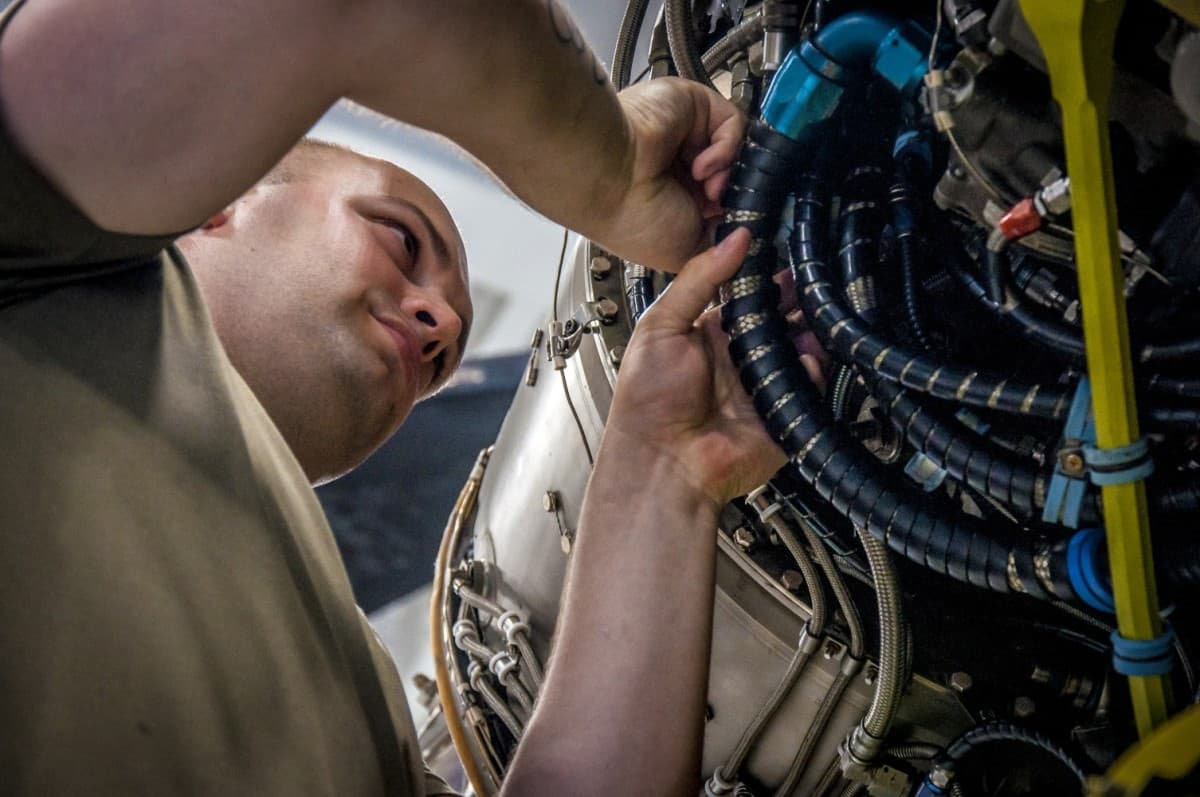
U.S. Army Cpl. Zachary Tallis, a CH‑47 Chinook mechanic with the Connecticut National Guard’s 1109th Theater Aviation Support Maintenance Group, works on the rear engine of a helicopter that was battle‑damaged from a hard landing while serving in Iraq. The TASMG recovered this helicopter from Kuwait and performed a complete overhaul of the aircraft to return it to the Army’s operational fleet. (June 22 2021)
U.S. Army Spc. Kaitlin Cavanaugh and Sgt. Omar Sewell conduct maintenance on the forward rotor of a CH‑47 Chinook helicopter that was battle‑damaged from a hard landing while serving in Iraq. The TASMG recovered this helicopter from Kuwait and performed a complete overhaul of the aircraft to return it to the Army’s operational fleet. (June 22 2021)
The team responsible for the complete overhaul of a CH‑47 Chinook helicopter that was battle‑damaged from a hard landing while serving in Iraq pose for a group photo in front of the helicopter at the Connecticut National Guard’s 1109th Theater Aviation Support Maintenance Group. The work was part of a new initiative to restore inoperable aircraft and get them back into the Army’s operational fleet. (June 22 2021)
Comments
Want to join the conversation?
Loading comments...