Defense News and Headlines
  • All Technology
  • AI
  • Autonomy
  • B2B Growth
  • Big Data
  • BioTech
  • ClimateTech
  • Consumer Tech
  • Crypto
  • Cybersecurity
  • DevOps
  • Digital Marketing
  • Ecommerce
  • EdTech
  • Enterprise
  • FinTech
  • GovTech
  • Hardware
  • HealthTech
  • HRTech
  • LegalTech
  • Nanotech
  • PropTech
  • Quantum
  • Robotics
  • SaaS
  • SpaceTech
AllNewsDealsSocialBlogsVideosPodcastsDigests

Defense Pulse

EMAIL DIGESTS

Daily

Every morning

Weekly

Sunday recap

NewsDealsSocialBlogsVideosPodcasts
DefenseNewsCracks in the ‘Ironclad’ South Korea-US Alliance
Cracks in the ‘Ironclad’ South Korea-US Alliance
Defense

Cracks in the ‘Ironclad’ South Korea-US Alliance

•January 28, 2026
0
The Diplomat – Asia Defense
The Diplomat – Asia Defense•Jan 28, 2026

Companies Mentioned

Google

Google

GOOG

Hyundai Canada

Hyundai Canada

Why It Matters

Strained economic and security ties risk undermining U.S. strategic stability in East Asia, and could force a realignment of regional security architectures.

Key Takeaways

  • •Trump imposed new tariffs and forced $350B investment demand.
  • •U.S. threatened to raise Korean export tariffs to 25%.
  • •Alliance faces strain from protectionist policies and nationalist sentiment.
  • •Korean nuclear ambitions rise amid U.S. coercion.
  • •Congressional safeguards limit potential U.S. troop drawdown.

Pulse Analysis

The South Korea‑U.S. partnership, long billed as "ironclad," has been tested by a series of aggressive economic measures. Since 2025, the Trump administration levied unprecedented tariffs on Korean goods, demanded a $350 billion investment in the United States, and even detained hundreds of Korean workers on visa violations. Successive Biden‑era policies have continued to push Seoul toward supply‑chain decoupling from China, creating a climate of economic coercion that fuels distrust and fuels nationalist backlash on both sides.

Security considerations remain the alliance’s backbone, yet they are increasingly fragile. The stationing of 28,000 American troops on the peninsula provides a deterrent against North Korean aggression, but recent U.S. signals of a possible force posture reduction—outlined in the 2026 National Defense Strategy—have raised alarm in Seoul. Simultaneously, South Korean debates over a potential nuclear option reflect growing frustration with U.S. reliability, adding another layer of complexity to a relationship that has traditionally hinged on conventional deterrence.

Politically, rising nationalist sentiments in Washington and Seoul intersect with institutional safeguards. Congressional provisions in the 2020 and 2026 National Defense Authorization Acts create procedural hurdles to any rapid U.S. troop drawdown, yet a pliant defense secretary and cooperative congressional Republicans could still navigate around them. As economic pressure mounts and diplomatic frictions persist, the alliance’s durability will depend on moving beyond transactional "pragmatic diplomacy" toward a relationship grounded in mutual respect and shared strategic interests.

Cracks in the ‘Ironclad’ South Korea-US Alliance

By David Fields · January 29, 2026

Cracks in the ‘Ironclad’ South Korea‑US Alliance

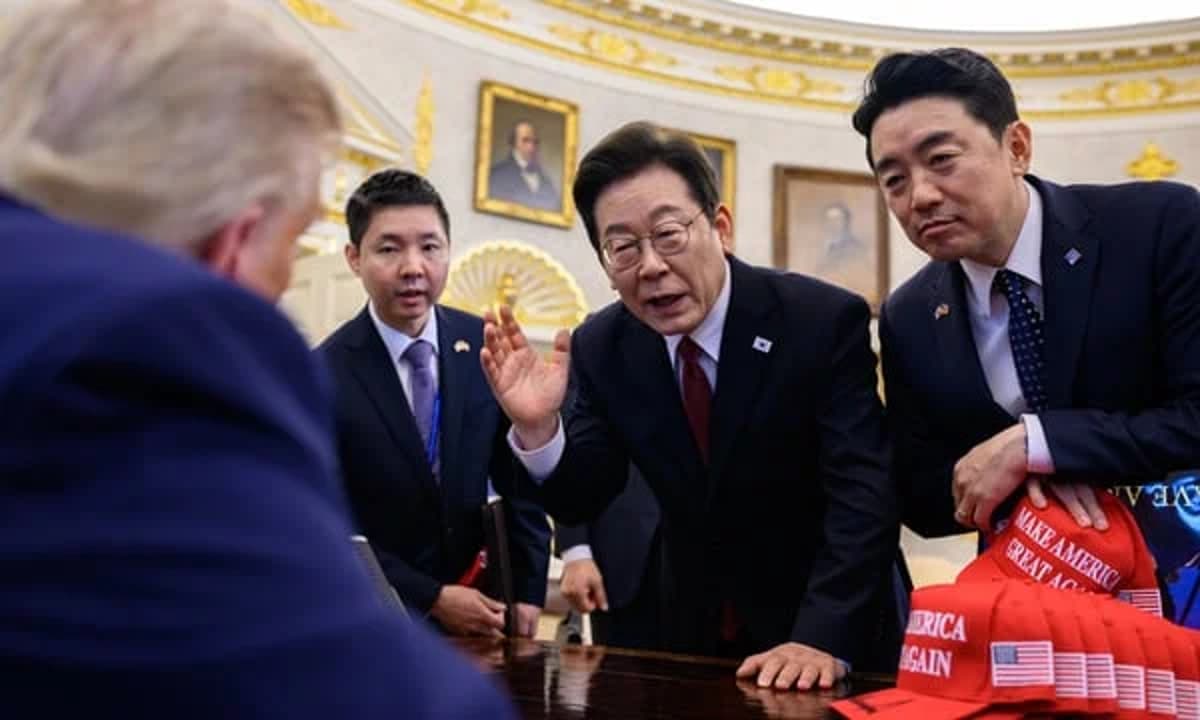
U.S. President Donald Trump visits with President Lee Jae‑myung of South Korea in the Oval Office, Aug. 25, 2025. Credit: Official White House Photo by Daniel Torok

Sometimes words betray those using them by conveying a quite different message from that intended. Insisting that something is true when observers suspect it is not can actually undermine one’s message. Shakespeare recognized this phenomenon more than 400 years ago in Hamlet, when he had Queen Gertrude deliver the immortal line: “The lady doth protest too much, methinks.” Subsequent psychoanalysts would call this tendency a “reaction formation.”

Such a reaction formation is clearly present in South Korea‑U.S. relations today in the frequency with which both Korean and U.S. officials use the term “ironclad.” President Donald Trump, Secretary of State Marco Rubio, and Secretary of Defense Pete Hegseth have all used the term many times in the past year. Korean President Lee Jae‑myung used the word “ironclad” at least four times on his first visit to Washington; once in his August 25 press conference with Trump and three times in his subsequent speech at the Center for Strategic and International Studies (CSIS).

The term is constantly invoked in analysis and op‑eds about the alliance. Google Books data shows a marked rise in the use of the “ironclad alliance” n‑gram since 2015, though it is impossible to attribute all of the growth to South Korea‑U.S. relations. Still, if rhetoric created reality, there would be little reason to fear for the future of the alliance.

Alas, that is not the case. In 2025 alone the Trump administration has slapped staggering new tariffs on South Korea, extorted a Korean pledge to invest $350 billion in the United States in the next three and a half years, and detained for a week more than 300 Korean workers at a Hyundai factory in Georgia who allegedly did not have the proper visas for the type of work they were performing.

Almost the same day as the detentions, the New York Times broke the story of a Trump‑authorized 2019 U.S. Navy SEAL raid into North Korea, which left several North Koreans dead and risked major retaliation against South Korea if it had been discovered.

These are just a few of the episodes in the last decade in which Seoul has hardly been treated like an ally at all, much less one in an “ironclad” alliance. The first Trump administration repeatedly berated South Korea for freeriding on American security and demanded South Korea make an exorbitant payment of $5 billion to maintain the alliance – five times greater than the agreed sum under previous cost‑sharing deals. Koreans refused and the demand was subsequently dropped by the Biden administration. If this brought some relief to South Korea it was short‑lived, for soon thereafter the Biden administration brought forward protectionist policies that demanded Korean firms decouple their supply chains from China even as the United States engaged in industrial policy at home.

The danger of such policies to the alliance has not been overlooked by specialists. A recent book by Scott Snyder, The United States–South Korea Alliance: Why It May Fail and Why It Must Not, highlights the threats to the alliance from within both countries. New nationalist movements in the United States and South Korea are attacking the alliance as a restraining force on their national aspirations. Think of Trump berating South Korea as a free‑rider on American security that is “killing us on trade.” On the Korean side, a renewed interest in nuclear weapons is both a reaction to the uncertainty the U.S. has injected into the relationship and a factor that further stresses the alliance. A South Korean nuclear weapons program and the breaking of international treaties it would entail could destroy the alliance itself.

One year into the second Trump administration, the Korean nationalist response seems to have been held in check so far. Korean elites in government and business appear determined to keep any nationalist impulses in check, enduring the indignities that Trump has heaped on them. They do so knowing that in the short term resistance will only bring more pain and that Trump is constitutionally barred from a third term.

Anyone doubting that this is South Korea’s approach should carefully review the transcript of the Lee‑Trump joint press conference during the South Korean president’s visit to Washington on August 25. The day started with a Trump post on Truth Social claiming that a “Purge or Revolution” was happening in South Korea and that “We can’t have that and do business there.” Lee surely walked into the Oval Office fearing a dressing‑down similar to that meted out to Ukrainian President Volodymyr Zelenskyy. The fact that Lee was “Zelenskyied” has been overlooked because he handled it so well.

Trump put Lee on the spot by asking him about alleged raids on churches and American military bases. He bluntly suggested South Korea “give us ownership of the land where we have the big fort” – a reference to Camp Humphries, the largest overseas American military base in the world. Finally, unbidden, Trump criticized South Korea for being “very stuck on” the issue of “comfort women” while Japan is willing to move on.

Each of these inflammatory comments must have had Lee biting his tongue. He performed ably, deflecting these issues while he flattered Trump over his (real or imagined) warm personal relationship with North Korean leader Kim Jong Un. Under any former American administration, such a meeting would have been considered a disaster. It is only when measured by the very low bar for diplomacy set by the Trump administration that this meeting was considered a success.

Trump and Lee’s second meeting in Gyeongju in October 2025 went better. Trump dropped his demand that South Korea invest $350 billion up front and accepted a $20 billion‑a‑year cap on South Korea’s cash investments in the United States – the highest amount the Bank of Korea said was feasible. The fact that two weeks elapsed between this meeting and the subsequent joint statement released by both governments hints that the negotiations were not smooth. Nor is it certain that arrangements made in Gyeongju can be kept. On January 16, 2026 Korean Finance Minister Koo Yun‑cheol stated that South Korea was unlikely to invest $20 billion in the United States in 2026, citing a lack of identified projects and the weakness of the Korean won.

The saga of this extorted investment is far from over. Most recently, on January 26 Trump threatened in a social‑media post to raise tariffs on South Korean exports from the current 15 percent to 25 percent, justifying the threat by saying the Korean legislature hadn’t approved the trade deal reached in Gyeongju and accusing South Korea of “not living up to its deal with the United States.”

And yet, for all the bad policy, narrow nationalism, and insulting rhetoric, the South Korea‑U.S. alliance endures. The foundation of the alliance is the 28,000 American troops stationed in South Korea, who train regularly with their Korean counterparts to “fight tonight.” As of today, there is no doubt that they would. As of today, there is also no other country to which South Korea could turn for comparable security guarantees and military support.

It is possible that Trump will try to chip away at this foundation during the next three years. The 2026 National Defense Strategy (NDS), published last week, says the United States will continue to provide South Korea with what it calls “critical” support, but that Seoul should expect reductions in other types of support as the United States updates its “force posture on the Korean Peninsula” – language that strongly hints at renewed attempts by the Trump administration to draw down forces from the peninsula.

Such a drawdown would be resisted by Congress. The 2020 National Defense Authorization Act (Section 1254) created procedural barriers for such a drawdown during the first Trump administration. Congress added additional barriers to the 2026 National Defense Authorization Act (Section 1268). But those barriers could be surmounted by a pliant secretary of defense and cooperative congressional Republicans.

As retired South Korean General Chun In Bum wrote this week, the strategy for Korea in the NDS does not necessarily weaken the alliance, but it does test it. Those concerned about the long‑term sustainability of the alliance wish this test of its military framework did not have to coincide with U.S. economic coercion against South Korea.

The South Korea‑U.S. alliance is still strong, but there are different kinds of strength. Alliances built on mutual respect and shared interests and values are surely stronger than those based on “pragmatic diplomacy centered on national interest” – a phrase Lee used five times in his August speech at CSIS. This is especially true if those national interests are narrowly defined.

Although few will say so publicly, Korean leaders have little respect for Trump and are rapidly losing respect for the United States. Inertia and a lack of better alternatives make the South Korea‑U.S. alliance stable in the short term, but in the medium to long term the prospects for the alliance are bleak if protectionism, industrial policy, and “America First” nationalism remain the driving forces of American foreign policy.

Alliances built on no better alternative are among the weakest of all. The Warsaw Pact was strong, even “ironclad,” so long as the threat of a Soviet invasion kept any members from attempting to leave. It shattered quickly when that threat was removed.

Could such a fate befall the “ironclad” South Korea‑U.S. alliance? In the short term, it seems unlikely. Currently the threatening behavior of North Korea and the bullying of China are sufficient to keep South Korea squarely in the alliance. But the United States’ recent behavior and the trajectory of bilateral relations – not to mention the frictions in China‑U.S. relations which could entangle South Korea in a superpower conflict – must surely leave Korean leaders wishing they had alternatives to consider. A few more years of “America First” foreign policy and they will be working hard to create them.

Read Original Article
0

Comments

Want to join the conversation?

Loading comments...