Defense News and Headlines
  • All Technology
  • AI
  • Autonomy
  • B2B Growth
  • Big Data
  • BioTech
  • ClimateTech
  • Consumer Tech
  • Crypto
  • Cybersecurity
  • DevOps
  • Digital Marketing
  • Ecommerce
  • EdTech
  • Enterprise
  • FinTech
  • GovTech
  • Hardware
  • HealthTech
  • HRTech
  • LegalTech
  • Nanotech
  • PropTech
  • Quantum
  • Robotics
  • SaaS
  • SpaceTech
AllNewsDealsSocialBlogsVideosPodcastsDigests

Defense Pulse

EMAIL DIGESTS

Daily

Every morning

Weekly

Sunday recap

NewsDealsSocialBlogsVideosPodcasts
DefenseNewsIran's Revolutionary Guard Commander Warns the US, Says His Force Has Its 'Finger on the Trigger'
Iran's Revolutionary Guard Commander Warns the US, Says His Force Has Its 'Finger on the Trigger'
Defense

Iran's Revolutionary Guard Commander Warns the US, Says His Force Has Its 'Finger on the Trigger'

•January 24, 2026
0
Military.com (Navy News)
Military.com (Navy News)•Jan 24, 2026

Why It Matters

The escalation raises the risk of direct military confrontation in a volatile region, potentially disrupting global energy markets and international travel.

Key Takeaways

  • •IRGC commander threatens US, says force ready
  • •US carrier group moves toward Middle East
  • •Protest death toll surpasses 5,000, still climbing
  • •European airlines suspend Dubai flights over security concerns
  • •Trump warns Iran, cites red lines on executions

Pulse Analysis

The Islamic Revolutionary Guard Corps, Iran’s elite paramilitary force, has once again positioned itself at the center of a geopolitical flashpoint. Commander General Mohammad Pakpour’s recent statement that the IRGC has its “finger on the trigger” coincides with the arrival of a U.S. carrier strike group, led by the USS Abraham Lincoln, in the Indian Ocean. This deployment follows weeks of nationwide protests sparked by a collapsing rial, which have been met with a violent crackdown that activists estimate has claimed more than 5,000 lives. The juxtaposition of internal unrest and external military posturing underscores Tehran’s willingness to signal deterrence while confronting domestic instability.

Washington’s response, articulated by former President Donald Trump, hinges on two explicit red lines: the killing of peaceful demonstrators and the mass execution of detainees. By positioning a massive fleet “just in case,” the United States signals a readiness to expand kinetic options beyond the limited strikes on Iranian nuclear facilities carried out last year. Analysts warn that any miscalculation could trigger a broader confrontation, threatening the security of the Strait of Hormuz, where a significant share of world oil passes. Diplomatic channels remain strained, with Tehran accusing the U.S. of interference and Israel preparing its own contingency plans.

The immediate fallout is already visible in commercial aviation. European carriers such as Air France, KLM, Transavia and Luxair have suspended routes to Dubai and Tel Aviv, citing safety concerns amid the escalating rhetoric. Flight cancellations ripple through tourism, trade and supply chains that rely on the Gulf’s logistics hub. Moreover, heightened geopolitical risk typically drives up oil premiums and prompts investors to seek safe‑haven assets, adding volatility to global markets. Stakeholders—from energy traders to multinational corporations—are closely monitoring diplomatic overtures, as a rapid escalation could reshape regional trade flows and reshape risk assessments for the coming months.

Iran's Revolutionary Guard Commander Warns the US, Says His Force Has its 'Finger on the Trigger'

By Elena Becatoros · Published January 24, 2026 at 6:30 am EDT

DUBAI, United Arab Emirates (AP) — Iran’s paramilitary Revolutionary Guard, a force which was key in putting down recent nationwide protests in a crackdown that left thousands dead, is “more ready than ever, finger on the trigger,” its commander said Saturday, as U.S. warships headed toward the Middle East.

Nournews, a news outlet close to Iran’s Supreme National Security Council, reported on its Telegram channel that the commander, Gen. Mohammad Pakpour, warned the United States and Israel “to avoid any miscalculation.”

“The Islamic Revolutionary Guards and dear Iran stand more ready than ever, finger on the trigger, to execute the orders and directives of the Commander‑in‑Chief,” Nournews quoted Pakpour as saying.

Tension remains high between Iran and the U.S. in the wake of a bloody crackdown on protests that began on Dec. 28, triggered by the collapse of Iran’s currency, the rial, and swept the country for about two weeks.

Trump’s warnings

U.S. President Donald Trump has repeatedly warned Tehran, setting two red lines for the use of military force: the killing of peaceful demonstrators and the mass execution of people arrested in the protests.

Trump has repeatedly said Iran halted the execution of 800 people detained in the protests. He has not elaborated on the source of the claim — which Iran’s top prosecutor, Mohammad Movahedi, strongly denied Friday in comments carried by the judiciary’s Mizan news agency.

On Thursday, Trump said aboard Air Force One that the U.S. was moving warships toward Iran “just in case” he wants to take action.

“We have a massive fleet heading in that direction and maybe we won’t have to use it,” Trump said.

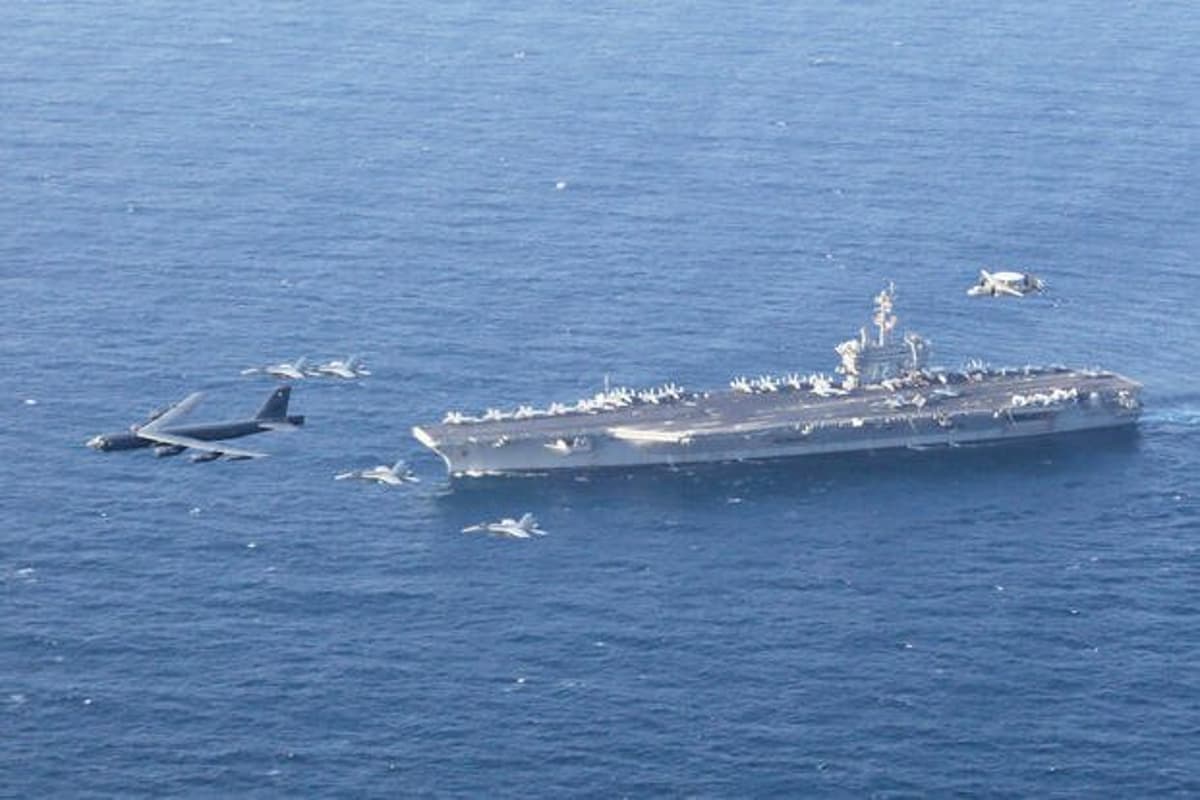
A U.S. Navy official, who spoke on condition of anonymity to discuss military movements, said Thursday that the aircraft carrier USS Abraham Lincoln and other warships traveling with it were in the Indian Ocean.

Trump also mentioned the multiple rounds of talks American officials had with Iran over its nuclear program before Israel launched a 12‑day war against the Islamic Republic in June, which also saw U.S. warplanes bomb Iranian nuclear sites. He threatened Iran with military action that would make earlier U.S. strikes against Iranian uranium enrichment sites “look like peanuts.”

“They should have made a deal before we hit them,” Trump said.

Airline jitters

The tension has led at least one European airline to cancel some flights to the wider region, with Air France saying it had decided to temporarily suspend its service to Dubai in the United Arab Emirates.

The airline cancelled two return flights from Paris to Dubai over the weekend, saying, without elaborating, that it was due to the current situation in the Middle East. It said it would resume its service to Dubai later Saturday.

“The airline is closely following developments in the Middle East in real time and continuously monitors the geopolitical situation in the territories served and overflown by its aircraft in order to ensure the highest level of flight safety and security,” the company said.

Arrivals information at Dubai’s international airport also showed the cancellation of Saturday flights from Amsterdam by Dutch carriers KLM and Transavia, and a flight from Luxembourg by Luxair. The airlines did not immediately respond to requests for comment.

Some flights from KLM were also canceled on Friday and Saturday to Tel Aviv, Israel, according to online flight trackers.

Rising death toll

Although there have been no further demonstrations in Iran for days, the death toll reported by activists has continued to rise as information trickles out despite the most comprehensive internet blackout in Iran’s history, which has now lasted more than two weeks.

The U.S.-based Human Rights Activists News Agency on Saturday put the death toll at 5,137, with the number expected to increase. More than 27,700 people have been arrested, it said.

The group’s figures have been accurate in previous unrest and rely on a network of activists in Iran to verify deaths. That death toll exceeds that of any other round of protest or unrest there in decades, and recalls the chaos surrounding Iran’s 1979 Islamic Revolution.

Iran’s government offered its first death toll on Wednesday, saying 3,117 people were killed. It said 2,427 were civilians and security forces and labeled the rest as “terrorists.” In the past, Iran’s theocracy has under‑counted or not reported fatalities from unrest.


Associated Press writers Jon Gambrell in Dubai, Samuel Petrequin in Paris, Melanie Lidman in Tel Aviv, Israel, and Konstantin Toropin and Aamer Madhani in Washington contributed to this report.

Read Original Article
0

Comments

Want to join the conversation?

Loading comments...