Adopting nuclear submarines would dramatically boost Japan’s underwater endurance and deterrence against a growing Chinese fleet, but the steep financial, legal, and manpower burdens could reshape its defense spending and regional security posture. The decision will also influence Japan’s role within the Japan‑South Korea‑U.S. security triangle.
The Pacific theater is undergoing a rapid power shift, driven by China’s unprecedented carrier operations beyond the Second Island Chain and increased activity around Japan’s remote outposts. For the Japan Maritime Self‑Defense Force, conventional diesel‑electric submarines struggle to maintain stealth and endurance in such a contested environment, prompting policymakers to consider platforms that can stay submerged for months and rapidly reposition across the ocean.
Nuclear propulsion, once dismissed as a Cold‑War relic, is re‑emerging thanks to advances in small modular reactors and micro‑reactor designs that promise higher safety margins and a smaller footprint suitable for naval vessels. Yet the financial calculus is stark: a single nuclear attack submarine could cost upwards of $5.8 billion—roughly seven times the price of Japan’s latest Taigei‑class diesel‑electric boat—while also demanding a new industrial supply chain, shore‑based testing facilities, and a trained nuclear‑qualified crew. Compounding these hurdles, Japan’s Atomic Energy Basic Act currently limits nuclear applications to peaceful purposes, creating a legal gray area for military propulsion.
Strategically, the choice between diesel and nuclear submarines will reverberate through Japan’s defense budget, its manpower planning, and its alliance dynamics. A nuclear fleet would enhance deterrence against China’s expanding carrier groups and preserve Japan’s relevance in the trilateral security framework with the United States and South Korea. Conversely, the massive cost and staffing requirements could divert resources from other priority programs, forcing a reassessment of national security spending. As Tokyo prepares its 2026 National Security Strategy, the nuclear submarine debate stands as a litmus test for how Japan balances fiscal prudence with the imperative to maintain a credible maritime deterrent.
By Takahashi Kosuke · January 29, 2026


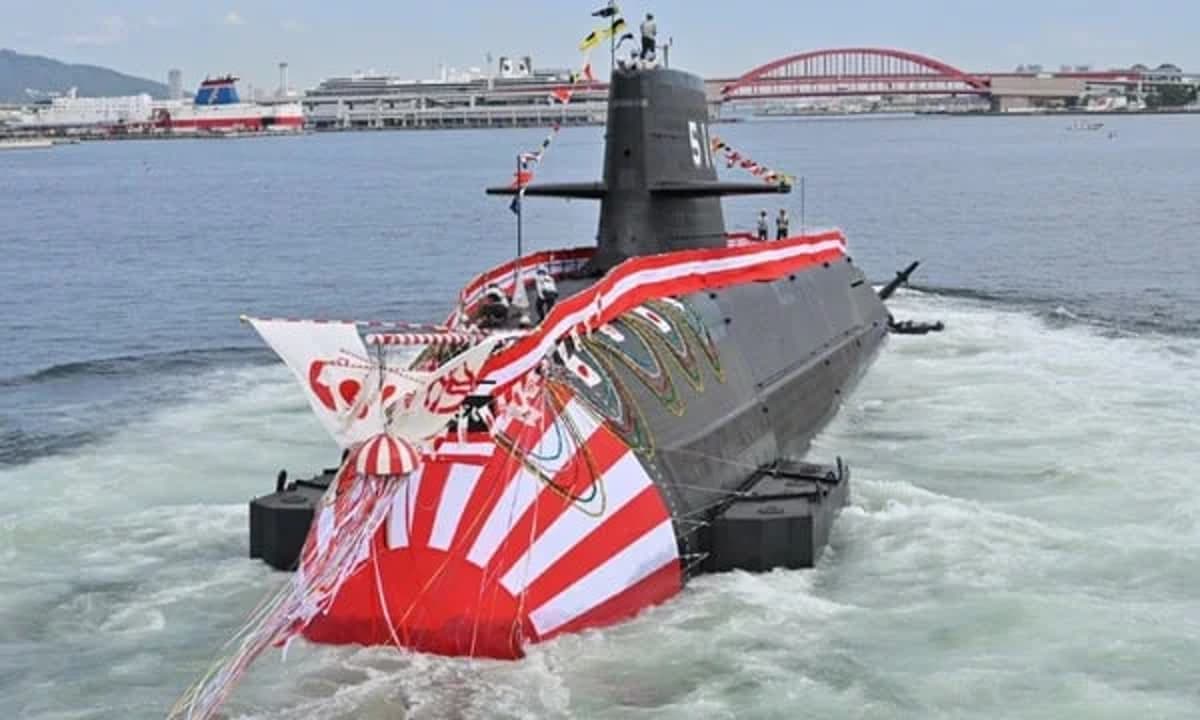
JS Sogei, the sixth Taigei‑class submarine, entered the water in a ceremony held at KHI’s shipyard in Kobe City, Japan, Oct. 14, 2025. The Taigei class are Japan’s newest diesel‑electric submarines.
Credit: Japan Acquisition, Technology & Logistics Agency
Japan’s debate over nuclear‑powered submarines is gaining momentum amid China’s expanding Pacific presence and U.S. tacit approval of South Korea’s program.
Still, significant hurdles remain. The construction of a single nuclear submarine can exceed $5.8 billion, and challenges such as securing skilled personnel and ensuring compliance with Japan’s Atomic Energy Basic Act add further complexity. The decision to pursue such capabilities goes beyond equipment considerations; it reflects how Japan prioritizes defense, allocates limited fiscal resources, and shapes its broader national‑security strategy.
The debate intensified in September 2025 when a panel of defense experts recommended “next‑generation propulsion” to support long‑range, long‑duration deployments of submarines equipped with vertical launch systems (VLS). Current diesel‑electric submarines, the backbone of the Japan Maritime Self‑Defense Force (JMSDF), face inherent limitations in endurance and stealth due to the need to surface periodically. While alternatives such as solid‑state batteries or fuel cells have been discussed, these technologies remain constrained by energy density. In practice, nuclear propulsion is the only viable solution for a large, long‑endurance, covert submarine.
Political circles have taken note. In October 2025, the coalition agreement between the Liberal Democratic Party and Nippon Ishin no Kai (the Japan Innovation Party) explicitly endorsed the acquisition of VLS‑equipped submarines capable of long‑range deployment using “next‑generation propulsion.” While nuclear power is not named outright, the language strongly suggests it as the preferred solution.
Paradoxically, nuclear power is a 20th‑century technology. Yet developments in small modular reactors (SMRs) and microreactors offer a “next‑generation” dimension. These reactors promise enhanced safety, operational flexibility, and compact designs suitable for naval applications. Japanese firms, such as Mitsubishi Heavy Industries, are actively exploring these technologies, alongside similar programs in the United States and China.
The discussion gained further traction through remarks by both current and former defense ministers.
On November 6, 2025, Defense Minister Koizumi Shinjiro noted on a TBS program that, following U.S. acceptance of South Korea’s nuclear submarine construction, “all the countries around us are acquiring nuclear submarines.” He emphasized that Japan’s security environment had become severe enough to necessitate a fundamental debate between diesel and nuclear propulsion.
Former Defense Minister Nakatani Gen went further on November 25, 2025, during a BS Fuji broadcast: “All of Japan’s neighbors – Russia, China, North Korea, and even the United States – possess nuclear submarines. To match them, Japan needs vessels capable of extended underwater endurance and high‑speed operations. Eventually, Japan will need nuclear propulsion.”
Nakatani also expressed confidence in Japan’s domestic shipbuilding capacity, underscoring a sense of urgency to avoid lagging behind regional powers.
Historically, Japan’s defense posture focused on the East China Sea and the Sea of Japan (East Sea). But China’s expanding naval operations in the Pacific have forced a strategic recalibration. In May‑June 2025, two Chinese aircraft carriers simultaneously conducted more than 1,000 flight operations in the Pacific, marking unprecedented activity beyond the Second Island Chain. Chinese warships and aircraft also operate increasingly around Japan’s remote islands, including Okinotorishima and Minamitorishima, highlighting the growing strategic importance of the Pacific front.
In this context, nuclear submarines offer a credible deterrent. Their combination of long submerged endurance, speed, and covert operations could enable persistent surveillance of Chinese carrier groups while enhancing Japan’s operational flexibility.
Tokyo faces another dilemma as well: if South Korea deploys nuclear submarines while Japan remains reliant on conventional diesel‑electric submarines, its relative deterrent posture and role within the trilateral Japan‑South Korea‑U.S. security framework could be weakened. North Korea also compounds the challenge, having publicly committed to nuclear submarine development in its 2021 five‑year defense plan.
East Asia is thus entering an unprecedented “nuclear submarine competition” era.
During a January 27, 2026 press conference, Admiral Saito Akira, chief of staff of the JMSDF, emphasized the tactical advantages of nuclear submarines:
“The capabilities are substantial. Their long endurance and high speed provide a marked improvement in operational flexibility. As the defense minister has noted, we are examining a broad range of options for next‑generation submarines, and we intend to engage actively as maritime experts in all possible scenarios.”
Despite growing political and strategic momentum, nuclear submarine acquisition comes with formidable hurdles. A former head of Japan’s Acquisition, Technology & Logistics Agency highlighted cost as the principal barrier.
Construction cost – According to the U.S. Navy’s FY 2025 budget, the latest Virginia‑class attack submarine (the 41st in its class) cost $5.8 billion. By comparison, Japan’s newest Taigei‑class diesel‑electric submarine costs about $790 million, making one nuclear submarine roughly equivalent to seven conventional submarines.
R&D and infrastructure – Japan would need to invest in small‑nuclear‑reactor R&D, shore‑based testing facilities, local‑government subsidies for nuclear infrastructure, and nuclear‑fuel management, potentially driving total project costs into the trillions of yen even for a handful of vessels.
Personnel – A Virginia‑class submarine carries around 132 crew members, nearly double that of a Taigei‑class vessel. Including reactor operation, maintenance, and training, total human‑resource requirements could reach ≈ 1,000 personnel. The JMSDF was operating at only 92 % of its authorized strength of 45,452 personnel as of March 2025, raising doubts about its ability to fully man nuclear submarines.
Legal constraints – Japan’s Atomic Energy Basic Act restricts nuclear use to “peaceful purposes.” Earlier interpretations in the 1960s suggested military propulsion might fall outside the law, but official statements as recent as September 2024 maintained that nuclear submarines would likely violate current interpretations. Evolving international norms—where nuclear propulsion for naval vessels is increasingly standardized—could permit reinterpretation, but political sensitivities remain.
Japan’s potential nuclear submarine acquisition is not merely a technical or budgetary consideration; it is a litmus test of national priorities. Balancing fiscal constraints, personnel realities, legal frameworks, and strategic imperatives will define the future of Japan’s maritime deterrence.
With the United States pressing Tokyo to strengthen its defensive capabilities and China normalizing its presence across the Pacific, proponents argue that nuclear submarines present a timely opportunity to bolster Japan’s self‑reliant deterrence. Yet, the immense costs and human‑resource requirements demand careful deliberation over what Japan seeks to protect, how resources are allocated, and which defense priorities must be emphasized.
As Tokyo prepares to revise its National Security Strategy and associated defense‑planning documents in 2026, the debate over nuclear‑powered submarines is likely to serve as a critical indicator of the country’s strategic trajectory. For a nation at the crossroads of rising regional naval competition, the choice will shape not only its maritime posture but also its broader security and fiscal identity.
Comments
Want to join the conversation?
Loading comments...