Defense News and Headlines
  • All Technology
  • AI
  • Autonomy
  • B2B Growth
  • Big Data
  • BioTech
  • ClimateTech
  • Consumer Tech
  • Crypto
  • Cybersecurity
  • DevOps
  • Digital Marketing
  • Ecommerce
  • EdTech
  • Enterprise
  • FinTech
  • GovTech
  • Hardware
  • HealthTech
  • HRTech
  • LegalTech
  • Nanotech
  • PropTech
  • Quantum
  • Robotics
  • SaaS
  • SpaceTech
AllNewsDealsSocialBlogsVideosPodcastsDigests

Defense Pulse

EMAIL DIGESTS

Daily

Every morning

Weekly

Sunday recap

NewsDealsSocialBlogsVideosPodcasts
DefenseNewsUS and Italian Soldiers Earn German Military Badge in Joint Italy Training
US and Italian Soldiers Earn German Military Badge in Joint Italy Training
Defense

US and Italian Soldiers Earn German Military Badge in Joint Italy Training

•February 9, 2026
0
Military Times
Military Times•Feb 9, 2026

Why It Matters

The joint training deepens NATO interoperability, giving U.S. troops a rare foreign qualification that enhances readiness and partnership credibility. It signals continued commitment to integrated European defense amid evolving security challenges.

Key Takeaways

  • •110+ U.S. and Italian soldiers earned German proficiency badges.
  • •Tests covered ruck march, shooting, swimming, CBRN, first aid.
  • •Americans received 11 gold, 30 silver, 19 bronze badges.
  • •Italians earned six gold and six silver badges.
  • •Exercise boosts NATO interoperability and joint morale.

Pulse Analysis

The German Armed Forces Proficiency Badge (GAPFB) is a demanding, tri‑level award that tests physical stamina, marksmanship, first‑aid and CBRN competence under Bundeswehr standards. Historically, only a handful of U.S. service members have been authorized to wear the badge, making the recent ceremony in Vicenza noteworthy. Over four days, more than 110 American and Italian soldiers tackled a 3.7‑to‑7.5‑mile ruck march, pistol qualification, a uniform‑on swim, and rigorous academic modules. Their performance earned 11 gold, 30 silver and 19 bronze German badges, underscoring a high degree of individual proficiency.

The event was not merely a fitness challenge; it served as a practical laboratory for NATO interoperability. German evaluators from the 10th Panzer Division’s Support Battalion 8 applied uniform criteria, allowing U.S. Southern European Task Force‑Africa units and Italy’s Folgore Parachute Brigade to benchmark against a common standard. Such cross‑national assessments reveal procedural gaps, harmonize safety protocols, and foster trust among allied troops who may operate side‑by‑side in future missions across Africa or Eastern Europe. The shared experience also strengthens personal bonds that translate into smoother joint operations.

Strategically, the badge program signals a deeper commitment to integrated European defense as geopolitical tensions rise. By granting American soldiers a rare foreign qualification, the U.S. demonstrates confidence in its partners’ training regimes and signals willingness to adopt allied best practices. Looking ahead, the Army may expand similar proficiency exchanges with other NATO members, creating a portfolio of interoperable skill sets that can be rapidly mobilized. For defense planners, these initiatives provide measurable data on readiness, helping to align resources with the evolving security landscape.

US and Italian soldiers earn German military badge in joint Italy training

By Eve Sampson · Feb 9, 2026, 07:46 PM

They spoke different languages and wore different uniforms but for four grueling days, U.S. and Italian soldiers operated under German standards to earn a foreign military badge few American troops are authorized to wear.

In early February, more than 110 candidates completed ruck marches, weapons qualifications, a swimming event and academic assessments in hopes of earning the German Armed Forces Proficiency Badge at an Italian military base, the U.S. Army announced Monday.

The Army said the event was meant to bring together U.S. Army Southern European Task Force, Africa (SETAF‑AF) forces and neighboring units and build morale and relationships with allied militaries.

The event helped 1st Lt. Michell Hansen, the executive officer for SETAF‑AF’s intelligence and sustainment company, better understand the work his unit does with European partners.

“This training has really opened my eyes, working with our Italian and German partners, because they each have different processes for completing the mission,” Hansen said in the release.

German troops from the Support Battalion 8, 10th Panzer Division, evaluated the Italian and American hopefuls to see if they scored high enough to meet the badge’s gold, silver or bronze levels.

American soldiers from the 173rd Airborne Brigade, 207th Military Intelligence Brigade (T), 517th Geospatial Planning Cell, 79th Theater Sustainment Command (FWD), 21st Theater Sustainment Command and SETAF‑AF earned 11 gold, 30 silver and 19 bronze badges. Italian soldiers with the Esercito Italiano’s “Folgore” Parachute Brigade earned six gold and six silver badges.

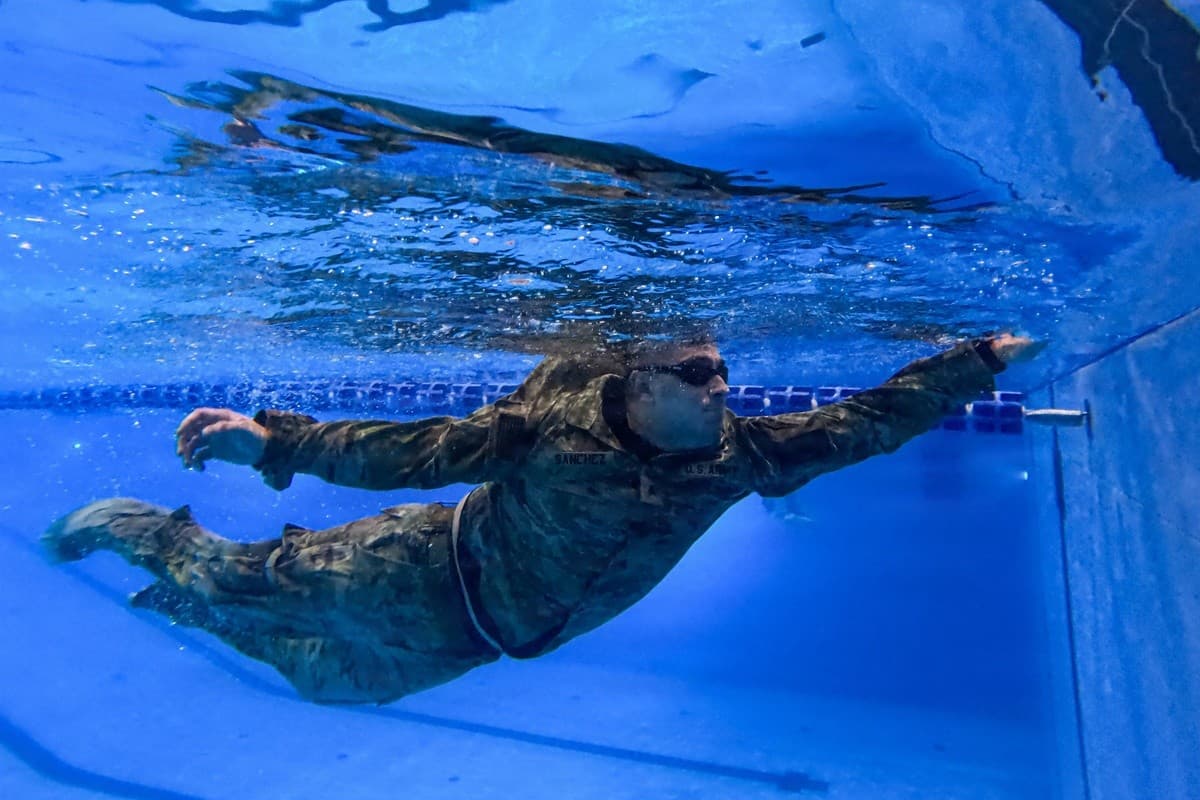
The events included a ruck march that ranged from 3.72 to 7.45 miles, pistol marksmanship, the Bundeswehr’s Basic Fitness Test and evaluations of first‑aid skills and chemical, biological, radioactive and nuclear training. Participants also had to swim 100 meters in their uniforms before removing their blouses and pants and tossing them out of the pool.

The badge recipients and participants were honored during a Feb. 6 ceremony.

About Eve Sampson

Eve Sampson is a reporter and former Army officer. She has covered conflict across the world, writing for The New York Times, The Washington Post and The Associated Press.


Image: U.S. Army Sgt. Christopher Sanchez, a visual information specialist assigned to the 173rd Airborne Brigade, finishes the swim event during the German Armed Forces Proficiency Badge (GAPFB) test at Caserma Del Din, Vicenza, Italy, Feb. 3, 2026. (Sgt. Gleidine Irish Lebornio/U.S. Army)

Read Original Article
0

Comments

Want to join the conversation?

Loading comments...