The reallocation of U.S. focus to China heightens South Korea’s strategic autonomy and reshapes regional security dynamics, compelling Seoul to act as an independent deterrent force.
The latest U.S. National Defense Strategy marks a watershed moment for the Korean Peninsula, signaling a deliberate reduction of American conventional involvement. By confining its role to nuclear extended deterrence, Washington aims to free up assets for high‑end competition with China, a shift that redefines the operational purpose of USFK. For policymakers and defense analysts, this change underscores a broader trend of the United States reallocating forces to counter near‑peer threats, while encouraging allies to shoulder greater burden sharing.
South Korea’s response will be pivotal. With a fifth‑largest global military and a decade‑long modernization drive, Seoul possesses the hardware and training to manage conventional threats independently. However, the lack of wartime operational control and the prohibition on developing its own nuclear arsenal create strategic gaps. Leveraging the United Nations Command for armistice monitoring could preserve stability on the 38th parallel, while diplomatic initiatives expand Seoul’s security portfolio to include European and other Indo‑Pacific partners, mitigating reliance on fluctuating U.S. policy.
The regional ripple effects are profound. A more self‑reliant South Korea may alter the calculus of North Korean provocations, potentially reducing the incentive for Pyongyang to test new weapons if the U.S. response is perceived as limited. Simultaneously, China will view a stronger, autonomous Korean ally as a counterbalance in its own strategic competition, especially concerning Taiwan. For investors and businesses operating in East Asia, understanding this evolving security architecture is essential for risk assessment and strategic planning.
By Mitch Shin · January 26, 2026


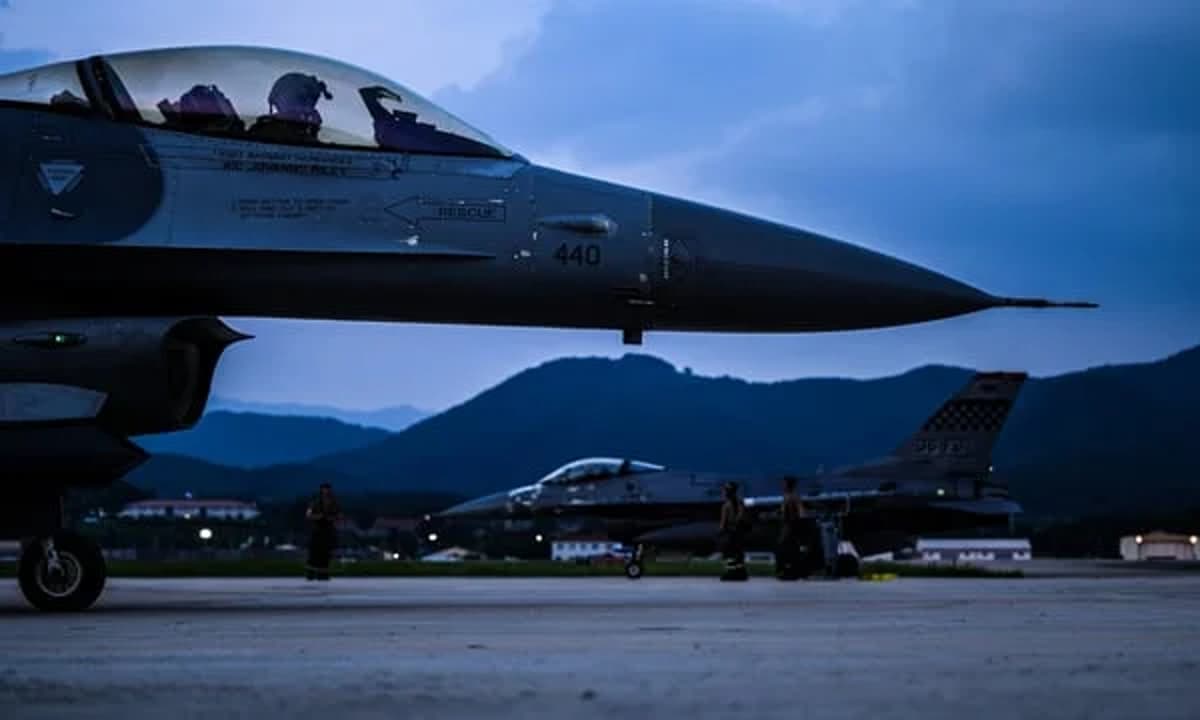
Two U.S. Air Force F‑16 Fighting Falcons sit on the flight line after a hot‑pit refueling during exercise Ulchi Freedom Shield 25 at Daegu Air Base, South Korea, Aug. 21, 2025. Credit: U.S. Air Force photo by Senior Airman Andrew Garavito
On January 23, the U.S. Defense Department released the unclassified National Defense Strategy (NDS), which marks a definitive shift in the South Korea‑U.S. alliance. It explicitly states that Seoul must now take primary responsibility for countering North Korean conventional threats.
The document outlines a strategic pivot where the United States intends to focus its regional resources on deterring China, effectively limiting its role on the Korean Peninsula to “extended deterrence” – the nuclear umbrella meant to prevent an atomic strike. While Washington has historically provided a wide safety net for South Korea’s defense, future support will move toward a more limited scope. The Pentagon’s assessment justifies this drawdown by asserting that South Korea possesses the capability to lead the deterrence of North Korean aggression, pushing Seoul toward military self‑reliance for its own conventional defense.
U.S. President Donald Trump’s “America First” approach includes a broader effort to husband American military assets for high‑end conflicts with near‑peer competitors like China and Russia, rather than maintaining the decades‑old status quo of the armistice. For a sovereign nation like South Korea, which currently lacks wartime operational control (OPCON) and its own nuclear arsenal, this transition carries profound implications.
South Korea has long relied on U.S. strategic assets to balance North Korea’s nuclear brinkmanship, as Washington’s strict non‑proliferation policy prevents Seoul from developing its own deterrent. In response to these constraints, South Korea has spent decades modernizing its military into the world’s fifth‑most powerful force. Given this immense conventional strength, the Trump administration’s demand for Seoul to handle its own neighborhood is less a crisis and more an acknowledgment of South Korea’s growth into a global military power. Building a “bullet‑proof” defense posture that deters North Korean provocation is a task Seoul is now arguably ready to handle, and doing so independently may provide more long‑term stability than continued reliance on shifting U.S. political priorities.
The evolving mission of the approximately 28,500 U.S. troops stationed in South Korea (USFK) also points toward a new regional reality. While the U.S. president cannot unilaterally withdraw these forces without approval from Congress, the NDS suggests USFK’s primary mission is shifting from North Korean deterrence to strategic flexibility. This shift is aimed at checking Chinese expansion and preparing for potential contingencies in the Taiwan Strait.
South Korea has little diplomatic standing to oppose this shift, nor would it likely call for a full withdrawal of U.S. forces. Instead, Seoul may need to exercise diplomatic ingenuity by leveraging the United Nations Command (UNC). As the UNC is tasked with monitoring the 1953 Armistice Agreement, it could take over the traditional border‑watching roles formerly held by USFK, allowing South Korea to maintain stability on the 38th parallel while U.S. forces refocus on China.
Should a conflict arise in the Taiwan Strait, Seoul will face a critical test in determining how much support aligns with its national interest without compromising its own security. Furthermore, the NDS highlights a sobering truth for the peninsula: unless North Korea conducts a seventh nuclear test or perfects an intercontinental ballistic missile capable of striking the U.S. mainland, it is no longer Washington’s top priority.
The Trump administration appears to view North Korea as a secondary concern compared to the active threats posed by China, Russia, and Iran. While Trump remains open to high‑stakes diplomacy with Kim Jong Un, the goal is management rather than complete denuclearization. Washington and Beijing may even prefer the current status quo, using the Koreas as a buffer zone in their superpower rivalry. In this scenario, neither power is likely to push for a collapse of the North Korean regime.
This new normal requires South Korea to move beyond the empty rhetoric of denuclearization and step onto the world stage as an independent security actor. By deepening defense ties with European nations and other partners, Seoul can diversify its security portfolio. As the Trump NDS sets a likely blueprint for future American administrations, South Korea must raise its voice to match its status as a global power, transitioning from a nation in a state of truce to a leader of regional security.
Comments
Want to join the conversation?
Loading comments...